Free T4 and Free T3 Blood Test: What High or Low Results Mean
Free T4 and Free T3 are blood tests that measure thyroid hormones.
They are commonly written as:
- FT4 — Free T4 or Free Thyroxine
- FT3 — Free T3 or Free Triiodothyronine
These tests help doctors understand how much thyroid hormone is available in the blood.
However, FT4 and FT3 should usually not be interpreted alone. They are commonly interpreted together with TSH — Thyroid-Stimulating Hormone. The pattern formed by TSH and thyroid-hormone levels often provides more useful information than any one result by itself.
What Are T4 and T3?
The thyroid gland produces thyroid hormones that help regulate many body functions. The two main thyroid hormones discussed on laboratory reports are:
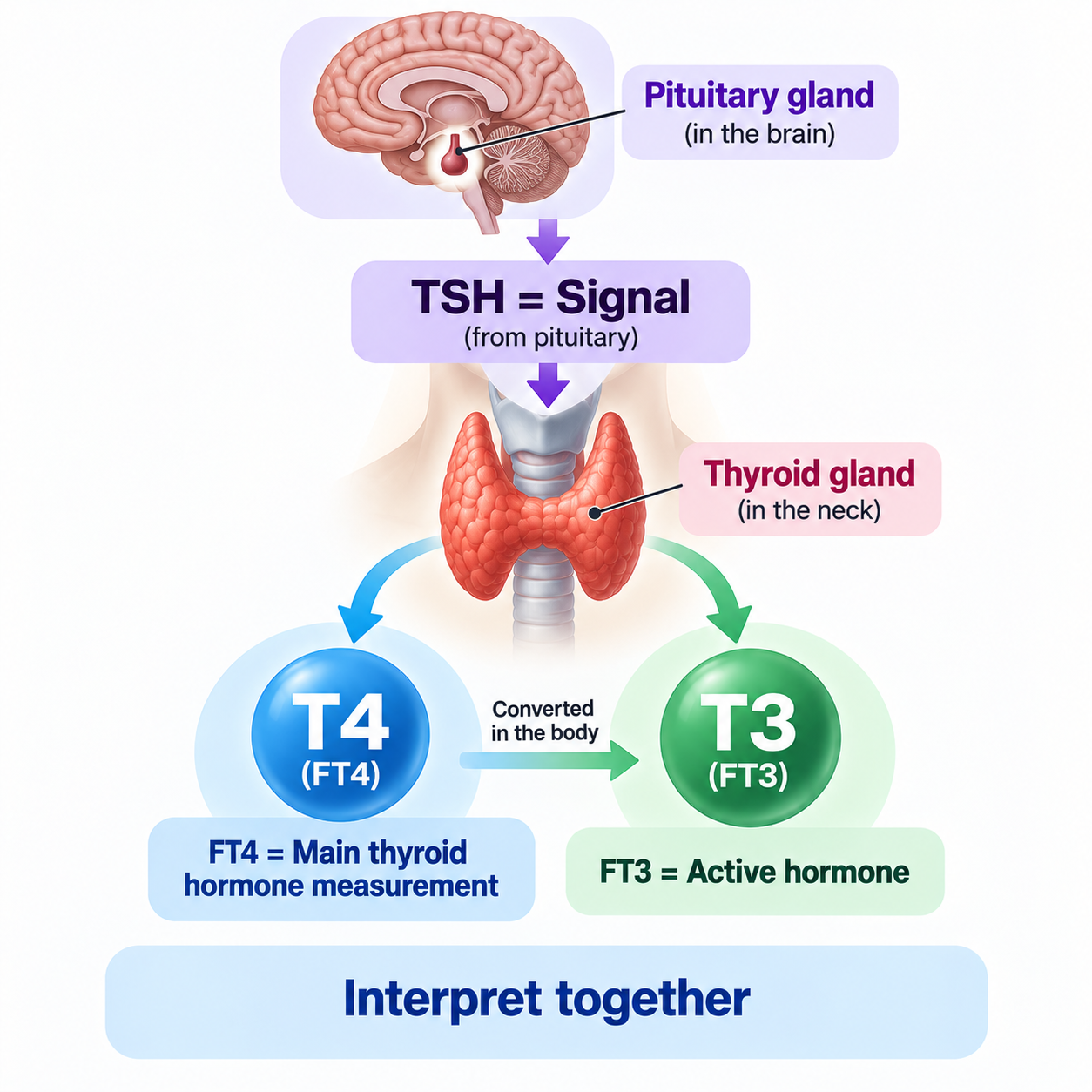
T4 — Thyroxine. T4 is the main hormone released by the thyroid gland.
T3 — Triiodothyronine. T3 is a more biologically active thyroid hormone. The thyroid produces some T3 directly, but much of the body's T3 is formed when T4 is converted into T3 in tissues.
Both hormones are important, but their blood tests have different clinical roles.
What Does Free T4 or Free T3 Mean?
Most thyroid hormone circulating in the blood is attached to proteins. A smaller proportion is not attached to these carrier proteins. This unbound portion is called free hormone.
Therefore: FT4 = free thyroxine, and FT3 = free triiodothyronine.
Measuring the free hormone can help assess the thyroid hormone available to the body's tissues without being as directly influenced by changes in thyroid-hormone-binding proteins as total hormone measurements.
What Is the Difference Between Free T4 and Total T4?
A Total T4 test measures both T4 attached to blood proteins and free T4. A Free T4 test measures the unbound portion.
Changes in blood proteins can sometimes alter total T4 even when thyroid function itself has not changed in the same way. This is one reason FT4 is commonly used when assessing thyroid function.
The same general distinction exists between Total T3 and Free T3.
How Is TSH Different From T4 and T3?
TSH is not a thyroid hormone made by the thyroid gland. TSH is produced by the pituitary gland, a small gland located at the base of the brain. TSH acts as a signal telling the thyroid how much thyroid hormone to produce.
When thyroid hormone becomes too low, TSH often rises to stimulate the thyroid. When thyroid hormone becomes too high, TSH often falls. This relationship explains many common thyroid-function-test patterns. However, there are important exceptions, so results must be interpreted in clinical context.
Read TSH Test Explained.
Why Might Free T4 or Free T3 Be Requested?
Doctors may measure FT4 and/or FT3 to:
- investigate symptoms that could be related to thyroid disease;
- investigate an abnormal TSH result;
- help diagnose an underactive thyroid;
- help diagnose an overactive thyroid;
- assess suspected pituitary-related thyroid problems;
- monitor certain thyroid conditions;
- or monitor treatment in selected circumstances.
Not every patient needs all three tests — TSH, FT4 and FT3 — every time. Which tests are useful depends on the clinical situation.
Is TSH Usually Tested Before FT4 and FT3?
In many adults without suspected pituitary disease, TSH is commonly used as the initial thyroid-function test. If TSH is abnormal, additional thyroid-hormone measurements can then help clarify the pattern.
If TSH is high, FT4 is particularly useful. If TSH is low, FT4 and FT3 may both be useful.
There are situations where TSH and FT4 are measured together from the beginning, including when a pituitary-related thyroid problem is suspected. Testing strategies may also differ in children, pregnancy, established thyroid disease, and patients already receiving treatment.
What Is a Free T4 Test?
FT4 measures the free, unbound portion of thyroxine in the blood. T4 is the main hormone produced by the thyroid gland.
FT4 is particularly useful when interpreting an abnormal TSH, suspected hypothyroidism, suspected hyperthyroidism, and certain situations where TSH alone may not provide the full picture.
FT4 should usually be interpreted together with TSH.
What Is a Free T3 Test?
FT3 measures free triiodothyronine in the blood. T3 is a biologically active thyroid hormone.
FT3 can be especially useful when TSH is low, hyperthyroidism is suspected, FT4 is not elevated despite clinical suspicion of hyperthyroidism, or a doctor needs to determine whether T3 itself is elevated.
FT3 generally has a more limited role in diagnosing hypothyroidism. A patient should therefore not assume: “If FT3 was not ordered, my thyroid testing was incomplete.” The appropriate tests depend on the clinical question.
Can T3 Be High When Free T4 Is Normal?
Yes. In some patients with hyperthyroidism, T3 may become elevated while FT4 remains within the laboratory reference range. This pattern may sometimes be called T3 thyrotoxicosis.
This is one reason FT3 or T3 measurement can be useful when TSH is low, hyperthyroidism is suspected, but FT4 is not elevated.
How Are Free T4 and Free T3 Tests Performed?
FT4 and FT3 are measured from a blood sample. A healthcare worker usually takes a small amount of blood from a vein in your arm.
The laboratory report may show TSH, FT4 and FT3, or only some of these tests depending on what was requested.
Do I Need to Fast for Free T4 or Free T3 Tests?
Usually, special fasting is not required solely for thyroid-function testing. However, other tests being performed at the same time may require fasting. Follow the instructions provided for the complete set of tests.
Can Medicines Affect Free T4 and Free T3 Results?
Yes. Some medicines can affect thyroid function itself, thyroid-hormone levels, hormone binding, or laboratory test interpretation.
If you take thyroid medication, the timing of the blood test in relation to your medication may also be relevant depending on the clinical situation and local instructions.
Tell the healthcare professional about prescription medicines, thyroid medicines, non-prescription medicines, vitamins, and supplements.
Can Biotin Affect Thyroid Blood Tests?
Yes. High intake of biotin — vitamin B7, particularly from some supplements, can interfere with certain laboratory methods used for thyroid tests. This interference can sometimes produce misleading thyroid-function-test results.
Biotin may be present in products marketed for hair, skin, nails, or general vitamin supplementation.
How Do I Read My Free T4 or Free T3 Result?
First identify which test was performed, your result, the unit, the laboratory reference range, and your TSH result, if available.
What Is a Normal Free T4 or Free T3 Level?
There is no single numerical range that should be copied onto every patient's report. Laboratory reference ranges can vary according to testing method, laboratory, population, and clinical circumstances.
Use the reference interval printed on your own laboratory report. Pregnancy and some other situations may require different interpretation.
What Does a High Free T4 Result Mean?
A high FT4 means the measured free thyroxine concentration is above the relevant laboratory reference range. One important possibility is hyperthyroidism — an overactive thyroid. However, high FT4 can occur in other situations as well. Interpretation depends particularly on the TSH result.
For example, low TSH + high FT4 is a common laboratory pattern in overt primary hyperthyroidism. But a high FT4 result alone does not identify the cause.
Possible causes of excess thyroid hormone can include conditions such as Graves' disease, toxic thyroid nodules, thyroiditis, excessive thyroid-hormone medication, and other less common situations.
What Does a Low Free T4 Result Mean?
A low FT4 means the measured free thyroxine concentration is below the laboratory reference range. One important possibility is hypothyroidism — an underactive thyroid. Interpretation again depends strongly on TSH.
For example, high TSH + low FT4 is a common pattern in overt primary hypothyroidism.
However, a low FT4 with a TSH that is not appropriately elevated can have a different meaning and may require consideration of pituitary or hypothalamic problems, serious illness, medicines, or other clinical factors.
What Does a High Free T3 Result Mean?
High FT3 can occur when there is excessive thyroid-hormone activity. It is particularly useful in evaluating suspected hyperthyroidism.
A pattern such as low TSH + high FT3 can support biochemical hyperthyroidism. Sometimes FT3 or T3 is elevated while FT4 remains within its reference range. This can occur in T3-predominant hyperthyroidism.
The laboratory pattern does not by itself establish whether the cause is Graves' disease, a toxic nodule, another form of hyperthyroidism, medication, or another condition. Further assessment may be required.
What Does a Low Free T3 Result Mean?
A low FT3 result is more difficult to interpret in isolation. FT3 is not generally the main test used to diagnose hypothyroidism. T3 levels can fall during significant illness even when the thyroid gland itself is not the primary problem.
How Are TSH, Free T4 and Free T3 Interpreted Together?
The following patterns are useful for understanding the general logic of thyroid-function tests. They are not a self-diagnosis table.
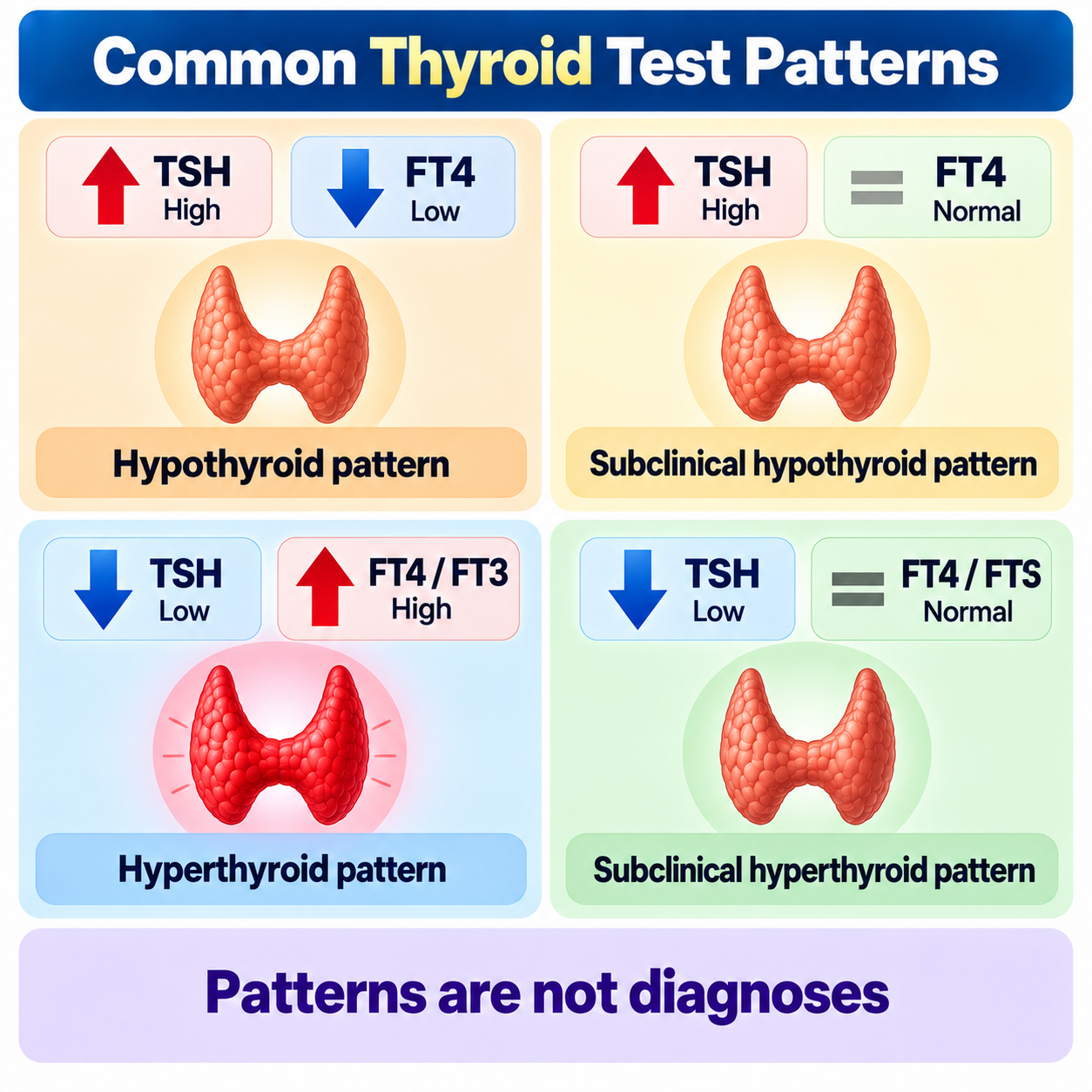
High TSH + Low FT4
This pattern commonly suggests overt primary hypothyroidism. The thyroid is producing insufficient thyroid hormone and the pituitary responds by increasing TSH. Further evaluation may be needed to identify the cause. Read High TSH Explained.
High TSH + Normal FT4
This pattern may be described as subclinical hypothyroidism. The word “subclinical” refers to the laboratory pattern — it does not mean that symptoms are impossible. Clinical interpretation depends on the degree and persistence of TSH elevation, symptoms, age, pregnancy status, thyroid antibodies, medicines, and other factors. Read High TSH Explained.
Low TSH + High FT4 and/or FT3
This pattern commonly suggests overt hyperthyroidism / thyrotoxicosis. Further assessment is needed to determine the cause. Read Low TSH Explained and, where appropriate, Hyperthyroidism.
Low TSH + Normal FT4 and FT3
This laboratory pattern may be described as subclinical hyperthyroidism. Clinical importance depends on how low the TSH is, whether the abnormality persists, symptoms, age, heart-related risk, bone-related risk, medicines, and the underlying cause. Read Low TSH Explained.
Low TSH + Normal FT4 + High FT3
This can occur in T3-predominant hyperthyroidism / T3 thyrotoxicosis. Further medical evaluation is needed to determine the cause.
Low FT4 + TSH That Is Low or Not Appropriately High
This is not the usual pattern of primary hypothyroidism. It can occur in situations including pituitary-related thyroid dysfunction, hypothalamic disease, serious illness, medicine effects, or other circumstances. This pattern requires clinical interpretation rather than self-diagnosis.
| TSH | FT4 / FT3 | Possible General Pattern |
|---|---|---|
| High | FT4 low | Overt primary hypothyroidism pattern |
| High | FT4 normal | Subclinical hypothyroidism pattern |
| Low | FT4 and/or FT3 high | Overt hyperthyroidism/thyrotoxicosis pattern |
| Low | FT4 and FT3 normal | Subclinical hyperthyroidism pattern |
| Low | FT4 normal, FT3 high | Possible T3-predominant hyperthyroidism |
| Low or normal | FT4 low | May require assessment for central/pituitary-related or other causes |
What Do “Overt” and “Subclinical” Thyroid Disease Mean?
These terms describe laboratory patterns.
- Overt hypothyroidism — typically TSH high + FT4 low.
- Subclinical hypothyroidism — typically TSH high + FT4 within reference range.
- Overt hyperthyroidism — typically TSH low + FT4 and/or FT3 high.
- Subclinical hyperthyroidism — typically TSH low + FT4 and FT3 within reference range.
These terms do not tell you the underlying cause. They also do not determine treatment by themselves.
Can I Have Thyroid Symptoms With Normal FT4 or FT3?
Yes. Symptoms and blood-test results do not always correspond perfectly. Symptoms commonly associated with thyroid disorders can also have many other causes — for example tiredness, weight change, palpitations, anxiety, feeling unusually hot or cold, hair changes, bowel changes, and menstrual changes are not specific to thyroid disease.
A normal result should therefore be considered together with TSH, symptoms, examination, medical history, and other relevant investigations.
Can Other Illnesses Affect Free T4 or Free T3?
Yes. Significant acute or chronic illness can alter thyroid-function-test patterns even when the thyroid gland itself is not the primary problem. T3 can be particularly affected during systemic illness. This is one reason an isolated low FT3 result should be interpreted cautiously.
Doctors may sometimes repeat thyroid-function tests after an illness has improved if the original result does not fit the clinical picture.
Are Free T4 and Free T3 Interpreted Differently During Pregnancy?
Pregnancy changes thyroid physiology and can affect thyroid-function-test interpretation. Laboratory methods and pregnancy-specific reference ranges may be relevant.
Pregnant patients with abnormal thyroid-function tests should discuss them with the healthcare professional managing their pregnancy or thyroid condition.
Why Can TSH Sometimes Be Misleading?
For most people with primary thyroid disease, TSH is extremely useful. However, TSH depends on normal pituitary function. If the pituitary gland is not producing TSH appropriately, a patient may have low FT4 with TSH that is low, normal or insufficiently elevated.
This is one reason FT4 is particularly important when pituitary-related thyroid dysfunction is suspected.
Can Thyroid Treatment Change FT4 and FT3 Results?
Yes. Thyroid medicines can change thyroid-function-test results. Examples include levothyroxine, medicines containing T3, and antithyroid medicines used for hyperthyroidism.
Interpretation depends on which treatment is being used, dose, timing, duration, TSH, FT4, FT3 where relevant, and the reason for treatment.
Does One Abnormal FT4 or FT3 Result Diagnose Thyroid Disease?
No. Doctors may consider TSH, FT4, FT3, symptoms, examination, previous results, medicines, supplements such as biotin, pregnancy, acute illness, pituitary disease, and sometimes thyroid antibody tests or other investigations. A laboratory result is one part of the assessment.
Why Might Thyroid Blood Tests Be Repeated?
Repeat testing may be useful when an abnormal result needs confirmation, symptoms change, treatment has started or changed, an unexpected result does not fit the clinical picture, temporary illness may have affected the result, or a thyroid condition is being monitored.
The appropriate timing depends on the clinical situation.
Are Thyroid Antibody Tests the Same as FT4 or FT3?
No. FT4 and FT3 measure thyroid hormones. Thyroid antibody tests look for immune-system markers associated with certain autoimmune thyroid diseases, such as thyroid peroxidase antibodies — TPO antibodies — and TSH receptor antibodies — TRAb. These tests answer different questions.
Is a Free T4 or Free T3 Test the Same as a Thyroid FNAC?
No. FT4 and FT3 are blood tests assessing thyroid hormone levels. A thyroid FNAC — fine-needle aspiration cytology — examines cells collected from a thyroid nodule. They answer completely different questions. Read Thyroid FNAC Explained.
Need Help Reading Your Thyroid Blood Test?
The site already contains a Thyroid Report Reader.
What Should I Do if My Free T4 or Free T3 Is High?
First check:
- Which test is high — FT4, FT3 or both?
- What is the TSH?
- What reference range does your laboratory use?
- Are you taking thyroid medication?
- Are you taking biotin or other supplements?
- Do you have symptoms suggesting excess thyroid hormone?
- Is this the first abnormal result?
- Are you pregnant?
- Are you currently significantly unwell?
Discuss a clearly abnormal result with the healthcare professional responsible for your care.
What Should I Do if My Free T4 Is Low?
Look at the TSH result. If TSH is high, the pattern may suggest primary hypothyroidism. If TSH is not high, the interpretation can be different and may require consideration of pituitary-related disease, serious illness, medicines, or other factors.
What Should I Do if My Free T3 Is Low?
Do not assume that low FT3 means hypothyroidism. FT3 is not generally the main test for diagnosing an underactive thyroid. Low T3 can occur during significant illness and in other situations.
Interpret TSH, FT4, symptoms, illness, medicines, and clinical context before drawing conclusions.
When Should I Discuss My FT4 or FT3 Result With a Doctor?
Medical advice is particularly appropriate when:
- FT4 or FT3 is clearly outside the laboratory reference range;
- TSH is also abnormal;
- results are repeatedly abnormal;
- you have significant symptoms;
- you are taking thyroid medication;
- you are pregnant or planning pregnancy;
- pituitary disease is known or suspected;
- you have recently been seriously ill;
- your laboratory pattern is unusual;
- or the result does not fit how you feel.
When Can Thyroid Symptoms Require Urgent Medical Assessment?
Most abnormal thyroid blood tests are not emergencies by themselves. However, seek prompt medical assessment if abnormal thyroid results are accompanied by concerning symptoms such as:
- severe or persistent chest pain;
- marked shortness of breath;
- fainting;
- a very rapid or markedly irregular heartbeat with significant symptoms;
- severe agitation or confusion;
- unusual severe drowsiness;
- collapse;
- or another rapidly worsening illness.
Do Not Treat a Thyroid Number by Itself
Do not automatically:
- start thyroid hormone, increase or reduce levothyroxine, or stop thyroid medication;
- start antithyroid medication;
- take T3 supplements or use “thyroid support” supplements;
- diagnose Graves' disease, Hashimoto's disease, or pituitary disease;
- or assume one abnormal FT4 or FT3 explains all your symptoms.
Related thyroid topics
Key Points
- FT4 means Free T4 or Free Thyroxine. FT3 means Free T3 or Free Triiodothyronine.
- T4 is the main thyroid hormone produced by the thyroid gland. Much of the body's T3 is formed from T4.
- “Free” means hormone that is not attached to carrier proteins in the blood.
- FT4 and FT3 are different from Total T4 and Total T3.
- TSH is produced by the pituitary gland and acts as a signal to the thyroid.
- TSH is commonly used as the first thyroid-function test in many adults.
- FT4 is particularly useful when TSH is abnormal and when hypothyroidism is being assessed.
- FT3 has a particularly useful role when TSH is low and hyperthyroidism is suspected, and is generally less useful for diagnosing hypothyroidism.
- High TSH + low FT4 commonly forms an overt primary hypothyroidism pattern. High TSH + normal FT4 may form a subclinical hypothyroidism pattern.
- Low TSH + high FT4 and/or FT3 commonly forms an overt hyperthyroidism/thyrotoxicosis pattern. Low TSH + normal FT4 and FT3 may form a subclinical hyperthyroidism pattern.
- FT3 can sometimes be high while FT4 remains normal. Low FT3 alone does not automatically mean hypothyroidism.
- Significant illness and pituitary disease can produce unusual thyroid-test patterns.
- Pregnancy requires appropriate thyroid-test interpretation.
- Biotin supplements can interfere with some thyroid laboratory tests.
- One abnormal thyroid result does not establish the cause. Do not change thyroid medication from an online interpretation alone.