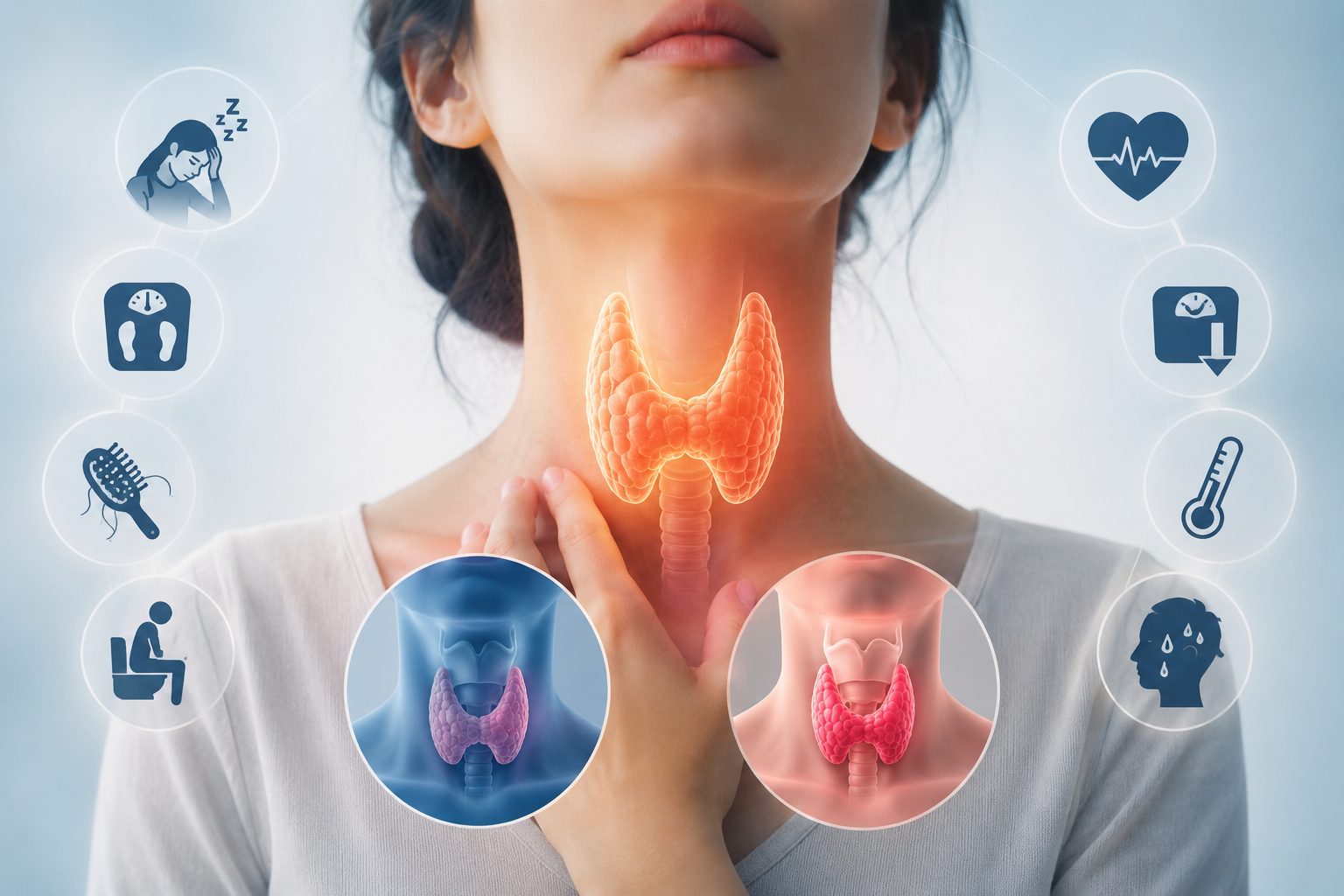

The thyroid gland is a small, butterfly-shaped gland located at the front of the neck. It produces hormones that control metabolism, energy use, body temperature, heart rate, and many other vital functions throughout the body.
When the thyroid becomes underactive or overactive, a wide range of symptoms can develop — many of which are vague and easily confused with other conditions. This guide explains the most common thyroid symptoms and the tests used to diagnose thyroid disease.
What is the thyroid gland?
The thyroid gland sits in the lower front of the neck, just below the Adam's apple. It is part of the endocrine system and plays a central role in regulating how the body uses energy.
The thyroid hormone pathway works like this:
Two main types of thyroid disease
Most thyroid symptoms fall into one of two categories, depending on whether the thyroid is producing too little or too much hormone.
| Type | What it means | Common causes |
|---|---|---|
| Hypothyroidism (underactive thyroid) | The thyroid does not produce enough hormones. Body processes slow down. | Hashimoto's thyroiditis, iodine deficiency, post-thyroid surgery, certain medicines |
| Hyperthyroidism (overactive thyroid) | The thyroid produces too much hormone. Body processes speed up. | Graves' disease, toxic nodular goitre, thyroiditis |
Quick thyroid symptom summary
The easiest way to understand thyroid symptoms is to compare an underactive thyroid with an overactive thyroid.
| Underactive thyroid / Hypothyroidism | Overactive thyroid / Hyperthyroidism |
|---|---|
| Weight gain | Weight loss |
| Fatigue and sleepiness | Anxiety and restlessness |
| Cold intolerance | Heat intolerance |
| Constipation | Frequent bowel motions |
| Dry skin and hair loss | Sweating and tremors |
| Slow pulse | Fast heartbeat and palpitations |
| Heavy or irregular periods | Light or absent periods |
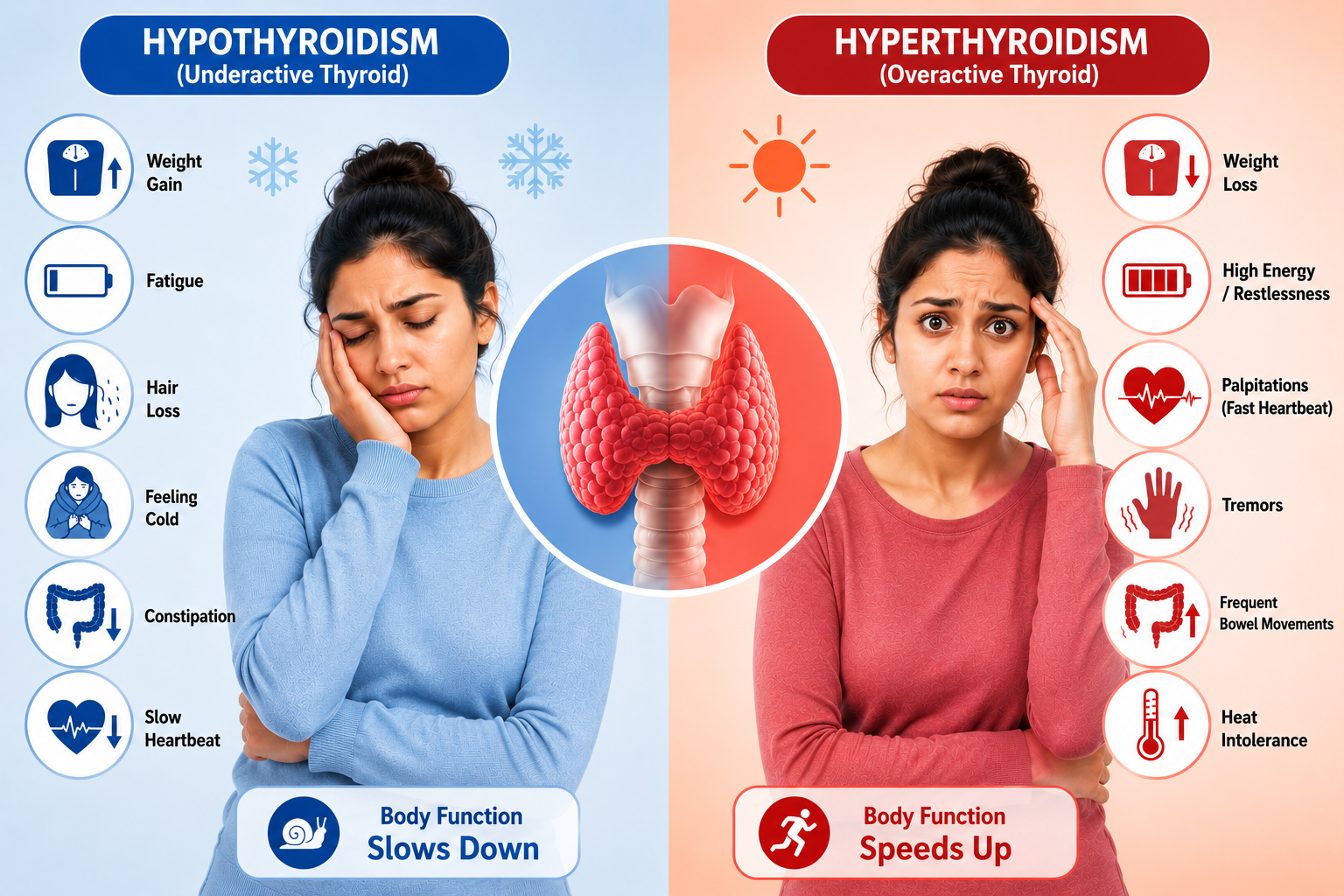
10 symptoms of hypothyroidism (underactive thyroid)
When thyroid hormone levels are too low, metabolism slows down. Symptoms tend to develop gradually and are often subtle at first.
10 symptoms of hyperthyroidism (overactive thyroid)
When thyroid hormone levels are too high, metabolism speeds up. Symptoms are often more acute and noticeable, and can be mistaken for anxiety or cardiac problems.
Hypothyroidism vs hyperthyroidism: quick comparison
The two conditions often produce opposite symptoms because one slows the body down and the other speeds it up.
| Symptom area | Hypothyroidism (underactive) | Hyperthyroidism (overactive) |
|---|---|---|
| Weight | Weight gain | Weight loss |
| Temperature | Cold intolerance, feeling cold | Heat intolerance, excessive sweating |
| Heart rate | Slow pulse (bradycardia) | Fast pulse (tachycardia), palpitations |
| Bowel habit | Constipation | Frequent bowel motions, diarrhoea |
| Energy | Fatigue, tiredness | Restlessness, insomnia |
| Mood | Depression, low mood | Anxiety, irritability, nervousness |
| Skin and hair | Dry skin, hair loss, brittle nails | Fine hair, warm moist skin |
| Menstrual cycle | Heavy or irregular periods | Light or absent periods |
| Cognition | Brain fog, poor memory | Difficulty concentrating due to anxiety |
Can thyroid disease cause a swelling in the neck?
Yes. Thyroid disease can sometimes cause a visible or felt swelling at the front of the neck. This is called a goitre.
A goitre may happen when the whole thyroid gland becomes enlarged, or when one or more thyroid nodules develop inside the gland. Some goitres are painless and grow slowly, while others may be noticed because of pressure symptoms.
Symptoms that may suggest thyroid swelling
- Visible swelling at the front of the neck
- Feeling of pressure or tightness in the neck
- Difficulty swallowing
- Voice change or hoarseness
- Rapidly growing neck lump
Do thyroid symptoms differ in women?
Thyroid disease is more common in women than in men. In women, thyroid symptoms may be noticed through changes in weight, mood, hair, skin, periods, fertility, or pregnancy.
- Heavy, irregular, light, or missed periods
- Hair thinning or increased hair fall
- Unexplained weight gain or weight loss
- Mood changes, anxiety, low mood, or brain fog
- Difficulty becoming pregnant or pregnancy-related thyroid concerns
Do thyroid symptoms differ in men?
Men can develop the same thyroid symptoms as women, including fatigue, weight changes, palpitations, tremors, heat intolerance, cold intolerance, constipation, and mood changes.
However, men may also notice symptoms related to sexual health and physical performance.
- Reduced energy and exercise tolerance
- Muscle weakness
- Reduced libido
- Erectile dysfunction in some cases
- Reduced fertility in uncontrolled thyroid disease
Can thyroid disease affect fertility and pregnancy?
Yes. Thyroid hormones play an important role in the menstrual cycle, ovulation, fertility, and pregnancy. Both hypothyroidism and hyperthyroidism can disturb normal reproductive function.
In women, thyroid disease may cause:
- Irregular menstrual cycles
- Heavy, light, or missed periods
- Ovulation problems
- Difficulty becoming pregnant
- Higher pregnancy risk if thyroid disease is uncontrolled
If you are planning pregnancy and have thyroid symptoms, irregular periods, previous miscarriage, or known thyroid disease, discuss TSH testing with your doctor.
When should you get a thyroid blood test?
A thyroid blood test is usually considered when symptoms suggest either an underactive or overactive thyroid. The first test is usually TSH.
- Persistent unexplained fatigue
- Unexplained weight gain or weight loss
- Hair loss or eyebrow thinning
- Palpitations or fast heartbeat at rest
- Cold intolerance or heat intolerance
- Irregular, heavy, light, or missed periods
- Swelling at the front of the neck
- Family history of thyroid disease
- Planning pregnancy or currently pregnant with thyroid symptoms
Which tests are used to diagnose thyroid disease?
If thyroid disease is suspected based on symptoms, your doctor will request one or more blood tests and occasionally an imaging scan.
- TSH (Thyroid Stimulating Hormone): The first and most important test. TSH is produced by the pituitary gland to control thyroid activity. An abnormal TSH is the earliest and most sensitive indicator of thyroid dysfunction.
- Free T4 (Free Thyroxine): Measures the active form of the main thyroid hormone. Used together with TSH to confirm hypothyroidism or hyperthyroidism. Read Free T4 & Free T3 Explained.
- Free T3 (Free Triiodothyronine): The active form of the other thyroid hormone. Measured when T3 toxicosis is suspected or to monitor hyperthyroidism treatment.
- Thyroid antibodies (TPO and TgAb): Used to identify autoimmune thyroid disease such as Hashimoto's thyroiditis (causing hypothyroidism) or Graves' disease (causing hyperthyroidism).
- Thyroid ultrasound: An imaging scan to assess the size, shape, and structure of the thyroid gland. Useful when a goitre or nodule is felt or suspected on examination.
In most cases, the TSH alone is enough to screen for thyroid disease. Your doctor will decide which additional tests are needed based on your result and clinical picture.
To understand your thyroid blood test results, use our Thyroid Report Reader tool.
How is TSH interpreted?
The TSH result works in the opposite direction to what most people expect — because TSH rises when the pituitary gland is trying to stimulate a sluggish thyroid.
| TSH result | Most likely meaning | Next step |
|---|---|---|
| TSH high (above reference range) | Hypothyroidism (underactive thyroid) | Free T4 is measured to confirm |
| TSH normal | Thyroid is likely functioning normally | Review other possible causes of symptoms |
| TSH low (below reference range) | Hyperthyroidism (overactive thyroid) | Free T4 and Free T3 are measured to confirm |
| TSH borderline high with normal T4 | Subclinical hypothyroidism | Monitoring with repeat testing; treatment depends on symptoms and antibody status |
Related thyroid articles and tools
This article is the starting point of our thyroid education series. Use these pages to understand your symptoms and blood test results more clearly.