
Dengue usually develops over several days rather than remaining the same throughout the illness.
Many people want to know:
“Which day of dengue am I on, and what happens next?â€
The day of illness can be useful, but dengue does not follow exactly the same timetable in every person.
A better way to understand the illness is through three phases:
Febrile phase → Critical phase → Recovery phase
Most people with dengue recover without developing severe dengue.
The important point is that the time when the fever comes down is not always the same as the time when the risk has passed.
Warning signs of severe dengue often appear around this transition.
Therefore:
Do not decide whether you are safe simply from the number of days you have been ill.
Your symptoms, overall condition, ability to drink, urine output, bleeding, warning signs and medical assessment are more important than the calendar day alone.
How Long Does Dengue Usually Last?
The main symptomatic illness usually develops over several days.
Fever commonly lasts about 2–7 days.
Many people begin to improve after this, but the complete recovery period can take longer.
Some people continue to experience tiredness or weakness after the acute illness has resolved.
The World Health Organization notes that most people with dengue recover within about 1–2 weeks, although fatigue may continue for several weeks in some people.
There is no exact number of days that applies to every patient.
Some people have a relatively short uncomplicated illness.
Others need closer monitoring or hospital treatment.
People who develop severe dengue may take longer to recover.
The important question is therefore not only:
“How many days have I had dengue?â€
It is also:
“Which phase of the illness am I in, and how am I clinically?â€
Why Does the Day of Illness Matter?
Doctors often ask:
“Which day of fever is this?â€
There is a reason for that question.
Dengue changes over time.
Symptoms, blood-test results and clinical risks can be different during different stages of the illness.
Knowing when the fever started helps healthcare professionals interpret what is happening.
However, the day number is only part of the assessment.
For example, two people who both say they are on “Day 5†may be in different clinical situations.
One may already be improving.
Another may be developing warning signs.
Therefore:
The day of illness provides context. It does not determine severity by itself.
Days 1–3: The Early Febrile Phase
Dengue commonly begins suddenly with fever.
During the early days, symptoms may include:
- high fever;
- headache;
- pain behind the eyes;
- muscle and joint pains;
- nausea;
- vomiting;
- tiredness;
- rash.
Not every patient develops all of these symptoms.
At this stage, dengue can also resemble many other viral illnesses.
Some blood-test changes may begin to appear, but a single early blood count cannot predict exactly how the illness will progress.
The priorities during this period include appropriate medical assessment, adequate oral fluid intake when possible, appropriate fever management and monitoring for changes.
Do not assume that dengue must remain mild simply because the first few days were uncomplicated.
Continue the follow-up plan recommended by your healthcare professional.
Days 3–7: What May Change?
This is the period when the course of dengue can become more important to monitor.
The exact timing varies.
The fever may continue for several days and then begin to settle.
Blood counts may also change during this period.
Platelet counts may fall.
White blood cell counts may already be low.
In some patients, changes related to plasma leakage can begin around the time the fever settles.
Most patients will not progress to severe dengue.
However, patients who do develop warning signs often do so around this transition.
That is why the middle part of the illness deserves careful observation.
Do not interpret “Day 3–7†as a fixed danger window that works exactly the same for everybody.
What matters most is how the patient is changing clinically.
What Happens When the Fever Comes Down?
This is probably the most important concept in the dengue timeline.
With many common infections, the fever disappearing usually feels like clear evidence that the illness is ending.
In dengue, that assumption can sometimes be misleading.
The medical term for the fever settling is defervescence.
Many patients begin to improve as their fever resolves.
However, in patients who develop the critical phase of dengue, this phase commonly begins around defervescence.
Therefore:
Fever going away can mean recovery is beginning — but it does not prove that the risky period has passed.
Around this time, continue watching for:
- abdominal pain;
- persistent vomiting;
- bleeding;
- unusual drowsiness or restlessness;
- dizziness or fainting;
- difficulty drinking;
- reduced urine output;
- breathing difficulty;
- worsening general condition.
A patient whose temperature is normal but whose overall condition is becoming worse needs medical reassessment.
What Is the Critical Phase of Dengue?
The critical phase is a relatively short period during which some patients can develop important complications.
In severe dengue, increased leakage of fluid from small blood vessels can reduce the effective circulating blood volume.
This can lead to shock if severe.
Other serious complications can include severe bleeding or organ impairment.
For patients and families, the most important thing is not to understand the detailed physiology.
It is to understand this:
A person can sometimes become more unwell around the time the fever settles.
That is why warning signs and the patient's overall condition must continue to be monitored even when the temperature is improving.
Does Everyone With Dengue Develop a Dangerous Critical Phase?
No.
This is very important.
The term critical phase can sound as if every patient with dengue will become critically ill.
That is not true.
Most people with symptomatic dengue do not develop severe dengue.
Many patients pass through the period around defervescence without developing significant plasma leakage or severe complications and continue into recovery.
Therefore:
Do not assume that reaching the time when the fever settles means severe dengue will occur.
At the same time, do not assume that it cannot occur.
The purpose of monitoring is to recognize the smaller group of patients who begin to develop warning signs or clinical deterioration.
How Long Does the Critical Phase Last?
When a clinically important critical phase occurs, it is usually relatively short.
It typically lasts around 24–48 hours.
This is one reason careful monitoring during this period can be so important.
The patient may change considerably over a relatively short time.
After this period, patients who are improving generally move into the recovery phase as the abnormal fluid leakage resolves and circulation stabilizes.
Again, the exact timing differs between patients.
Do not try to calculate the end of the critical period yourself and then stop monitoring solely because a particular number of hours has passed.
Clinical improvement is what matters.
What Warning Signs Should You Watch For?
Important dengue warning signs include:
- significant or worsening abdominal pain;
- persistent vomiting;
- mucosal bleeding such as bleeding from the nose or gums;
- unusual drowsiness;
- marked restlessness or irritability;
- worsening general condition.
Other concerning features include blood in vomit or stool, severe dizziness or fainting, breathing difficulty, inability to maintain adequate oral fluids or a substantial reduction in urine output.
Warning signs deserve particular attention around the time the fever settles.
Do not wait for every warning sign to appear.
If your condition is becoming significantly worse, seek medical assessment.
For the detailed guide, see:
What Happens to Platelet Counts During the Dengue Timeline?
Platelet counts commonly fall during dengue.
The decline often becomes more noticeable during the middle part of the illness.
This understandably causes anxiety.
However:
The platelet count does not provide a countdown showing exactly where you are in dengue.
A low or falling platelet count does not by itself tell you whether severe dengue is developing.
Doctors consider the platelet trend together with:
- symptoms;
- warning signs;
- clinical examination;
- hematocrit;
- circulation;
- bleeding;
- urine output;
- stage of illness.
During recovery, platelet counts usually begin to rise again.
Platelet recovery may occur after other signs of improvement have already started.
Do not wait for a particular platelet value before seeking medical attention if warning signs develop.
For a detailed explanation, see:
Platelets in Dengue: What Platelet Counts Mean and When to Worry
What Happens to the White Blood Cell Count and Hematocrit?
The full blood count changes during dengue.
The white blood cell count commonly falls during the febrile illness.
During recovery, the white cell count often begins to rise before the platelet count recovers.
Hematocrit, also called PCV, can provide important information when interpreted together with the patient's clinical condition.
A rising hematocrit in the appropriate clinical context can be associated with plasma leakage.
However, hematocrit should not be interpreted from one number in isolation.
Changes over time and the patient's clinical condition matter.
Patients should therefore not attempt to determine the dengue phase simply by looking at individual laboratory values.
For detailed explanations, see:
Full Blood Count (FBC) in Dengue Explained
and:
When Does the Recovery Phase Begin?
The recovery phase begins when the period of increased vascular permeability resolves and the patient's clinical condition starts to improve.
This generally follows the critical period in patients who experienced one.
Patients who never develop clinically important complications may simply transition from the febrile illness into improvement.
There is no single clock time at which every patient enters recovery.
Signs that recovery is occurring can include:
- improving general wellbeing;
- returning appetite;
- easier oral intake;
- improving circulation;
- increasing urine output;
- improvement of gastrointestinal symptoms.
Blood counts also begin to recover.
What Happens During Recovery?
As recovery progresses, the body begins returning toward its usual state.
Appetite often improves.
Nausea and abdominal symptoms generally settle.
Urine output may increase.
The white blood cell count commonly begins to rise.
Platelets generally recover later.
Some patients develop a rash during the recovery phase.
This rash may sometimes itch.
The patient may feel clearly better but still not have their normal energy level.
Recovery should show an overall trend toward improvement.
If you initially appear to recover and then become significantly more unwell again, seek medical advice rather than assuming that every new symptom is part of normal dengue recovery.
Why Can Weakness Continue After Dengue?
The end of the acute dengue illness does not necessarily mean that your energy immediately returns to normal.
Some people remain tired or weak for a period after dengue.
The duration varies between individuals.
Activity should generally return gradually as recovery progresses.
Persistent weakness does not necessarily mean that dengue is still in the critical phase.
However, symptoms that are worsening, unusually prolonged or accompanied by new concerning features should be medically reviewed.
For the detailed guide, see:
Recovery After Dengue Fever: Weakness, Tiredness and Returning to Normal
Can Dengue Fever Come Back?
Dengue fever can sometimes be biphasic, meaning the temperature pattern may fall and then rise again during the illness.
Therefore, a temporary reduction in fever does not always mean that the illness has completely ended.
However, a new fever after you had clearly recovered should not automatically be assumed to be normal dengue.
Another infection or another medical problem may be responsible.
If fever returns after apparent recovery, particularly if you feel unwell again, seek medical advice. A later fresh dengue infection with a different serotype is also possible — see Can You Get Dengue Twice? Second Dengue Infection Explained.
Can Symptoms Worsen After You Initially Feel Better?
Yes.
This is one reason dengue requires appropriate monitoring.
A person may feel somewhat better as the fever settles but then develop:
- increasing abdominal pain;
- repeated vomiting;
- bleeding;
- marked weakness;
- dizziness;
- drowsiness or restlessness;
- difficulty drinking;
- breathing difficulty.
This pattern can be important because warning signs may appear around defervescence.
Do not allow a lower temperature to override what the rest of your body is telling you.
Improving fever with worsening general condition is not reassuring.
Seek medical reassessment.
When Should You Seek Urgent Medical Care?
Seek urgent medical assessment if suspected or confirmed dengue is accompanied by:
- severe or worsening abdominal pain;
- persistent vomiting;
- significant bleeding;
- blood in vomit or stool;
- severe dizziness or fainting;
- unusual drowsiness, confusion or marked restlessness;
- breathing difficulty;
- inability to maintain adequate fluid intake;
- substantially reduced urine output;
- rapidly worsening general condition.
Do not delay because you believe you are on the “wrong day†for severe dengue.
Similarly, do not wait for the platelet count to fall below a particular number before seeking care.
Clinical deterioration matters more than the calendar.
Simple Dengue Timeline
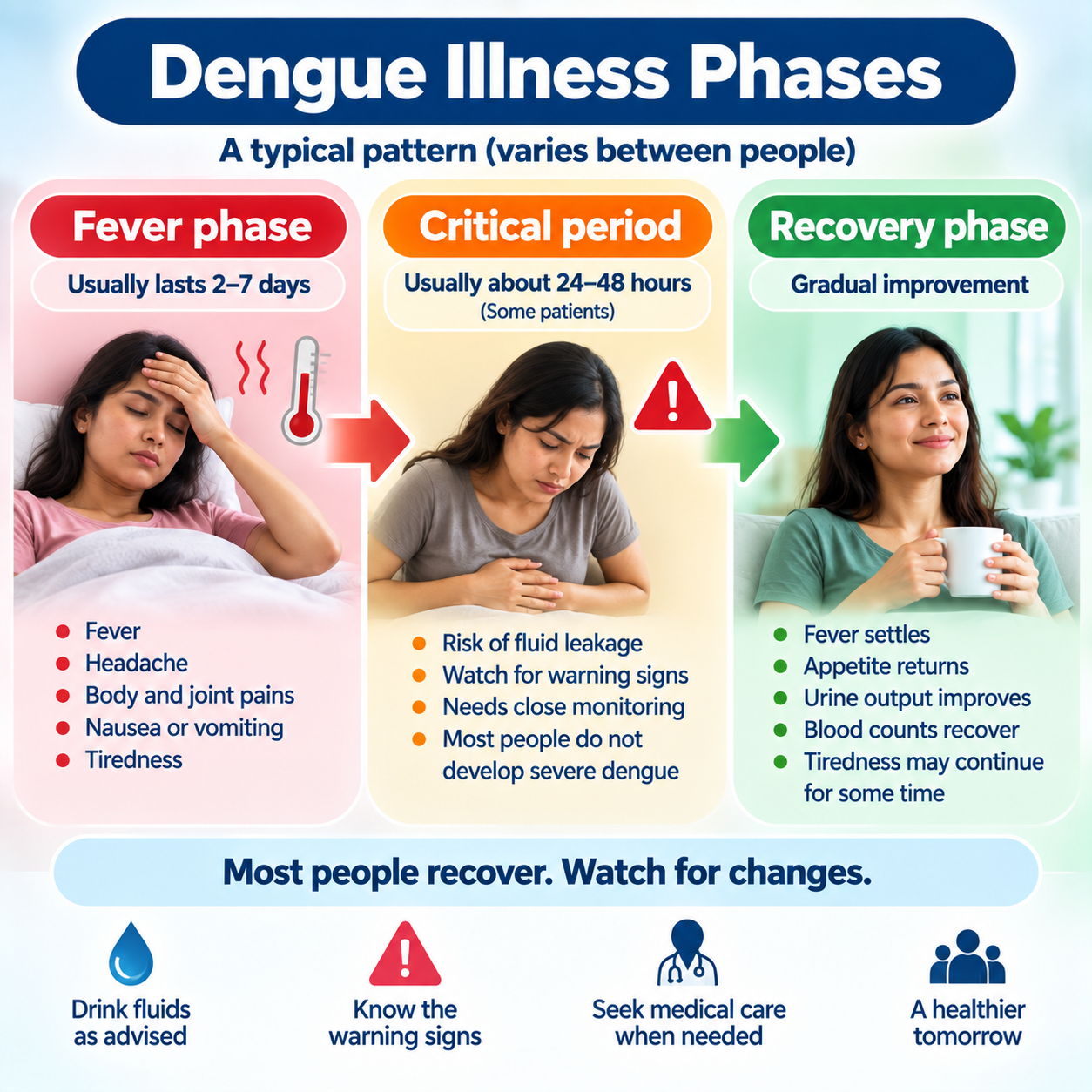
A simple way to understand the usual course is:
Febrile Phase
Fever and other dengue symptoms
Usually lasts several days.
↓
Around the Time the Fever Settles
Continue monitoring carefully
Most patients improve.
Some patients develop warning signs and enter a clinically important critical phase.
↓
Critical Phase, If It Occurs
Usually about 24–48 hours
The main concerns are significant plasma leakage, shock, severe bleeding or organ impairment.
↓
Recovery Phase
Overall condition improves
Appetite returns.
Urine output improves.
White blood cells begin to recover.
Platelet recovery usually follows.
Energy may take longer to return completely.
Remember
This is a general pattern — not an exact timetable for every patient.
One-Minute Summary
- Dengue does not follow exactly the same timetable in every patient.
- Fever commonly lasts around 2–7 days.
- Dengue is best understood as febrile, critical and recovery phases.
- The day of illness helps doctors understand the clinical context but does not determine severity by itself.
- The time when the fever settles is particularly important.
- Most patients improve without developing severe dengue.
- When a clinically important critical phase occurs, it usually lasts about 24–48 hours.
- Platelet counts commonly fall and then recover, but platelet count alone does not determine the dengue phase or severity.
- Recovery involves improving wellbeing, appetite, oral intake and urine output, followed by recovery of blood counts.
- Seek medical care if warning signs or clinical deterioration develop, regardless of which day of dengue you are on.
Most Important Message
Do not use the calendar as your main safety test for dengue.
Knowing the day of illness is useful, but dengue does not follow exactly the same timetable in every person.
Pay particular attention around the time the fever settles.
Most patients will continue toward recovery, but this is also the period when warning signs can appear in patients who develop more serious disease.
Monitor how you actually feel.
Watch for abdominal pain, persistent vomiting, bleeding, difficulty drinking, reduced urine, dizziness, unusual drowsiness or restlessness, breathing difficulty and worsening general condition.
And remember:
A normal temperature does not always mean that the risky period has passed, and a particular platelet count does not tell you that you are safe.
Frequently Asked Questions
How many days does dengue usually last?
The main dengue illness usually develops over several days. Fever commonly lasts about 2–7 days, and many people recover within about 1–2 weeks. Tiredness or weakness can continue longer in some people.
Which day of dengue is the most dangerous?
There is no single numbered day that is the most dangerous for every patient. Warning signs and the critical phase, when they occur, commonly appear around the time the fever settles. The patient's clinical condition is more important than the day number alone.
Is Day 5 of dengue always dangerous?
No. Some patients may be around the time of defervescence on Day 5, while others may be at a different stage. Do not use Day 5 or any other numbered day as a fixed danger rule. Watch the patient's symptoms and clinical condition.
When does the critical phase of dengue begin?
The critical phase, when it occurs, usually begins around defervescence — the time when the fever settles. The exact illness day varies between patients.
How long does the critical phase of dengue last?
A clinically important critical phase typically lasts around 24–48 hours. However, patients should not calculate the end of this period themselves and stop monitoring solely because a particular number of hours has passed.
Is dengue safe once the fever goes away?
Not necessarily. Most people will improve, but warning signs can appear around the time the fever settles. Continue monitoring your overall condition and follow your medical review plan even when the temperature returns to normal.
When do platelets start increasing in dengue?
Platelets generally begin to recover during the recovery phase. Their recovery often occurs after the white blood cell count has started to rise. The exact timing varies, so platelet count should be interpreted together with the patient's overall clinical condition.
Can dengue fever come back after it goes down?
Dengue can sometimes have a biphasic fever pattern, with the temperature falling and then rising again during the illness. However, a new fever after clear recovery should be medically assessed rather than automatically assumed to be dengue.
How do I know that I am recovering from dengue?
Recovery usually involves an overall improvement in wellbeing, returning appetite, easier oral intake, improving urine output and resolution of gastrointestinal symptoms. Blood counts also begin to recover. Some tiredness may continue after the acute illness.
When should I go to hospital during the dengue timeline?
Seek urgent medical assessment if you develop severe or worsening abdominal pain, persistent vomiting, significant bleeding, blood in vomit or stool, severe dizziness or fainting, unusual drowsiness or restlessness, breathing difficulty, inability to maintain fluids, substantially reduced urine output or a rapidly worsening overall condition. Do not wait for a particular illness day or platelet value.
Related Articles
- Dengue Warning Signs: When Should You Go to Hospital?
- Platelets in Dengue: What Platelet Counts Mean and When to Worry
- Full Blood Count (FBC) in Dengue Explained
- Fluids in Dengue: How Much Should You Drink?
- Dengue Home Management Explained
- Recovery After Dengue Fever: Weakness, Tiredness and Returning to Normal
- Dengue Fever: Symptoms, Warning Signs, Tests and Treatment
- Haematocrit (PCV) in Dengue Explained
- Dengue Treatment in Hospital Explained
Dengue Testing Guides
Sources and References
- CDC — Clinical Features of Dengue
- CDC — Clinical Care of Dengue
- WHO — Guidelines for Clinical Management of Arboviral Diseases (2025)
- WHO South-East Asia — Dengue Case Management for Primary Health Care and Home-Based Care
- WHO — Dengue and Severe Dengue
- WHO — Dengue Guidelines for Diagnosis, Treatment, Prevention and Control