

What Are Platelets?
Platelets are tiny blood components that help stop bleeding.
When a blood vessel is injured, platelets gather at the site and form a temporary plug to reduce blood loss.
Unlike red blood cells, which carry oxygen, or white blood cells, which fight infection, platelets are mainly responsible for blood clotting.

Doctors routinely measure platelet counts as part of a Full Blood Count (FBC).
The normal platelet count in most adults is 150,000 to 400,000 per microlitre. A count below this range is known as thrombocytopenia.
Why Do Platelets Fall in Dengue?
A falling platelet count is one of the most recognised laboratory findings in dengue fever.
Several mechanisms contribute to this fall.
The dengue virus can temporarily suppress bone marrow activity, reducing platelet production. At the same time, the immune system may increase platelet destruction.
Some platelets are also consumed during the body's inflammatory response to infection.
The result is a gradual decline in platelet count during the course of illness.

When Do Platelets Start Falling?
Platelet counts are often normal during the first few days of illness.
They usually begin to fall around day 3–5. The lowest platelet counts are commonly seen during the critical phase, around day 5–7.
As patients recover, platelet counts usually begin to rise again.

| Day of Illness | Typical Platelet Trend |
|---|---|
| Days 1–3 | Usually normal |
| Days 3–5 | Begin to fall |
| Days 5–7 | Lowest levels |
| Recovery Phase | Rise again |
What Is a Normal Platelet Count?
Most healthy adults have platelet counts between 150,000 and 400,000 per microlitre. Platelet counts below this range are considered low.
However, the severity of dengue cannot be determined using platelet count alone. Doctors evaluate the following before deciding on treatment or admission:
| Platelet Count | General Interpretation |
|---|---|
| 150,000 – 400,000 | Normal |
| Below 150,000 | Low (thrombocytopenia) |
| Falling rapidly | Needs closer monitoring |
| Very low values | May require urgent review depending on symptoms |
Important FBC Values in Dengue
Doctors do not assess platelet counts alone. Several values in the Full Blood Count (FBC) help doctors understand the severity of dengue fever.
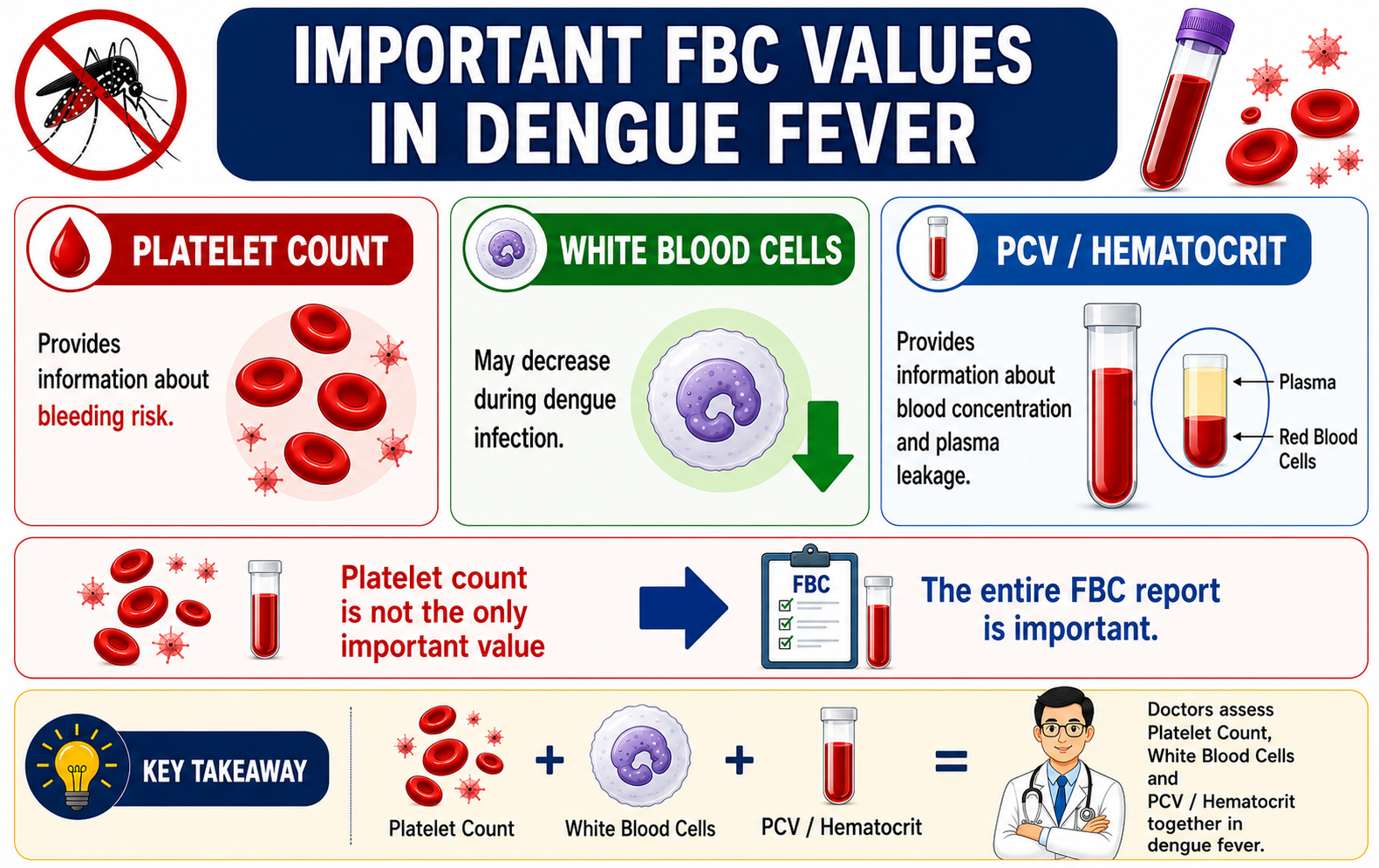
Provides information about bleeding risk.
May decrease during dengue infection.
Provides information about blood concentration and plasma leakage.
PCV, also called hematocrit, is especially important because a rising value can suggest plasma leakage, one of the important complications doctors monitor during dengue.
Does a Low Platelet Count Mean Severe Dengue?
No.
This is one of the most common misconceptions about dengue. Many patients recover completely despite very low platelet counts.
Conversely, some patients develop severe dengue complications while their platelet counts are still relatively high.
Doctors assess the entire clinical picture rather than focusing on a single number.

Warning signs such as the following are often more important than the platelet count itself:
- Severe abdominal pain
- Persistent vomiting
- Any bleeding
- Difficulty breathing
- Drowsiness or confusion
When Is Platelet Transfusion Needed?
Platelet transfusions are not routinely required for every patient with a low platelet count.
Many patients recover without receiving any platelets.
Even patients with very low platelet counts may recover without platelet transfusion if they are clinically stable and do not have significant bleeding.
Doctors make transfusion decisions based on the overall clinical picture rather than a platelet count alone.
Doctors consider transfusion when:

- Significant bleeding is occurring
- The clinical situation suggests a high bleeding risk
- Specialist teams determine it is necessary based on the overall clinical picture
How Fast Do Platelets Recover?
Platelet recovery usually begins once the patient enters the recovery phase of dengue.
Counts often start rising after the critical phase ends. Many patients see substantial improvement over several days.
In most cases, platelet counts eventually return to normal without specific treatment.
Frequently Asked Questions
- 🩸Platelet counts commonly fall during dengue fever, particularly during the critical phase (days 5–7).
- âŒA low platelet count alone does not determine disease severity — doctors assess the full clinical picture.
- 📊The trend of the platelet count over time is often more important than a single isolated reading.
- 🚩Warning signs — not the platelet number — are the primary indicator of danger in dengue.
- 💉Platelet transfusions are not routine — they are given only when clinically indicated, not for a low number alone.
- 🌱Most patients recover naturally and platelet counts return to normal during the recovery phase.
- 🧪Doctors assess the entire FBC report, including platelet count, white blood cells and PCV / hematocrit.
- 📈Repeated blood tests may be needed because the trend over time is more useful than one isolated result.
For parents and caregivers, read our guide to dengue in children, including symptoms, monitoring and when to seek medical help.
For pregnancy-specific information, read our guide to dengue in pregnancy, including possible risks, warning signs and when to seek medical care.
For the usual course of the illness, see the dengue timeline.