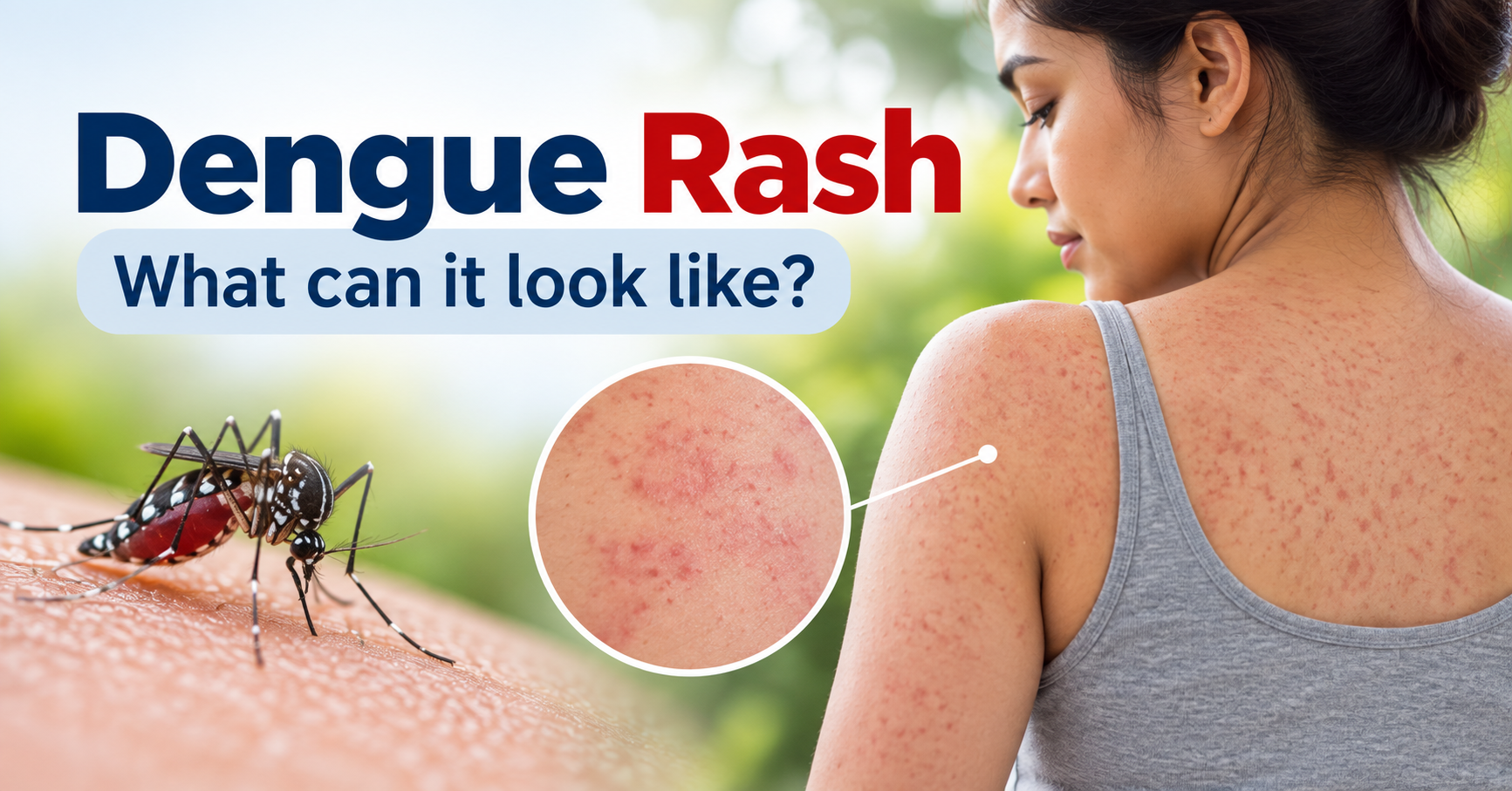

A rash can occur with dengue fever.
It may appear while you still have fever, or skin changes may become more noticeable later as you begin to recover.
But there is an important point to understand:
Dengue can cause different types of skin changes, and many other infections, medicines and medical conditions can also cause a rash.
Some people with dengue develop a noticeable rash. Others may have only mild skin changes, and some may not notice a rash at all.
Therefore, you should not try to diagnose dengue simply by comparing your skin with a photograph online.
Doctors consider the rash together with your fever, other symptoms, examination findings and, when appropriate, blood tests for dengue.
This article explains what a dengue rash can look like, when it may appear, whether it can itch, and how to distinguish the idea of a rash from more concerning bleeding manifestations.
Can Dengue Cause a Rash?
Yes.
A rash is one of the possible symptoms of dengue.
However, not everyone with dengue develops the same skin changes.
The appearance can also change during different stages of the illness.
Some people may notice redness or flushing of the skin early in the illness.
A more obvious rash can appear later.
Another rash may become noticeable around the time the illness is improving or during recovery.
This variation is one reason why a rash alone cannot confirm or exclude dengue.
If you have fever and think you may have dengue, the diagnosis should be considered from the overall illness rather than from the appearance of your skin alone.
What Does a Dengue Rash Look Like?
There is no single appearance that every dengue rash follows.
The skin may look generally red in some people.
In others, the rash may appear as many small red areas or spots spread over the skin.
Doctors may describe some dengue rashes as macular or maculopapular.
These are medical terms describing the appearance of the skin. You do not need to identify these patterns yourself in order to know whether you have dengue.
During recovery, some people develop more widespread redness with small areas of relatively normal-looking skin between the red areas.
The appearance can vary considerably from one person to another.
It can also be difficult for a patient to distinguish an ordinary rash from small bleeding spots or from a rash caused by another illness.
For that reason:
When Does Dengue Rash Appear?
A dengue-related rash does not always appear on the same day of illness.
Skin changes can occur at different stages.
Early in the illness
Some people develop flushing or redness of the skin early during the fever.
This may be subtle and may not look like the type of rash people normally expect.
During the febrile illness
A more recognizable rash can develop while the person is still unwell with fever.
It may appear as areas of redness or as a more widespread spotted rash.
Around recovery
Another characteristic time for skin changes is when the illness is beginning to improve.
A recovery-phase rash may become noticeable around or after the fever settles.
This can sometimes surprise patients.
They may think:
“My fever has gone. Why am I developing a rash now?”
A rash appearing during recovery does not automatically mean that the illness is becoming worse.
However, the period around the time the fever settles is also important in dengue because warning signs of severe disease can occur around this stage.
Therefore, the rash should never be used by itself to decide that everything is safe.
Your overall condition and any other symptoms are more important.
Where Can Dengue Rash Appear?
A dengue rash can involve different areas of the body.
It may be seen over areas such as the:
The exact distribution varies.
Some people may have widespread skin changes, while others notice them only in certain areas.
The rash may also become more noticeable in one area before spreading to others.
Again, the location does not provide a reliable home test for dengue.
A rash on a particular part of the body does not prove that dengue is the cause.
Does Dengue Rash Itch?
It can.
Not every dengue rash is itchy.
However, itching can occur, particularly with the rash seen during the recovery phase.
Some people may notice that they are otherwise beginning to feel better but their skin has become itchy.
The itching may involve areas where the rash is visible or may feel more generalized.
A recovery-phase rash can therefore be uncomfortable even while other symptoms of dengue are improving.
Avoid assuming that every itchy rash occurring during or after a fever is caused by dengue.
Allergic reactions, medicines and many other illnesses can also cause itching and rash.
If the rash is severe, rapidly worsening, associated with swelling or breathing difficulty, or you are unsure whether it represents dengue or another problem, seek medical advice.
Does a Rash Mean Dengue Is Becoming Worse?
Not necessarily.
The appearance of a rash by itself does not mean that dengue is becoming severe.
A rash can occur during the febrile phase of dengue, and another pattern of rash may become noticeable as the person begins to recover.
In fact, some people notice a rash around the time they are otherwise starting to feel better.
However, there is an important safety point.
Doctors assess the whole clinical picture.
They consider factors such as:
- how you are feeling overall
- whether warning signs have developed
- your ability to drink
- vomiting
- abdominal pain
- bleeding
- circulation and hydration
- examination findings
- relevant blood-test results
This is particularly important around the time the fever settles.
Many patients expect that the disappearance of fever always means that the danger has passed.
In dengue, important warning signs can sometimes develop around this stage of the illness.
Therefore, a person who develops a rash as the fever settles should still pay attention to their overall condition and any warning symptoms.
A rash during recovery may be part of the normal course of dengue.
But a rash does not guarantee that the illness is safely over.
Dengue Rash Versus Bleeding Under the Skin
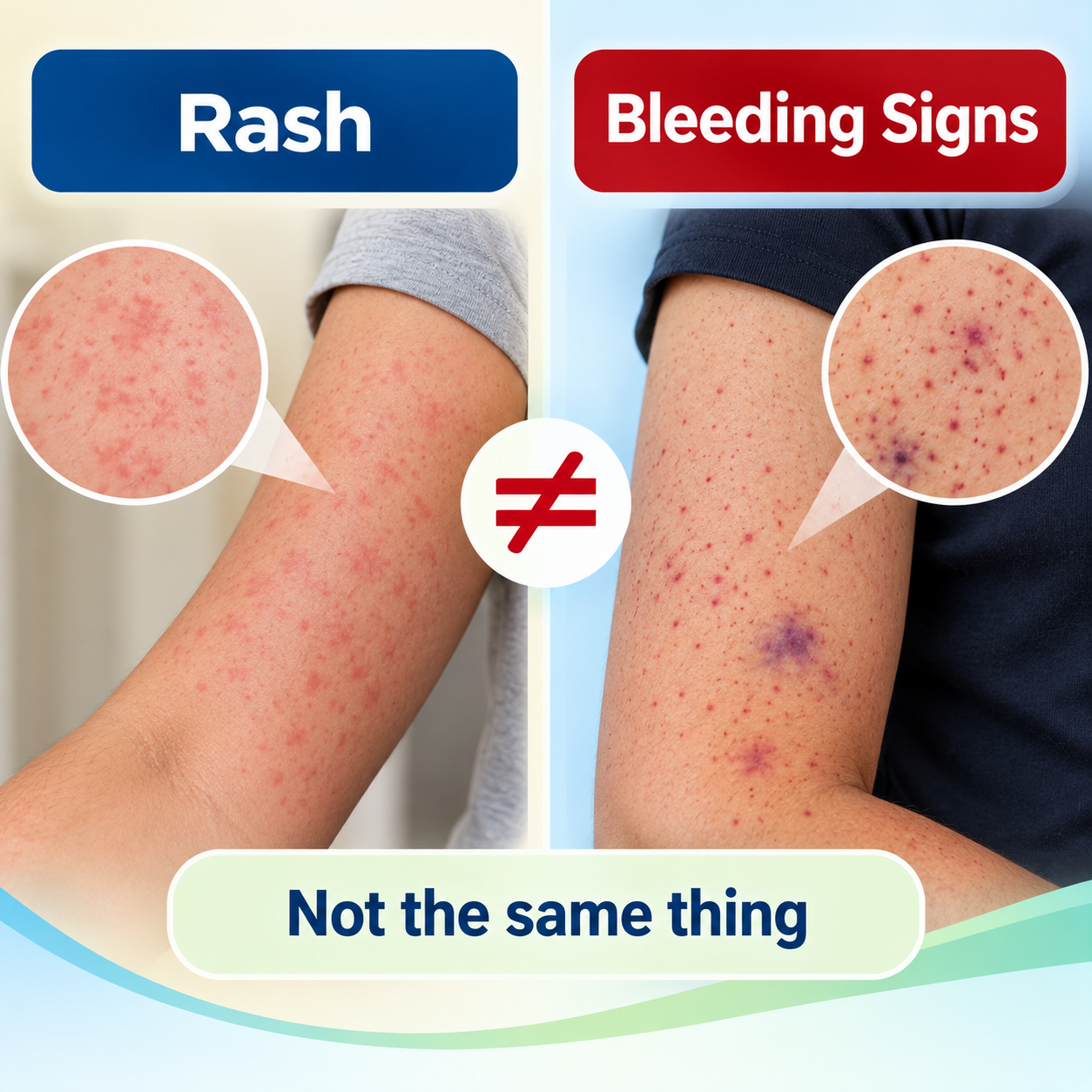
Patients sometimes use the words “rash,” “red spots” and “bleeding spots” to describe the same thing.
Medically, they are not necessarily the same.
A rash
A rash is a visible change in the appearance or texture of the skin.
Dengue can produce areas of redness or a more widespread spotted rash.
These changes can occur as part of the illness and may also appear during recovery.
Bleeding under the skin
Dengue can also be associated with bleeding manifestations.
Very small areas of bleeding under the skin may appear as tiny red, reddish-purple or purple spots.
Doctors may use the term petechiae for very small spots caused by bleeding into the skin.
Larger areas of bleeding under the skin may look more like bruising.
These findings are different in concept from an ordinary inflammatory rash.
Why the distinction matters
It can be difficult for someone without medical training to decide whether small red spots represent a rash, bleeding into the skin, or something else.
Online photographs are not a reliable way to make that distinction.
Do not assume:
But also do not assume:
If you develop unexplained bleeding, unusual bruising, blood in vomit or stool, bleeding from the nose or gums, unusually heavy menstrual bleeding, or other concerning symptoms, seek medical advice.
For a detailed explanation of symptoms that require closer attention during dengue, see Dengue Warning Signs: When Should You Go to Hospital?
Can You Diagnose Dengue From a Rash?
No.
A rash may support the clinical picture of dengue, but it cannot confirm the diagnosis by itself.
Many illnesses can cause fever and rash.
Skin changes can also occur because of medicines, allergic reactions and other medical conditions.
At the same time, a person can have dengue without developing a noticeable rash.
Therefore:
Doctors diagnose dengue by considering several pieces of information together.
These may include:
- your symptoms
- the day of illness
- possible exposure to dengue
- physical examination
- blood-count changes
- specific dengue tests when appropriate
The type of dengue test that is useful can also depend on when during the illness the test is performed.
If dengue testing is required, your healthcare professional can decide which investigation is appropriate for your stage of illness.
Do not delay medical assessment because your rash does not resemble a photograph labelled “dengue rash” on the internet.
What Should You Do If You Develop a Rash With Fever?
If you develop a rash while you have a fever, first consider your overall condition rather than concentrating only on the skin.
A fever with rash can have many causes.
If dengue is possible where you live or you have other symptoms consistent with dengue, medical assessment may be appropriate.
Pay particular attention to:
- how unwell you feel
- whether you can drink adequately
- whether you are vomiting repeatedly
- whether significant abdominal pain is present
- whether there is bleeding
- whether you feel faint or unusually weak
- whether your condition is becoming worse
Do not start medicines simply because you think the rash is dengue.
Some medicines that are commonly used for pain or fever are not recommended when dengue is suspected because of bleeding risk.
For specific guidance about medicines, see Medicines to Avoid in Dengue Fever.
Similarly, do not rely on the rash to decide whether you need a dengue blood test.
The appropriate assessment depends on your symptoms and the stage of the illness.
What Happens to the Rash During Recovery?
A rash can become noticeable during the recovery phase of dengue.
For some people, this is one of the more surprising parts of the illness.
The fever may have settled and appetite or general wellbeing may be improving, but the skin may become more obviously red or itchy.
The recovery rash can sometimes have areas of relatively normal-looking skin within more widespread redness.
It may also be associated with itching.
In some people, mild peeling or flaking of the skin may occur as the rash resolves.
The rash should generally improve as recovery continues.
Try not to judge your overall recovery from the skin appearance alone.
Your general wellbeing, ability to eat and drink, strength, symptoms and clinical assessment are more important.
For information about tiredness, weakness and returning to normal activities after dengue, see Recovery After Dengue Fever.
If the rash is becoming rapidly worse, remains unusually severe, or is accompanied by other new symptoms, medical review may be appropriate because not every rash occurring after dengue is necessarily caused by dengue.
When Should You Seek Urgent Medical Attention?
A rash alone is not usually the main feature doctors use to identify severe dengue.
The more important question is whether you have other concerning symptoms.
Seek urgent medical assessment if you have dengue or possible dengue and develop symptoms such as:
- Severe or worsening abdominal pain
- Persistent or repeated vomiting
- Significant bleeding
- Blood in vomit or stool
- Severe dizziness or fainting
- Unusual drowsiness, confusion or difficulty waking
- Breathing difficulty
- Inability to maintain adequate fluid intake
- Rapidly worsening overall condition
You should also seek urgent help if a rash is accompanied by features suggesting a serious allergic reaction, such as swelling of the face, lips or tongue or difficulty breathing.
Do not wait for a rash to appear before seeking help if other dengue warning signs are already present.
Likewise, do not assume that developing a rash means that the dangerous stage of dengue has passed.
For a complete patient guide to warning symptoms, see Dengue Warning Signs: When Should You Go to Hospital?
One-Minute Summary
- Dengue can cause a rash, but a rash alone cannot diagnose dengue
- Some people develop skin redness or a rash while they still have fever
- A rash may also become more noticeable during the recovery phase
- The appearance varies considerably, so there is no single “dengue rash” that every patient develops
- Some recovery-phase rashes can be itchy
- Not everyone with dengue develops a noticeable rash
- An ordinary rash and bleeding under the skin are not necessarily the same thing
- Do not try to decide from an online photograph whether red spots represent dengue rash or bleeding
- A rash appearing as the fever settles does not automatically mean that dengue is becoming worse, but it also does not prove that the illness is safely over
- Your overall condition and the presence or absence of warning signs are more important than the rash itself
Most Important Message
Dengue can cause skin changes at different stages of the illness, including during recovery.
But there is no single appearance of the skin that can confirm dengue.
Do not diagnose dengue by comparing your rash with photographs online, and do not assume that every red spot is either harmless rash or dangerous bleeding.
The rash must be considered together with the rest of your illness.
Pay attention to how you feel overall and whether warning signs such as significant abdominal pain, persistent vomiting, bleeding, fainting, breathing difficulty or worsening general condition develop.
If you are unsure about a rash, particularly if you also have fever or other concerning symptoms, seek medical advice.
Frequently Asked Questions
For the usual course of the illness, see the dengue timeline.