

When Should You Seek Urgent Medical Attention?
Most people with dengue fever recover completely. However, a small number develop warning signs — symptoms that suggest the illness may be becoming more serious and requires urgent medical assessment.
Understanding these warning signs is one of the most important things a patient or family member can do during dengue illness.
Dengue Warning Signs at a Glance
| Question | Quick Answer |
|---|---|
| What are warning signs? | Symptoms that may indicate severe dengue. |
| When do they usually appear? | Around the time the fever begins to settle (critical phase). |
| What should I do? | Seek urgent medical assessment. |
| Will everyone develop them? | No. Most patients recover without warning signs. |
| Should I wait for another blood test? | No. New warning signs require medical assessment without delay. |
This table provides a quick overview. Continue reading to understand each warning sign in detail.
What Is the Critical Phase of Dengue?
Dengue passes through three phases: febrile, critical and recovery. The critical phase begins around the time the fever starts to settle — often between days 3 and 7 — and is when warning signs are most likely to appear.

| Phase | Typical Timing | What to Expect |
|---|---|---|
| Febrile Phase | Days 1–3 | High fever, headache, body aches, early rash |
| Critical Phase | Days 3–7 | Fever may settle; warning signs may appear |
| Recovery Phase | After day 7 | Gradual improvement; platelet counts begin to rise |
What Are the Warning Signs of Dengue?
The following seven warning signs indicate that a dengue patient may need closer medical observation. Even one warning sign is enough to seek medical assessment without delay.
| Warning Sign | What the Patient May Notice |
|---|---|
| Severe abdominal pain | Persistent or worsening stomach pain |
| Persistent vomiting | Repeated vomiting or inability to keep fluids down |
| Bleeding | Nosebleeds, gum bleeding or other unexpected bleeding |
| Extreme tiredness or restlessness | Unusual sleepiness, confusion or agitation |
| Difficulty breathing | Breathlessness or rapid breathing |
| Enlarged liver | Usually detected during medical examination |
| Cold, clammy skin or collapse | Fainting, dizziness or poor circulation |
Understanding Each Warning Sign
Each warning sign reflects a different way that dengue can affect the body.
Severe Abdominal Pain
Severe or worsening abdominal pain should not be dismissed as a normal stomach ache. It may indicate important changes inside the body that require medical assessment.
Persistent Vomiting
Occasional nausea is common in dengue. However, repeated vomiting or inability to keep fluids down is a different matter — it can lead to dehydration and signals that the illness may be progressing.
Bleeding
Any unusual bleeding — nosebleeds, gum bleeding, blood in urine or stool — should be reported to a healthcare professional. Even small amounts count as a warning sign.
Extreme Tiredness or Restlessness
Ordinary tiredness is expected. However, if a patient becomes unusually difficult to wake, confused, agitated or unresponsive, this requires urgent medical attention. Family members often notice this change before the patient does.
Difficulty Breathing
Breathlessness or rapid breathing can indicate that fluid is accumulating in the chest. This requires prompt medical review.
Enlarged Liver
An enlarged liver is usually detected during a medical examination. It is a warning sign because it indicates that the dengue infection is significantly affecting the liver.
Cold, Clammy Skin or Collapse
Feeling faint, collapsing, or developing cold and clammy skin are signs that the body's circulation is under severe stress. This is among the most urgent warning signs and requires immediate medical attention.
What Should You Do If a Warning Sign Develops?
- Go to the nearest hospital.
- Continue drinking fluids unless unable.
- Bring previous blood reports.
- Tell the doctor when the fever started.
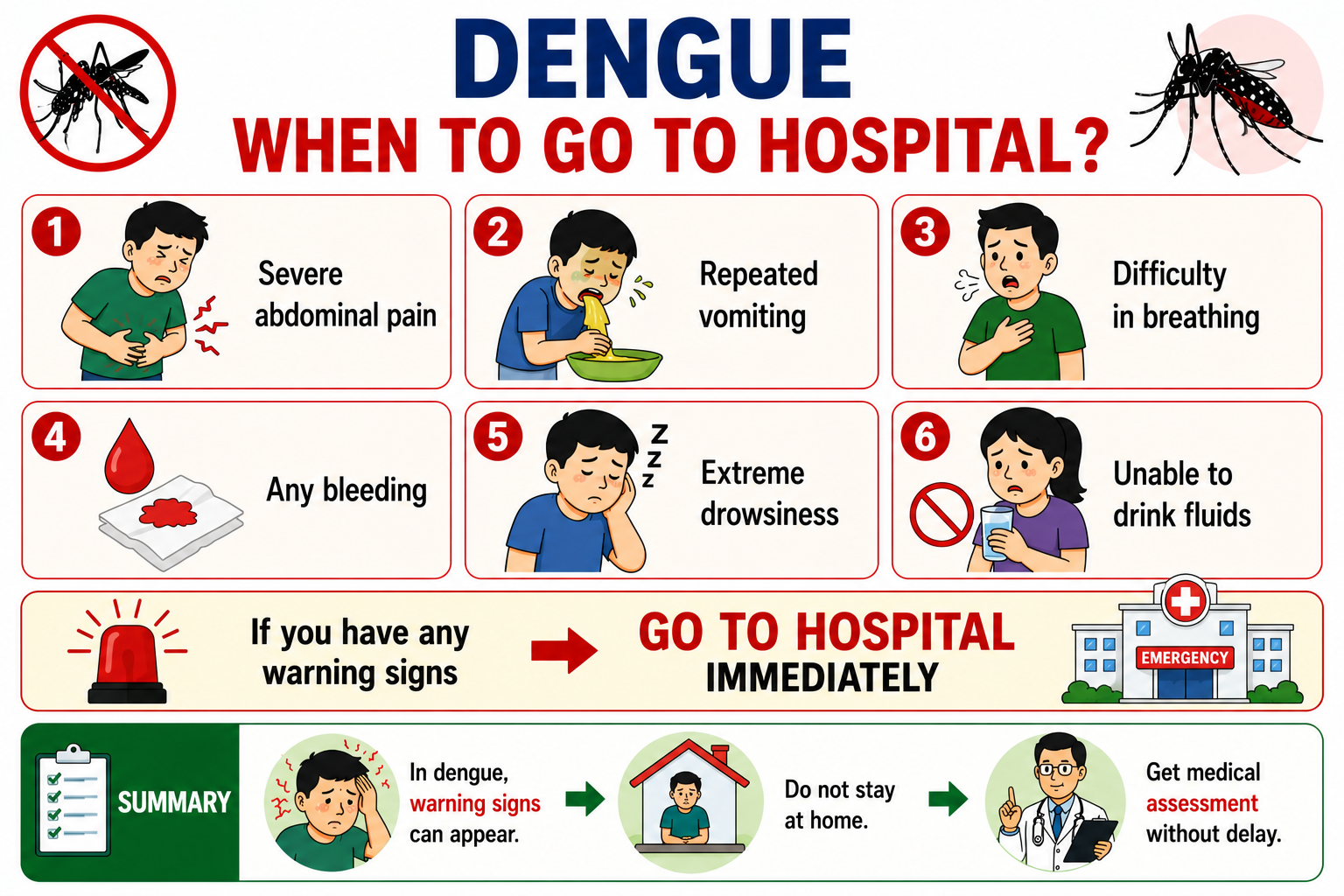
Doctors weigh these warning signs together with the overall clinical picture when deciding whether hospital admission is needed — see When Should a Dengue Patient Be Admitted to Hospital? for how that decision is made.
Real-Life Examples
These examples show why warning signs must never be dismissed.
Advice for Family Members
Family members often notice deterioration before the patient does.
- ✓Patient becoming unusually sleepy or difficult to wake
- ✓Increasing abdominal pain
- ✓Vomiting repeatedly
- ✓New bleeding
- ✓Difficulty breathing
- ✓Reduced urine output
- ✓Any sudden worsening of condition
If you notice any of these changes, seek medical assessment promptly.
Common Mistakes Patients Make
These misunderstandings are common reasons why patients reach hospital too late.
| Mistake | Correct Action |
|---|---|
| "My fever settled, so I must be better." | The dangerous phase often begins around the critical phase — when the fever settles. |
| "I'll repeat my blood test tomorrow and decide then." | If a warning sign develops, go to hospital today. Do not delay for another test. |
| "My platelet count was normal yesterday." | Blood results change over time. New symptoms always deserve attention. |
| "I only have one warning sign." | One warning sign is enough. Seek medical assessment without delay. |
| "I searched online and it seems mild." | Seek medical assessment. Every dengue patient is different. |
Recognising warning signs early gives doctors the best opportunity to prevent severe complications.
Why Might Your Doctor Repeat Blood Tests?
Dengue changes over time and one blood test does not always provide the complete picture. A repeat blood test does not automatically mean the illness has worsened — it is part of monitoring safely.
Investigations such as the IgM and IgG antibody tests and other blood results are interpreted together with your symptoms and clinical examination. Always follow the review schedule your healthcare professional recommends.
Monitoring Yourself at Home
If your doctor advises home care, continue to observe your condition carefully. Pay attention to fluid intake, urine output, any new symptoms and whether you feel better or worse.
- ✓Drink fluids as advised by your doctor.
- ✓Take medicines exactly as prescribed.
- ✓Attend all follow-up appointments and complete repeat blood tests if requested.
- ✓Watch carefully for warning signs and seek medical review if your condition worsens.
One-Minute Revision

- Most patients recover completely.
- Warning signs usually appear after the fever begins to settle.
- Even one warning sign needs urgent medical assessment.
- Do not wait for another blood test.
- Seek medical care early.
Quick Summary Table
| Question | Simple Answer |
|---|---|
| What are dengue warning signs? | Symptoms that may indicate dengue is becoming more serious. |
| When do they usually appear? | Most commonly around the time the fever begins to settle. |
| What should I do if I notice one? | Seek urgent medical assessment without delay. |
| Can I wait until tomorrow? | No. Warning signs should be assessed as soon as possible. |
| Does everyone with warning signs become critically ill? | No. Most patients recover well when warning signs are recognised early and managed promptly. |
Summary
Most people with dengue recover completely. However, warning signs identify the patients who may develop severe disease and require urgent medical assessment.
Warning signs usually appear around the time the fever begins to settle rather than when the fever is highest.
If any warning sign develops, do not wait for another blood test or for symptoms to worsen. Early medical assessment allows doctors to detect complications before they become life-threatening.
One dengue warning sign is enough to seek urgent medical assessment. Early treatment saves lives.
Important Medical Advice
This article is intended for patient education only. It should not be used to diagnose or treat dengue without professional medical advice.
Seek urgent medical assessment immediately if a patient with suspected or confirmed dengue develops:
- Severe abdominal pain
- Persistent vomiting or inability to drink fluids
- Any bleeding (nose, gums or elsewhere)
- Difficulty breathing
- Unusual drowsiness, confusion or difficult-to-wake state
- Collapse or cold, clammy skin
- Markedly reduced urine output
- Any sudden worsening of condition
If you are uncertain whether a symptom is a warning sign, it is safer to seek medical advice than to wait.
Frequently Asked Questions
- 🟢Most people with dengue recover completely.
- 📅Warning signs typically appear around the time the fever begins to settle — not when the fever is highest.
- 🚨7 warning signs: severe abdominal pain, persistent vomiting, bleeding, extreme tiredness or restlessness, difficulty breathing, enlarged liver, cold/clammy skin or collapse.
- âš ï¸One warning sign is enough. Do not wait for several to appear.
- ðŸ¥Early medical assessment is always the safest choice.
For parents and caregivers, read our guide to dengue in children, including symptoms, monitoring and when to seek medical help.
For pregnancy-specific information, read our guide to dengue in pregnancy, including possible risks, warning signs and when to seek medical care.
For the usual course of the illness, see the dengue timeline.