Serum Calcium Test Explained: High and Low Calcium Results
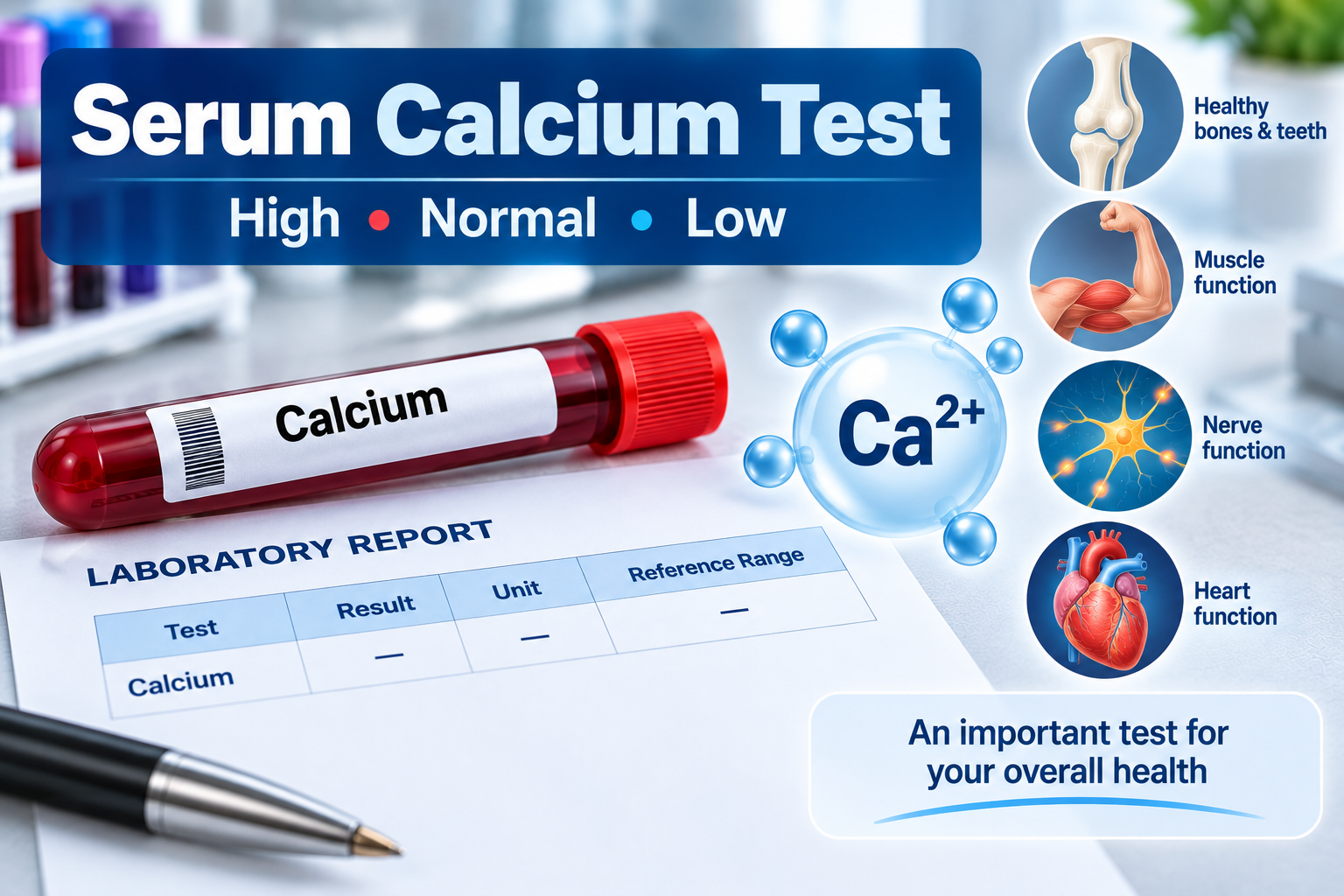
A serum calcium test measures calcium in your blood.
Calcium is well known for its role in bones and teeth, but calcium in the blood is also important for normal:
- muscle function;
- nerve function;
- heart function;
- and many other body processes.
A blood calcium result can be within the laboratory reference range, higher than expected, or lower than expected.
A high blood calcium level is called hypercalcaemia. A low blood calcium level is called hypocalcaemia.
However, interpreting calcium is not always as simple as comparing one number with a reference range.
Your report may refer to Total Calcium, Ionized / Ionised Calcium, Corrected Calcium or Adjusted Calcium. These terms are related but do not mean exactly the same thing.
What Is Calcium?
Most of the calcium in the body is stored in bones and teeth. A much smaller amount circulates in the blood.
Although this circulating amount is small, it is important for normal muscle contraction, nerve activity, heart function, blood clotting and other cellular processes.
The body therefore regulates blood calcium carefully. Several organs and hormones are involved in maintaining calcium balance, including the parathyroid glands, kidneys, intestines, bones and vitamin D.
Why Is a Calcium Blood Test Done?
A calcium blood test may be requested for many different reasons. Examples include:
- as part of routine or broader blood testing;
- as part of some renal/kidney profiles;
- when symptoms could possibly be related to abnormal calcium;
- when kidney disease is being assessed or monitored;
- when a parathyroid disorder is suspected;
- when vitamin D or bone-related problems are being investigated;
- when certain medicines or supplements are being monitored;
- when a previous calcium result was abnormal;
- in some people with kidney stones;
- or as part of the investigation or monitoring of certain other medical conditions.
The reason for testing can therefore differ considerably between patients.
How Is a Serum Calcium Test Done?
The test is usually performed using a blood sample. A healthcare worker takes a small amount of blood from a vein, usually in the arm.
The laboratory then measures the requested type of calcium. Your report may show Calcium, Total Calcium, Serum Calcium, Corrected Calcium, Adjusted Calcium, Ionized Calcium, or Ionised Calcium.
Total Calcium, Ionized Calcium and Corrected Calcium
Understanding these terms is one of the most important parts of reading a calcium report.
Total Calcium
Total calcium is the calcium measurement commonly reported on routine blood tests.
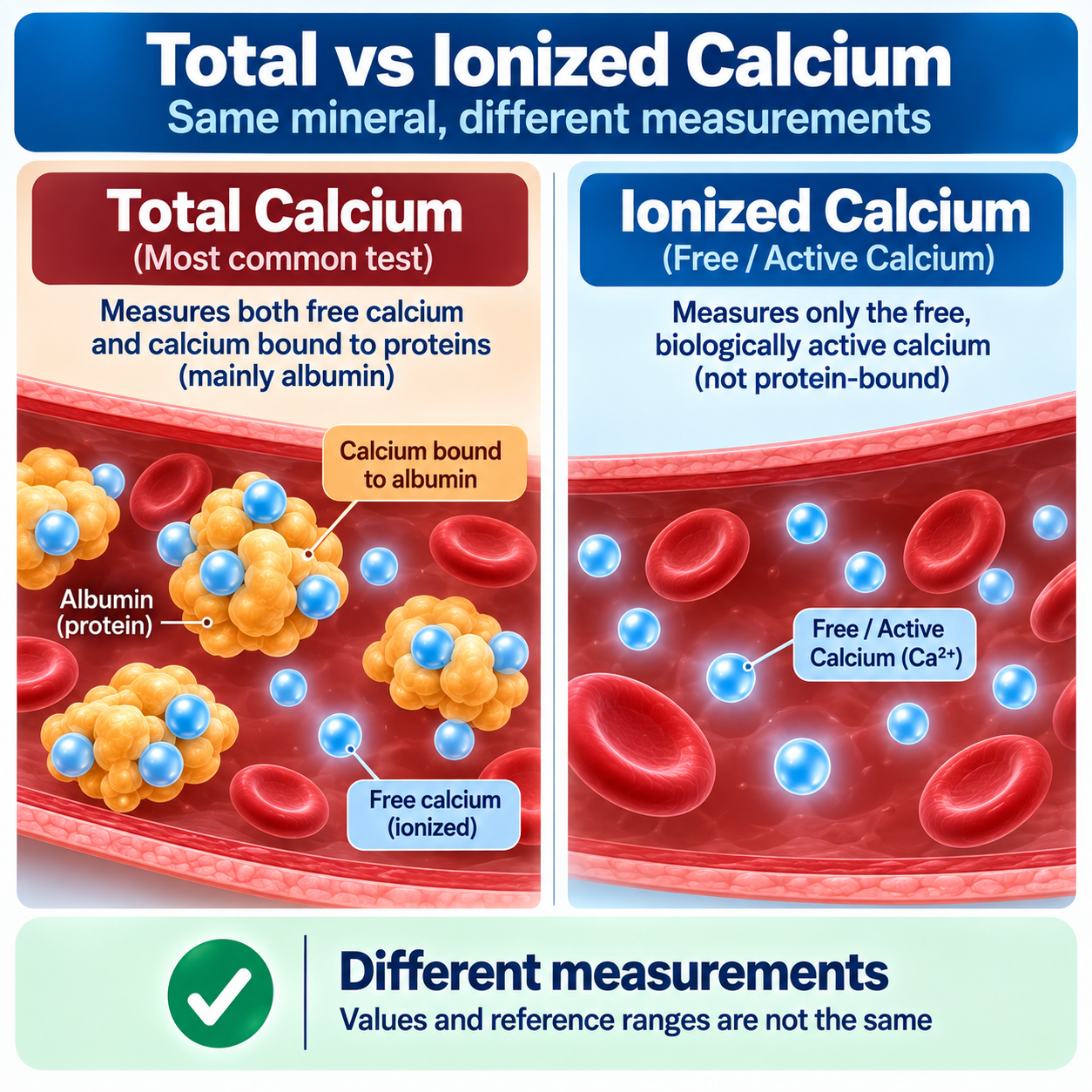
Calcium in the blood exists in different forms. Some is free in the blood, and some is bound to proteins, particularly albumin.
A total calcium test measures these forms together. This means that changes in blood proteins such as albumin can sometimes affect the total calcium result.
Ionized Calcium
Ionized calcium — also written ionised calcium — measures the calcium that is free rather than bound to proteins.
This is the biologically active form of calcium.
Ionized calcium may be requested in particular clinical situations when a more direct assessment of active circulating calcium is useful. It is not necessarily included in a routine calcium or renal-profile test.
Corrected or Adjusted Calcium
Because some calcium is bound to albumin, changes in albumin can affect the measured total calcium.
Some laboratories therefore report a value called Corrected Calcium or Adjusted Calcium. This is an estimate intended to account for the effect of albumin on the total calcium result.
If the laboratory has already reported an adjusted/corrected calcium value, that result should be interpreted according to the laboratory and clinical situation.
Why Does Albumin Matter When Reading Total Calcium?
Albumin is a major protein in the blood. Some circulating calcium is attached to albumin.
Therefore, when albumin is significantly abnormal, the total calcium result may not always reflect the biologically active calcium in a straightforward way.
This is one reason a doctor or laboratory may consider albumin, corrected/adjusted calcium, or ionized calcium when interpreting a calcium result.
Do not assume that every abnormal total calcium result represents the same abnormality in ionized calcium.
Do I Need to Fast for a Calcium Blood Test?
Fasting is not always required specifically for a standard serum calcium test.
However, calcium is often measured together with other blood tests that may have their own preparation or fasting requirements.
If you are unsure, check with the laboratory or healthcare professional who requested the test.
Should I Stop Calcium or Vitamin D Before the Test?
Do not stop prescribed calcium or vitamin D simply because you are having a calcium blood test unless the healthcare professional responsible for your care specifically tells you to do so.
Also tell the healthcare professional interpreting the result about calcium supplements, vitamin D supplements, multivitamins, antacids or other products containing calcium, and other medicines or supplements you use.
These details may sometimes be relevant to interpretation.
Can Medicines Affect Calcium Results?
Yes. Some medicines can affect blood calcium directly or indirectly.
The healthcare professional should interpret the result with knowledge of the medicines and supplements you are taking.
How Do I Read a Calcium Blood-Test Report?
First identify the exact test name. Look for terms such as Total Calcium, Serum Calcium, Corrected Calcium, Adjusted Calcium, Ionized Calcium or Ionised Calcium.
Then check your result, the unit, and the laboratory reference range.
| Test | Result | Unit | Reference range |
|---|---|---|---|
| Total Calcium | Your result | Laboratory unit | Laboratory range |
| Ionized Calcium | Your result | Laboratory unit | Laboratory range |
| Corrected/Adjusted Calcium | Your result | Laboratory unit | Laboratory range |
Do not compare a total calcium result with an ionized calcium reference range. Do not compare results reported in different units without appropriate conversion.
What Is the Normal Calcium Level?
There is no single numerical range that should replace the reference range printed by your laboratory.
Reference intervals can vary according to whether total or ionized calcium is being measured, laboratory method, reporting units, and other factors.
What Does High Calcium Mean?
A calcium level above the relevant laboratory reference range is called hypercalcaemia.
A high calcium result can occur for several different reasons. The calcium number alone does not identify the cause.
The first questions include:
- What type of calcium was measured?
- Is the result only slightly high or clearly abnormal?
- Is albumin relevant?
- Has calcium been high before?
- Are there symptoms?
- What medicines or supplements are being taken?
- What do the other blood tests show?
What Can Cause High Calcium?
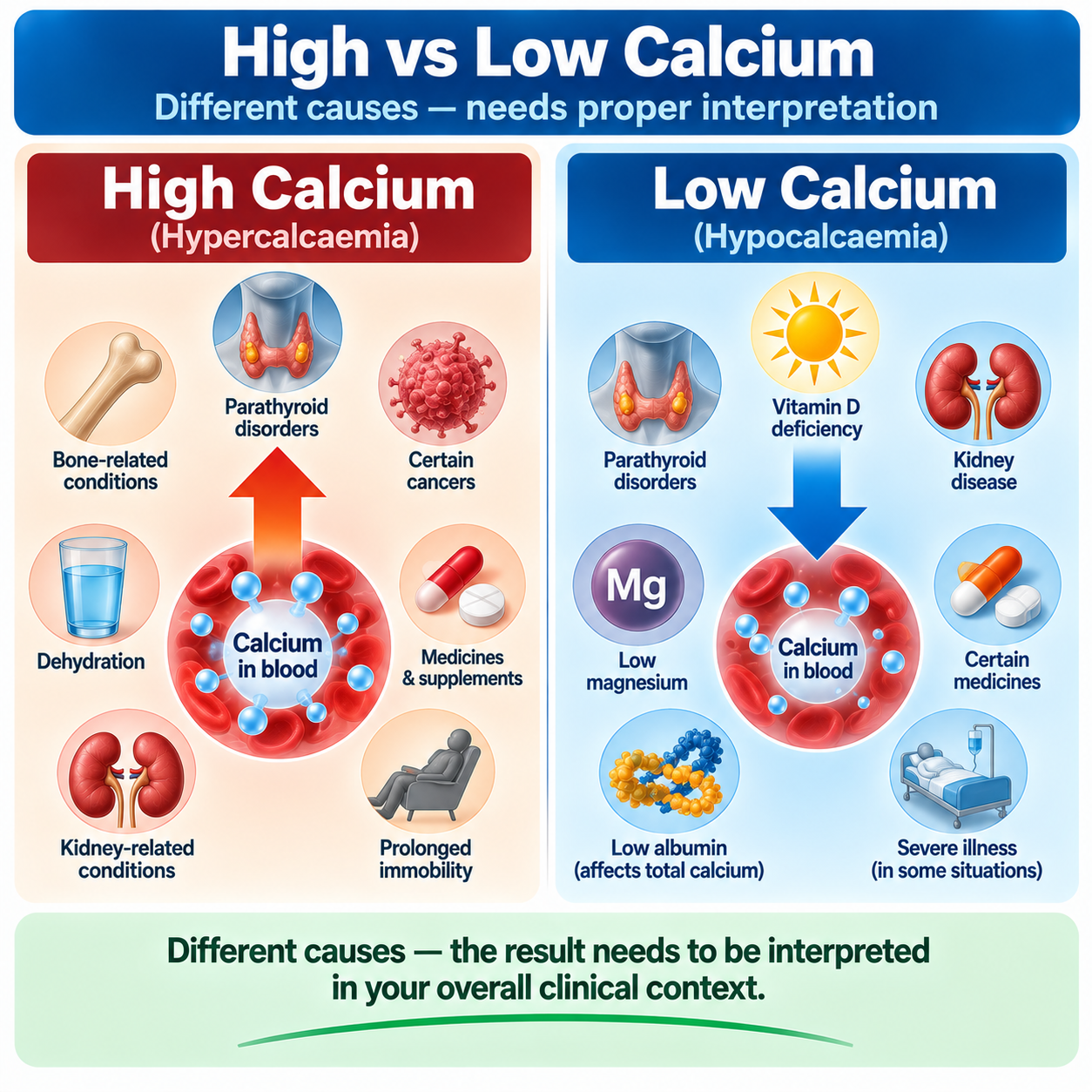
Possible causes or associations include:
- overactivity of one or more parathyroid glands;
- certain cancers;
- excessive calcium or vitamin D exposure in some situations;
- some medicines;
- dehydration, which may influence the measured concentration;
- prolonged immobility in particular circumstances;
- and other less common medical conditions.
Can a Parathyroid Problem Cause High Calcium?
Yes. The parathyroid glands help regulate blood calcium through a hormone called parathyroid hormone — PTH.
Overactivity of the parathyroid glands is an important cause of high blood calcium.
If calcium is persistently high, a doctor may therefore request a PTH blood test. The relationship between calcium and PTH can help determine the likely cause of the abnormal calcium.
Does High Calcium Mean Cancer?
No. Cancer is one possible cause of hypercalcaemia, but a high calcium result does not mean that a patient has cancer.
Other causes include parathyroid disorders, medicines, supplements and other medical conditions.
The cause should be assessed according to the degree and persistence of the abnormality, symptoms, medical history, medicines, and other investigations.
Can Dehydration Affect Calcium?
Yes. Changes in body water can influence measured blood concentrations, and dehydration may contribute to an elevated total calcium result in some situations.
Likewise, do not attempt to correct a high calcium result simply by drinking excessive amounts of water. Some patients have medical conditions that require specific fluid advice.
What Symptoms Can Occur With High Calcium?
Mild hypercalcaemia may cause few or no obvious symptoms.
More significant hypercalcaemia can be associated with symptoms such as increased thirst, passing urine more frequently, constipation, nausea or vomiting, abdominal discomfort, weakness, tiredness, difficulty concentrating, drowsiness, or confusion.
Symptoms are not specific to calcium and can have many other causes. The severity of symptoms can depend on how high the calcium is and how quickly it changed.
What Does Low Calcium Mean?
A calcium result below the relevant laboratory reference range is called hypocalcaemia.
Low calcium can occur for several reasons. Again, interpretation depends on whether total or ionized calcium was measured, albumin, other laboratory results, medicines, symptoms, and the patient's medical condition.
What Can Cause Low Calcium?
Possible causes or associations include:
- vitamin D deficiency;
- reduced parathyroid hormone activity;
- kidney disease;
- low magnesium in some situations;
- certain medicines;
- severe illness;
- changes in blood proteins such as albumin when total calcium is measured;
- and other medical conditions.
Can Vitamin D Deficiency Cause Low Calcium?
Yes. Vitamin D helps the body absorb calcium from the intestine and is involved in calcium balance. Vitamin D deficiency can contribute to low calcium in some patients.
If appropriate, the healthcare professional may request a vitamin D blood test along with other investigations.
Can a Parathyroid Problem Cause Low Calcium?
Yes. Parathyroid hormone plays an important role in maintaining blood calcium. Reduced parathyroid hormone activity can contribute to low calcium.
If clinically appropriate, the healthcare professional may request a PTH test to help investigate the cause.
Why Might Magnesium Be Checked?
Magnesium is another mineral involved in normal body functions and can influence calcium regulation.
In some situations, significantly abnormal magnesium can contribute to calcium abnormalities. Therefore, a doctor may sometimes check magnesium when investigating unexplained or persistent low calcium.
This does not mean that every patient with low calcium needs a magnesium test.
What Is the Relationship Between Calcium and the Kidneys?
The kidneys are involved in maintaining normal mineral and vitamin D balance. Kidney disease can therefore affect calcium regulation, particularly when kidney disease is more advanced.
Kidney function is assessed using other information such as serum creatinine, eGFR, urine testing where appropriate, and the patient's clinical situation.
Why Are Calcium and Phosphate Sometimes Tested Together?
Calcium and phosphate are both important minerals in the body. Their balance is influenced by factors including the kidneys, vitamin D, parathyroid hormone, bones and other processes.
For this reason, calcium and phosphate may be measured together in some clinical situations and in some broader renal profiles.
Why Is Calcium Included in Some Renal Profiles?
Some laboratories include calcium in a broader Renal Profile / Kidney Profile. This is because kidney health is connected with mineral balance, particularly in more advanced kidney disease.
For the broader panel, read Renal Profile / Kidney Profile Explained.
Is Calcium Included in an RFT?
Not necessarily. The term RFT can refer to different combinations of laboratory tests in different settings.
A smaller RFT package may not contain calcium. A broader renal profile may include it.
For details, read RFT / Renal Function Test Explained.
What If My Total Calcium Is Abnormal?
Do not immediately assume that the biologically active calcium is definitely abnormal.
The healthcare professional may consider albumin, whether corrected/adjusted calcium is available, whether ionized calcium is needed, previous calcium results, symptoms, medicines and supplements, kidney function, PTH, vitamin D, phosphate, magnesium, and other investigations where appropriate.
The exact next step depends on the clinical situation.
Why Might an Abnormal Calcium Test Be Repeated?
A calcium test may be repeated when an unexpected abnormality is found, the result does not fit the clinical situation, the healthcare professional wants to confirm whether the abnormality persists, treatment or a medical condition is being monitored, or additional calcium assessment is required.
A trend over time can sometimes provide more useful information than one isolated result.
When Might Ionized Calcium Be Requested?
Ionized calcium may be useful when a direct measurement of biologically active calcium is particularly important.
It may be considered in selected situations where total calcium is difficult to interpret, blood protein levels are significantly abnormal, a patient is seriously ill, or the clinical situation requires more direct calcium assessment.
This does not mean that everyone with an abnormal total calcium needs an ionized calcium test. The healthcare professional should decide which measurement is appropriate.
Can Calcium Supplements Affect the Result?
Yes. Calcium-containing supplements can affect calcium intake and may be relevant when interpreting an abnormal calcium result.
The cause of the abnormality needs to be considered first.
Can Vitamin D Supplements Affect Calcium?
Yes. Vitamin D influences calcium absorption and calcium balance. Vitamin D supplements may therefore be relevant when interpreting calcium results.
Tell the healthcare professional about vitamin D, calcium, multivitamins, and other supplements you take.
Do not change prescribed doses solely because of one calcium result unless instructed.
What If My Calcium Is High but I Have No Symptoms?
Mild hypercalcaemia may sometimes be discovered incidentally during routine blood testing. A person can feel well despite an abnormal result. The absence of symptoms does not determine the cause.
The healthcare professional may consider repeating the test, albumin or adjusted calcium, PTH, medicines and supplements, kidney function, and other investigations, depending on the situation.
What If My Calcium Is Low but I Have No Symptoms?
A mildly low total calcium result may sometimes occur without obvious symptoms.
Its importance depends on whether total or ionized calcium was measured, albumin, how low the result is, whether it persists, other blood tests, medicines, and the patient's medical condition.
An unexpected or persistent low result should be interpreted appropriately rather than treated solely from the number.
What Should I Do If My Calcium Is High?
Do not panic and do not attempt to treat the number yourself. Consider:
- Was total or ionized calcium measured?
- Is corrected/adjusted calcium reported?
- Is albumin also available?
- Has calcium been high before?
- Are you taking calcium, vitamin D or other supplements?
- What medicines are you taking?
- Do you have symptoms?
- What do the other blood tests show?
Discuss the result with the healthcare professional who requested the test when appropriate.
What Should I Do If My Calcium Is Low?
Again, do not automatically start calcium supplements. Consider:
- Was total or ionized calcium measured?
- Is albumin abnormal?
- Is corrected/adjusted calcium available?
- Is the result persistently low?
- Are there symptoms?
- Are vitamin D, PTH, magnesium, phosphate or kidney tests relevant?
- Are medicines contributing?
The appropriate next step depends on the cause.
When Should I Discuss an Abnormal Calcium Result With a Doctor?
Discuss the result with the healthcare professional who requested it particularly when:
- calcium is clearly outside the laboratory reference range;
- the abnormality persists;
- the result has changed significantly from previous measurements;
- you have symptoms;
- you have known kidney, parathyroid or other relevant medical disease;
- you have kidney stones;
- you take calcium or vitamin D supplements;
- you take medicines that may influence calcium;
- or you are unsure why the test was performed.
When Can a Calcium Problem Require Urgent Assessment?
Significant calcium disturbances can sometimes become medically important.
Seek prompt medical assessment when an abnormal calcium result is accompanied by concerning symptoms such as:
- marked confusion or unusual drowsiness;
- seizures;
- severe muscle spasms or cramping;
- severe or worsening weakness;
- fainting;
- significant palpitations or suspected abnormal heart rhythm;
- repeated vomiting with significant illness;
- severe dehydration or inability to maintain fluids;
- or another rapidly worsening medical condition.
If the laboratory or healthcare professional specifically tells you that the calcium result requires urgent assessment, follow that advice.
Do Not Treat the Calcium Number Yourself
Do not automatically respond to an abnormal calcium result by:
- starting calcium supplements;
- stopping calcium supplements;
- taking large amounts of calcium-containing food;
- avoiding all calcium-containing food;
- starting vitamin D;
- stopping prescribed vitamin D;
- drinking excessive amounts of water;
- restricting fluids;
- stopping prescribed medicines;
- or taking another supplement.
The correct response depends on why the calcium result is abnormal.
Related kidney & laboratory topics
Key Points
- A serum calcium test measures calcium in the blood.
- Total calcium is the calcium measurement commonly reported on routine blood tests.
- Some circulating calcium is bound to proteins, especially albumin.
- Ionized calcium measures the free, biologically active calcium.
- Corrected or adjusted calcium is a calculated estimate intended to account for albumin's effect on total calcium.
- Corrected calcium is not the same as directly measuring ionized calcium.
- Total calcium and ionized calcium have different reference ranges.
- Use the reference range printed on your own laboratory report.
- High calcium is called hypercalcaemia. Low calcium is called hypocalcaemia.
- High calcium has several possible causes and does not automatically mean cancer.
- Parathyroid disorders are one important cause of high calcium.
- Vitamin D deficiency can contribute to low calcium, but low calcium does not automatically prove vitamin D deficiency.
- Kidney disease can affect calcium balance, but abnormal calcium does not automatically mean kidney disease.
- Calcium is included in some renal profiles but is not a direct measurement of kidney filtration.
- Calcium is not necessarily included in every RFT.
- PTH, vitamin D, phosphate, magnesium, albumin or ionized calcium may sometimes be useful when investigating an abnormal result.
- One abnormal calcium result does not by itself identify the cause.
- Do not start or stop calcium or vitamin D supplements solely because of one laboratory result.
- Significant calcium abnormalities with concerning symptoms may require prompt medical assessment.