Parathyroid Hormone (PTH) Blood Test: High and Low PTH Results Explained
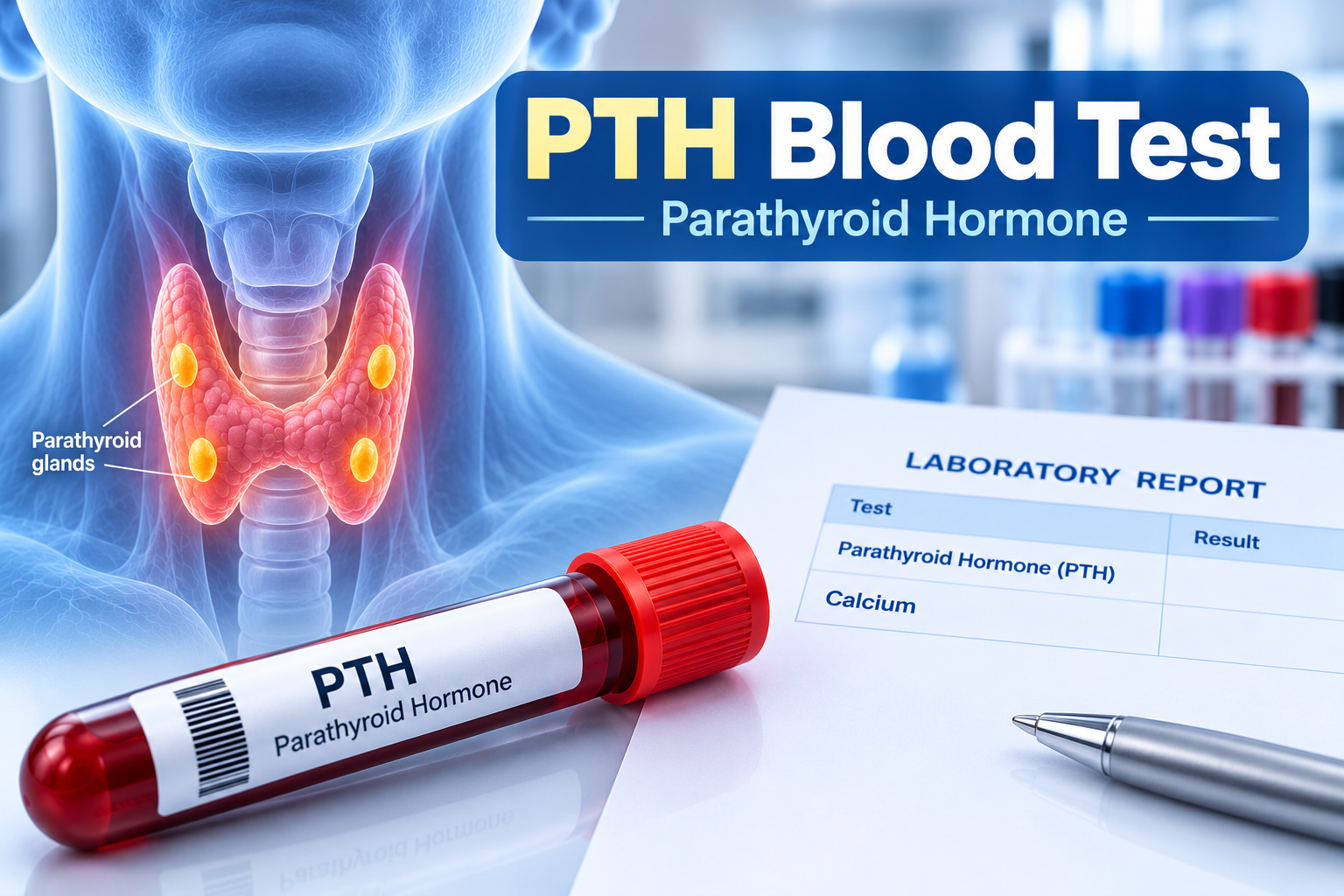
A PTH blood test measures the amount of parathyroid hormone in your blood.
PTH is a hormone made by the parathyroid glands. These are small glands located in the neck, usually behind or close to the thyroid gland. Their main job is to help keep the amount of calcium in your blood within an appropriate range.
That is why the most important rule when reading a PTH result is:
A high, low or even apparently normal PTH result can mean different things depending on your calcium level.
What Is Parathyroid Hormone?
Parathyroid hormone is usually shortened to PTH. It may also be called parathormone, intact PTH, or iPTH.
PTH is released by the parathyroid glands. It plays an important role in controlling calcium and also interacts with phosphate, vitamin D, bones, and the kidneys.
For most patients looking at a laboratory report, however, the most useful starting point is: PTH + calcium.
Are the Parathyroid Glands the Same as the Thyroid?
No. The thyroid gland and parathyroid glands are different glands. They are located close to each other in the neck, but they produce different hormones and perform different jobs.
Thyroid — produces thyroid hormones such as T4 and T3.
Parathyroid glands — produce PTH and play an important role in calcium regulation.
What Does PTH Do to Calcium?
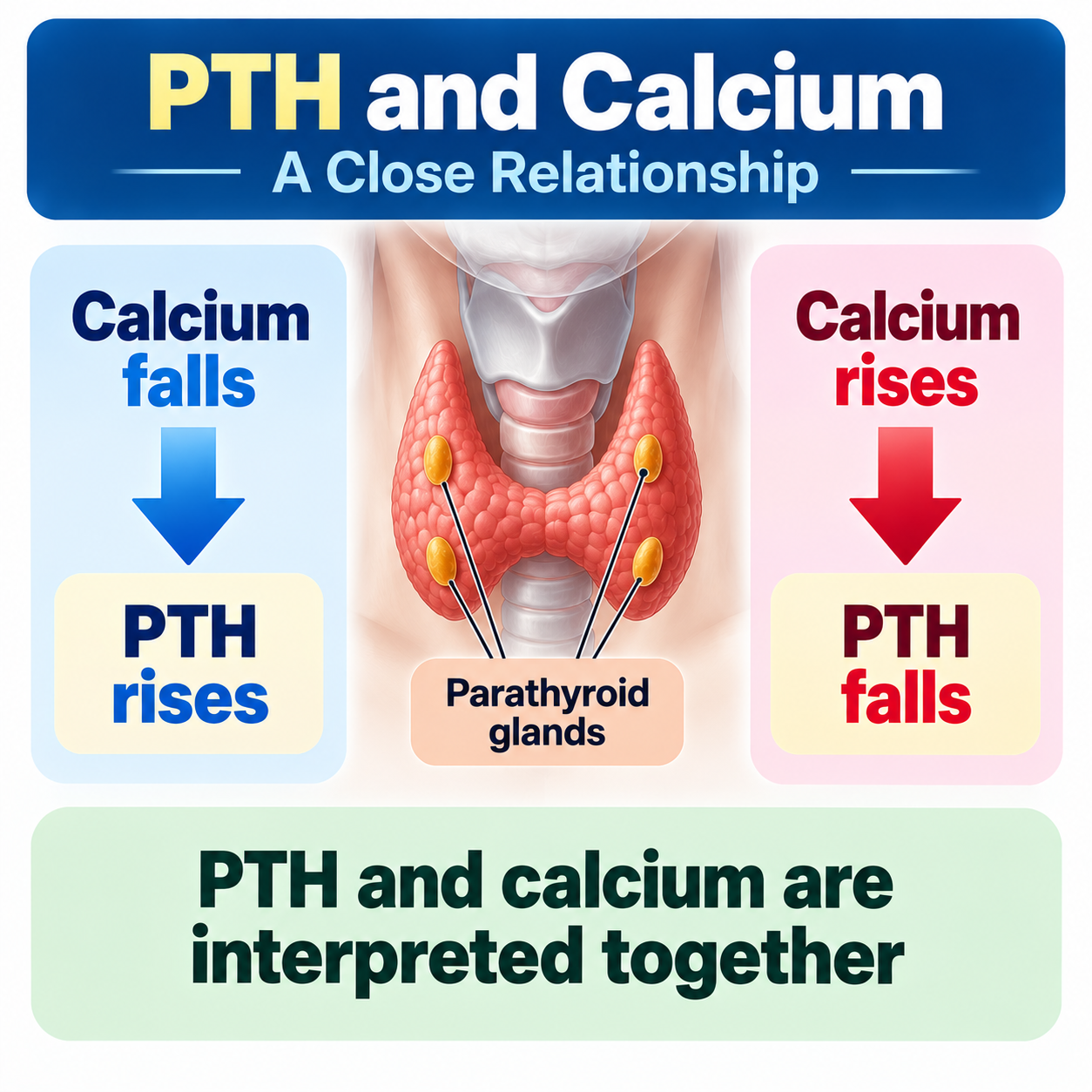
When the calcium level in the blood falls, the parathyroid glands normally respond by releasing more PTH. PTH helps raise the blood calcium level. It does this through effects involving bones, kidneys, and vitamin D, which helps the intestine absorb calcium.
When blood calcium rises, PTH production normally falls. A simple way to remember this is:
This relationship is the key to understanding most PTH results.
Why Might a Doctor Request a PTH Blood Test?
A PTH test may be requested when:
- calcium is high;
- calcium is low;
- a parathyroid problem is suspected;
- kidney disease is present;
- phosphate is abnormal;
- significant bone loss or osteoporosis needs further investigation;
- vitamin D and calcium problems need clarification;
- a known parathyroid condition is being monitored;
- or previous PTH results were abnormal.
One of the most common reasons is to understand why the calcium level is abnormal.
How Is a PTH Test Performed?
A PTH test is performed using a blood sample. A healthcare worker usually takes a small amount of blood from a vein in your arm.
The laboratory report may label the test as PTH, Parathyroid Hormone, Intact PTH, iPTH, or Parathormone. Check the exact test name on your report.
Do I Need to Fast for a PTH Blood Test?
Often no special preparation is needed, but preparation can vary. Some laboratories or clinical situations may require fasting, testing at a particular time, or specific instructions relating to other tests being performed at the same time.
Should I Stop Calcium, Vitamin D or Other Medicines Before a PTH Test?
Do not stop prescribed medicines or supplements unless the healthcare professional managing your care tells you to do so.
Tell them about calcium supplements, vitamin D supplements, prescribed medicines, non-prescription medicines, and other supplements. These may be relevant when your result is interpreted.
How Do I Read My PTH Result?
Start with four things:
- Your PTH result
- The PTH reference range printed by your laboratory
- Your calcium result
- Whether calcium is high, normal or low
Other results may then help explain the pattern. These can include vitamin D, phosphate, magnesium, creatinine, and eGFR. But calcium is usually the most important first companion result.
What Is a Normal PTH Level?
PTH reference ranges vary between laboratories and testing methods. Therefore:
A second important point is: a PTH value inside the laboratory reference range is not always appropriate for the patient's calcium level. This becomes particularly important when calcium is high.
How Can PTH Be “Normal” but Still Be Important?
This is one of the most important concepts in PTH interpretation.
Imagine that your blood calcium is clearly high. Normally, high calcium should tell the parathyroid glands: “Reduce PTH production.” Therefore, PTH would normally be expected to become low or suppressed.
If calcium is high but PTH remains within the laboratory reference range rather than becoming appropriately low, the PTH may be described as inappropriately normal or not appropriately suppressed.
This does NOT mean that every person with high calcium and normal-range PTH has primary hyperparathyroidism. It means:
What Does a High PTH Result Mean?
A high PTH result means the measured parathyroid hormone level is above the laboratory reference range. But high PTH does not have one single meaning.
The first question is: what is the calcium level? High PTH with high calcium can have a different meaning from high PTH with low or normal calcium.
What Does High PTH With High Calcium Mean?
When calcium is high, PTH would normally be expected to fall. Therefore:
An important possible cause is primary hyperparathyroidism. In primary hyperparathyroidism, one or more parathyroid glands produce more PTH than is appropriate.
However, this laboratory pattern does not by itself prove the diagnosis. Doctors may consider repeat calcium, PTH, vitamin D, kidney function, urine calcium, medicines, family history, and other information.
What Is Primary Hyperparathyroidism?
Primary hyperparathyroidism means that the main problem begins in the parathyroid gland or glands themselves. One or more glands produce excessive PTH. This often results in high PTH and high calcium.
A common cause is a benign parathyroid adenoma, which is a non-cancerous growth in one parathyroid gland. Other causes exist. Parathyroid cancer is rare.
The important point for patients reading laboratory results is:
What Does High PTH With Normal Calcium Mean?
This pattern has several possible explanations. PTH may rise because the body is trying to maintain a normal calcium level in the presence of another problem. Possible factors can include vitamin D deficiency, reduced calcium absorption, kidney disease, certain medicines, or other disturbances of calcium balance.
There is also a condition called normocalcaemic primary hyperparathyroidism, in which PTH remains elevated while calcium is normal. However, this diagnosis generally requires other causes of high PTH to be considered and excluded.
What Does High PTH With Low Calcium Mean?
When calcium is low, increasing PTH can be a normal response by the parathyroid glands — the glands are trying to raise the calcium level. Therefore:
Possible reasons include conditions involving vitamin D deficiency, poor calcium absorption, kidney disease, calcium deficiency in some circumstances, or other disturbances of calcium balance. Further investigation may be needed to identify the reason.
What Is Secondary Hyperparathyroidism?
Secondary hyperparathyroidism means the parathyroid glands are producing more PTH because another problem is stimulating them. The original problem is outside the parathyroid glands.
Common clinical situations include chronic kidney disease, vitamin D deficiency, and some problems affecting calcium absorption or balance. In these situations, increased PTH may initially be part of the body's attempt to maintain calcium balance.
Why Can PTH Be High in Kidney Disease?
The kidneys are important in maintaining normal mineral balance and vitamin D metabolism. As chronic kidney disease becomes more advanced, disturbances involving phosphate, calcium, vitamin D, and PTH can develop. PTH may rise as part of this process.
Read eGFR Explained and Serum Phosphate / Phosphorus Test Explained.
What Is Tertiary Hyperparathyroidism?
Tertiary hyperparathyroidism is a more specialized situation. It can develop after prolonged secondary hyperparathyroidism, particularly in some people with advanced kidney disease. The parathyroid glands become persistently overactive and may continue producing excessive PTH.
What Does a Low PTH Result Mean?
A low PTH result means the measured hormone level is below the laboratory reference range. Again, the meaning depends strongly on calcium. Ask: is the calcium high, normal or low?
Low PTH can be an appropriate response when calcium is high. But low PTH can be inappropriate when calcium is low.
What Does Low PTH With High Calcium Mean?
When calcium is high, the normal response of the parathyroid glands is to reduce PTH production. Therefore:
In this situation, doctors generally consider causes of high calcium that are not being driven by excessive PTH. There are many possible causes. The important distinction is:
- High calcium + high/non-suppressed PTH — suggests a PTH-dependent pattern.
- High calcium + suppressed PTH — suggests looking for causes outside excessive PTH production.
What Does Low PTH With Low Calcium Mean?
When calcium is low, the normal response should usually be an increase in PTH. Therefore, low PTH in the presence of low calcium may suggest that the parathyroid glands are not producing an adequate response.
One possible condition is hypoparathyroidism. However, the laboratory pattern still needs clinical assessment. Possible situations associated with inadequate PTH include damage to parathyroid glands during neck surgery, autoimmune disease, certain genetic conditions, significant magnesium abnormalities, and other causes.
What Is Hypoparathyroidism?
Hypoparathyroidism means that the parathyroid glands are producing too little PTH for the body's needs. This can lead to low calcium.
One important cause is damage to or removal of parathyroid tissue during surgery in the neck, particularly operations involving the thyroid or parathyroid glands. Other causes exist. The diagnosis requires more than simply finding one low PTH value.
What If Both PTH and Calcium Are Normal?
If both results are within their relevant reference ranges, this is often reassuring. However, laboratory results should still be interpreted according to why the tests were requested, symptoms, previous results, kidney function, vitamin D, medicines, and other clinical information.
A normal PTH and calcium result does not answer every possible question about bone, kidney or vitamin D health.
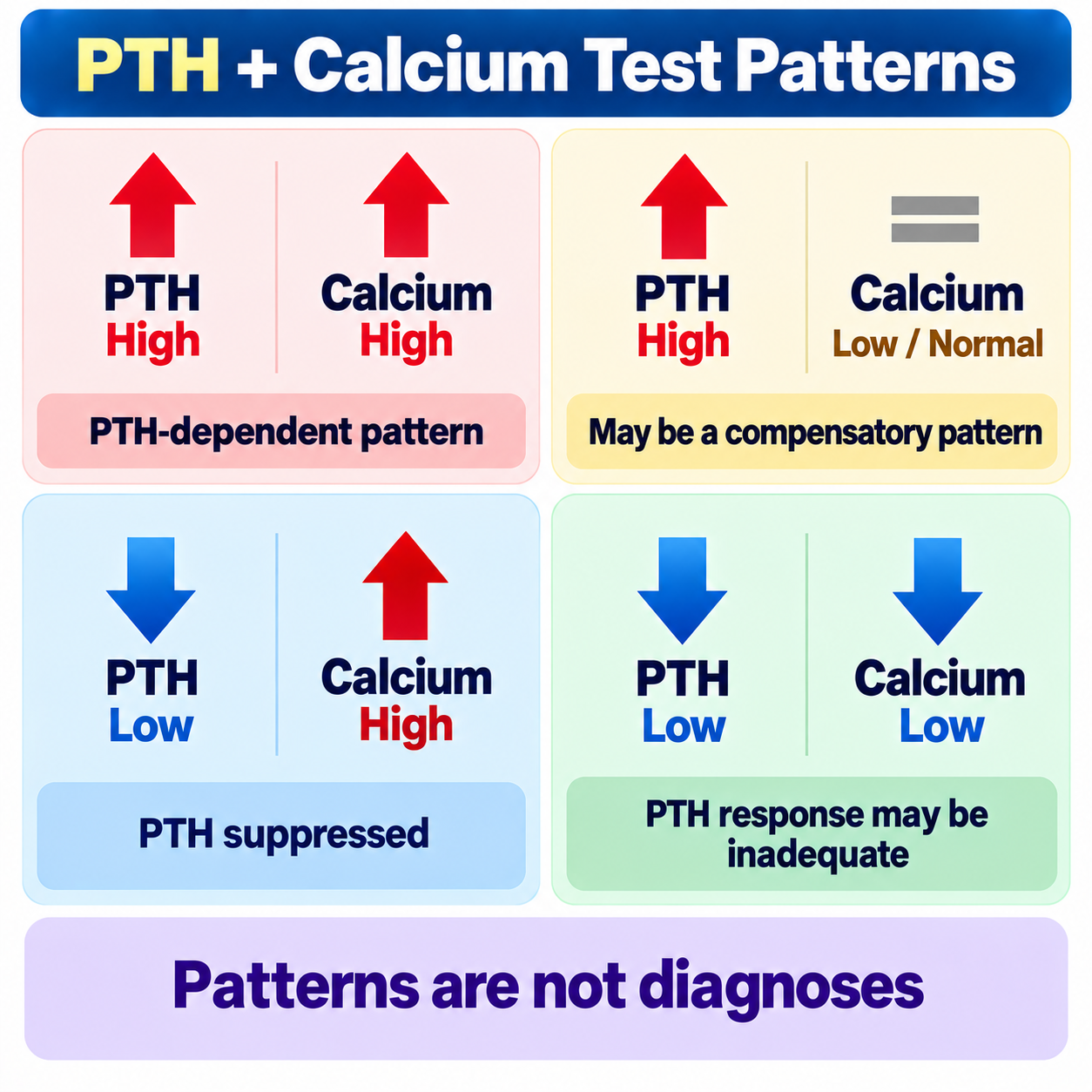
How Are PTH and Calcium Interpreted Together?
Use this patient-friendly table.
| PTH | Calcium | General Meaning |
|---|---|---|
| High or not suppressed | High | PTH-dependent high-calcium pattern; primary hyperparathyroidism is an important possibility |
| High | Normal | Several possibilities; vitamin D, kidney function and other causes should be considered |
| High | Low | PTH may be responding appropriately to low calcium; look for the underlying reason |
| Low | High | PTH may be appropriately suppressed; consider non-PTH causes of high calcium |
| Low or inappropriately normal | Low | PTH response may be inadequate; hypoparathyroidism and other causes may need assessment |
| Normal | Normal | Often reassuring, but interpret according to the clinical reason for testing |
Which Calcium Result Is Used With PTH?
Many patients have a total serum calcium result. Total calcium is influenced partly by blood proteins such as albumin. In some clinical situations, doctors may consider albumin-adjusted/corrected calcium, or directly measured ionized calcium. The appropriate choice depends on the clinical situation and local laboratory practice.
Read Serum Calcium Test Explained for a fuller explanation.
Why Is Vitamin D Checked When PTH Is High?
Vitamin D helps the body maintain calcium balance. When vitamin D is low, calcium absorption can be reduced. The body may respond by increasing PTH to help maintain blood calcium. Therefore:
This is particularly important when calcium is normal or low. However: high PTH does not automatically mean vitamin D deficiency.
Why Might Phosphate Be Checked With PTH?
PTH also affects phosphate balance. Therefore, phosphate can provide additional information when doctors are investigating parathyroid disorders, calcium abnormalities, kidney disease, or vitamin D/mineral problems.
Do not expect phosphate to move in a simple opposite direction to calcium in every patient.
Why Can Magnesium Matter When PTH or Calcium Is Abnormal?
Magnesium can affect PTH secretion and calcium balance. Significant magnesium deficiency can sometimes interfere with normal PTH secretion or action and contribute to low calcium.
Magnesium may be checked when calcium is low, PTH is unexpectedly low or inappropriate, or the laboratory pattern is difficult to explain. However: an abnormal PTH result does not automatically mean magnesium is abnormal.
Why Is Kidney Function Important?
Kidney disease can significantly change the relationship between PTH, calcium, phosphate, and vitamin D. This is particularly important in chronic kidney disease. Doctors may therefore consider serum creatinine, eGFR, phosphate, calcium, vitamin D, and PTH together.
Why Might a Urine Calcium Test Be Requested?
In selected patients with high calcium and a PTH pattern suggesting a parathyroid-related cause, doctors may measure calcium in the urine. This can provide additional information about how the body is handling calcium. It can also help doctors distinguish between certain causes of high blood calcium.
Not everyone with an abnormal PTH needs a urine calcium test.
Why Might PTH or Calcium Be Repeated?
Repeat testing may be useful when a result is unexpected, calcium is abnormal, PTH does not fit the calcium level, an abnormality needs confirmation, vitamin D deficiency or another contributing factor is being assessed, kidney function changes, or a known parathyroid condition is being monitored.
The timing depends on the clinical situation.
Do I Need a Parathyroid Scan Because My PTH Is High?
Not automatically. This is an important patient misconception.
Blood tests are used to establish whether the biochemical pattern suggests a parathyroid disorder. Imaging tests such as ultrasound or nuclear medicine scans may later be used in selected patients, particularly when planning treatment. But imaging is not simply a screening test for every high PTH result.
Does High PTH Mean I Need Parathyroid Surgery?
No. High PTH has several possible causes. Treatment depends on the cause, calcium level, kidney function, vitamin D, symptoms, complications, and other clinical information.
Some patients with confirmed primary hyperparathyroidism may eventually benefit from surgery. But:
Can High or Low PTH Cause Symptoms?
Symptoms usually relate more to the resulting calcium disturbance or underlying disease than to the PTH number itself.
High calcium may be associated with symptoms such as thirst, increased urination, constipation, nausea, weakness, tiredness, or confusion when more severe.
Low calcium may be associated with tingling, muscle cramps, muscle spasms, or more serious neurological or heart-related symptoms when severe.
Many people with abnormal PTH or calcium can also have few or no obvious symptoms. Symptoms alone cannot diagnose a PTH disorder.
Does One High PTH Result Mean I Have Hyperparathyroidism?
No. A high PTH result must be interpreted with calcium, kidney function, vitamin D, phosphate, magnesium where relevant, medicines, symptoms, and previous results. The reason for the PTH elevation must be identified.
Does One Low PTH Result Mean I Have Hypoparathyroidism?
No. If calcium is high, a low PTH may simply represent the body's normal attempt to reduce calcium. Low PTH becomes particularly important when calcium is also low and PTH is not responding appropriately. Therefore:
What Should I Do if My PTH Is High?
Start by checking:
- What is my calcium level?
- Is calcium high, normal or low?
- What is my vitamin D level, if measured?
- What is my kidney function?
- Is phosphate abnormal?
- Am I taking calcium or vitamin D supplements?
- Is this the first abnormal PTH result?
- Have I had previous calcium abnormalities?
Discuss a persistent or clearly abnormal result with the healthcare professional who requested the test.
What Should I Do if My PTH Is Low?
Again, check calcium.
If calcium is high — PTH may be appropriately suppressed.
If calcium is low — the PTH response may be inadequate and requires proper assessment.
Also tell the healthcare professional if you have had thyroid or other neck surgery, significant magnesium abnormalities, calcium or vitamin D treatment, or symptoms of low calcium.
My PTH Is “Normal” but Calcium Is High. Is Everything Fine?
Not necessarily. When calcium is high, PTH would normally be expected to become low. Therefore, a PTH value that remains within the laboratory reference range may still be inappropriate if it is not sufficiently suppressed.
This is an important reason not to interpret the PTH result only by checking whether the laboratory has marked it “normal.”
When Should I Discuss a PTH Result With a Doctor?
Medical advice is particularly appropriate when:
- PTH is clearly outside the laboratory reference range;
- calcium is high or low;
- PTH and calcium do not appear to fit together;
- abnormalities persist;
- you have chronic kidney disease;
- vitamin D is significantly abnormal;
- you have had thyroid or parathyroid surgery;
- kidney stones are recurrent;
- significant osteoporosis is present;
- or you are unsure why the test was requested.
When Can Calcium and PTH Problems Require Urgent Assessment?
The PTH number itself is rarely the only reason for emergency care. However, severe calcium disturbances can be dangerous.
Seek prompt medical assessment if an abnormal calcium/PTH result occurs with symptoms such as:
- severe confusion;
- collapse or fainting;
- seizures;
- severe muscle spasms;
- marked weakness;
- significant palpitations;
- serious breathing difficulty;
- repeated vomiting with worsening illness;
- or another rapidly deteriorating condition.
Do Not Treat the PTH Number Yourself
Do not automatically:
- start high-dose vitamin D, or stop vitamin D;
- start or stop calcium supplements, or severely restrict dietary calcium;
- take phosphate supplements, or take magnesium to correct PTH;
- diagnose primary hyperparathyroidism, secondary hyperparathyroidism, or hypoparathyroidism;
- request surgery based on PTH alone;
- or assume a normal-range PTH is always normal when calcium is high.
Related mineral and endocrine topics
Key Points
- PTH stands for parathyroid hormone, made by small parathyroid glands in the neck — different from the thyroid gland.
- PTH plays an important role in maintaining blood calcium. Low calcium normally stimulates PTH; high calcium normally suppresses it.
- PTH should usually be interpreted together with calcium. High PTH does not have one single meaning.
- High PTH + high calcium can suggest a PTH-dependent high-calcium pattern; primary hyperparathyroidism is an important possibility.
- High PTH + normal calcium has several possible explanations. High PTH + low calcium can represent an appropriate response to low calcium.
- Vitamin D deficiency and chronic kidney disease can both contribute to elevated PTH (secondary hyperparathyroidism).
- Low PTH + high calcium can represent appropriate PTH suppression. Low or inadequate PTH + low calcium may suggest hypoparathyroidism or another problem.
- A PTH result inside the laboratory range can still be inappropriate when calcium is high.
- Kidney function, vitamin D, phosphate and sometimes magnesium help explain PTH abnormalities.
- One abnormal PTH result does not diagnose the cause. A high PTH result does not automatically mean a parathyroid scan or surgery is needed.
- Do not change calcium or vitamin D treatment based on one PTH result.