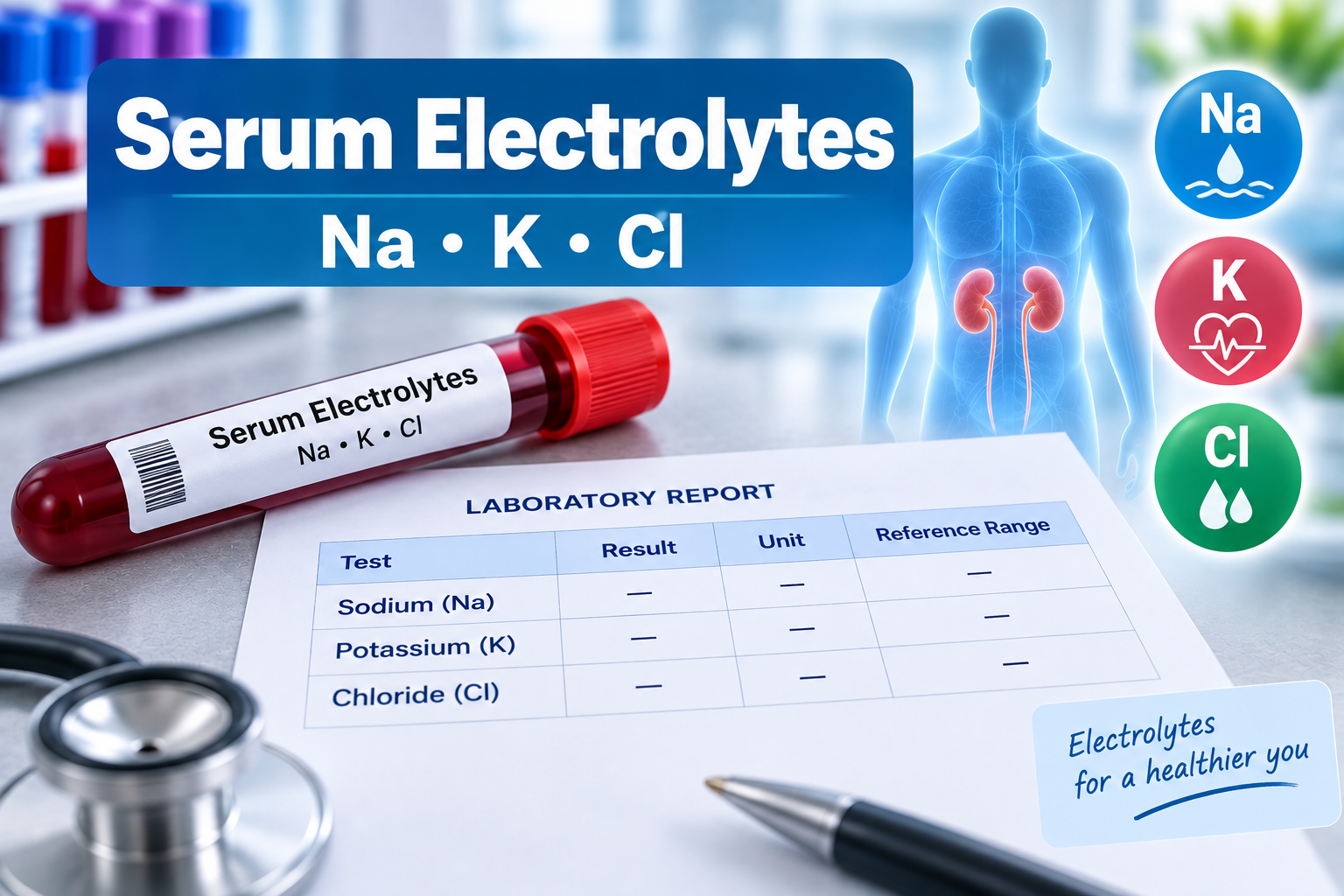
Serum Electrolytes Test Explained: Sodium, Potassium and Chloride
A serum electrolyte test is a blood test that measures important electrically charged minerals in your blood.
If your doctor has requested serum electrolytes, the report commonly includes:
- Sodium — Na
- Potassium — K
- Chloride — Cl
Depending on the laboratory or the test package requested, other measurements such as bicarbonate or total CO₂ may also appear.
Electrolytes are involved in important functions including maintaining the body's fluid balance and supporting normal nerve and muscle function.
However, an electrolyte result should not be interpreted by itself.
A high or low result can occur for many different reasons.
What Is a Serum Electrolyte Test?
The serum electrolyte test measures the concentration of certain electrolytes in the blood.
The three results that patients commonly see are:
| Report name | Abbreviation |
|---|---|
| Sodium | Na |
| Potassium | K |
| Chloride | Cl |
Some laboratory panels may also report:
- bicarbonate;
- total CO₂;
- or additional electrolytes.
The exact combination can vary between laboratories and test packages.
Therefore, always look at the individual test names actually printed on your report.
Why Are Serum Electrolytes Tested?
Doctors may request serum electrolytes for many reasons.
The test may be performed:
- as part of a general blood-test assessment;
- as part of an RFT or renal profile;
- when dehydration or excessive fluid loss is suspected;
- after significant vomiting or diarrhoea;
- when a patient is seriously unwell;
- when kidney-related problems are being assessed;
- when certain medicines are being used;
- when an electrolyte abnormality is already known and needs monitoring;
- or when symptoms could possibly be related to an electrolyte disturbance.
Serum electrolytes are therefore useful in many different medical situations.
Are Electrolytes Part of an RFT or Renal Profile?
Sometimes.
Some broader kidney-related blood-test packages include serum electrolytes.
However, the term RFT does not always refer to exactly the same group of tests.
If your request says only RFT, read RFT / Renal Function Test Explained.
A broader Renal Profile / Kidney Profile commonly includes kidney-related blood tests and may include serum electrolytes.
Read Renal Profile / Kidney Profile Explained.
How Is a Serum Electrolyte Test Done?
Serum electrolytes are usually measured from a blood sample.
A healthcare worker takes a small amount of blood from a vein, usually in the arm.
The laboratory then measures the electrolytes requested.
The report normally shows:
- the name of the electrolyte;
- your result;
- the unit;
- the laboratory reference range.
Do I Need to Fast for a Serum Electrolyte Test?
Usually, no special preparation is required just for a standard electrolyte panel.
However, serum electrolytes are often performed together with other blood tests.
Those other investigations may have their own preparation or fasting requirements.
Therefore:
Do not assume that you can eat simply because serum electrolytes alone usually do not require fasting if another requested test requires fasting.
Should I Drink Extra Water Before the Test?
Do not deliberately drink unusually large amounts of water simply to try to improve your blood-test results.
Your fluid balance can affect some electrolyte results.
Unless a healthcare professional has given you specific instructions, follow your usual appropriate fluid intake.
Patients who have been medically advised to restrict fluids should continue to follow their medical instructions.
Should I Stop My Medicines Before an Electrolyte Test?
No medicine should be stopped simply because you are having an electrolyte test unless a healthcare professional has specifically advised you to do so.
Many medicines can influence electrolyte levels.
Examples include some:
- diuretics or “water tablets”;
- blood-pressure medicines;
- medicines affecting hormones or kidney function;
- and other prescription or non-prescription medicines.
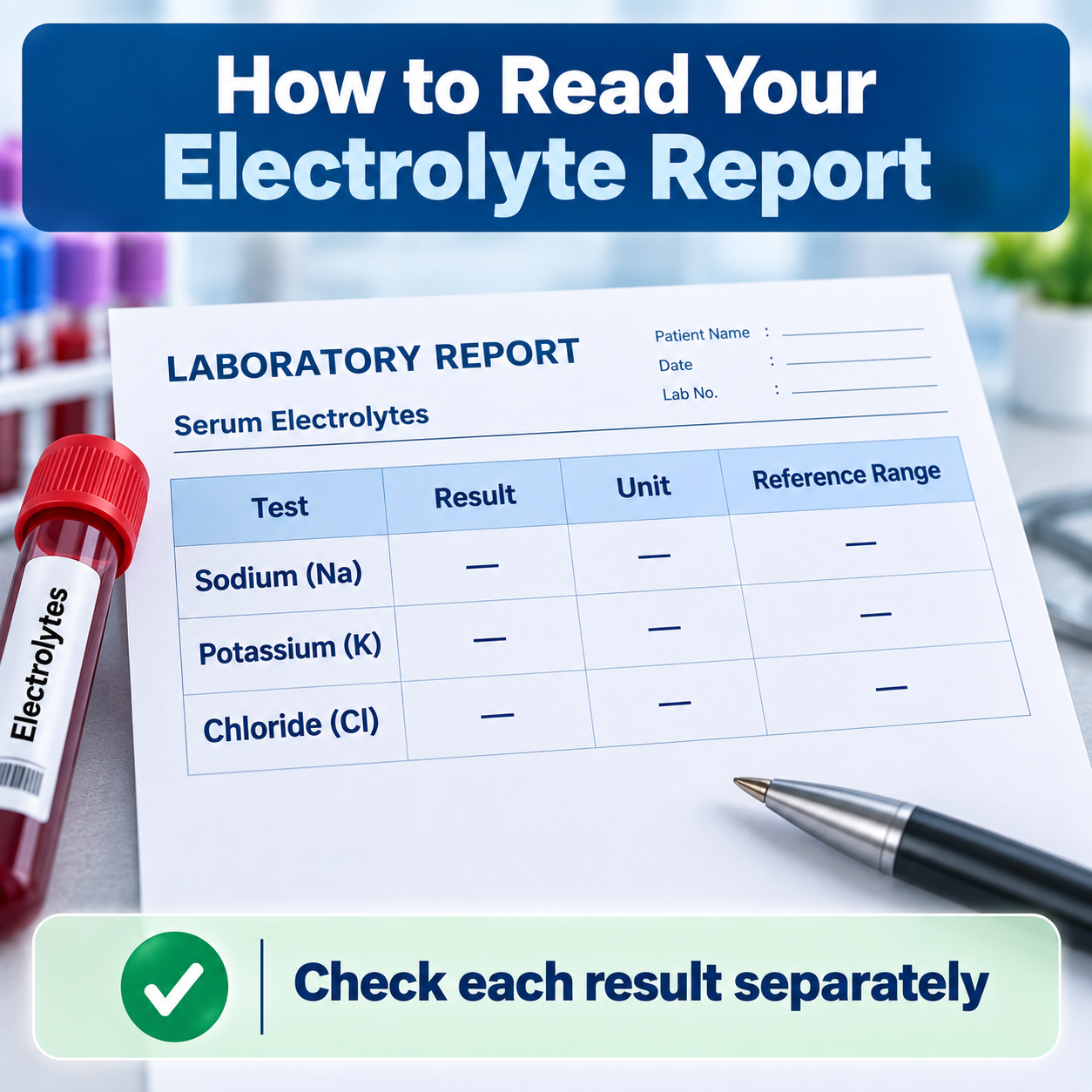
How Do I Read a Serum Electrolyte Report?
Look at each result separately.
For example:
| Test | Result | Unit | Reference range |
|---|---|---|---|
| Sodium (Na) | Your result | Laboratory unit | Laboratory range |
| Potassium (K) | Your result | Laboratory unit | Laboratory range |
| Chloride (Cl) | Your result | Laboratory unit | Laboratory range |
The patient should compare each result with the reference range printed by that laboratory.
Reference ranges and reporting conventions can differ slightly between laboratories.
Therefore:
Sodium, Potassium and Chloride
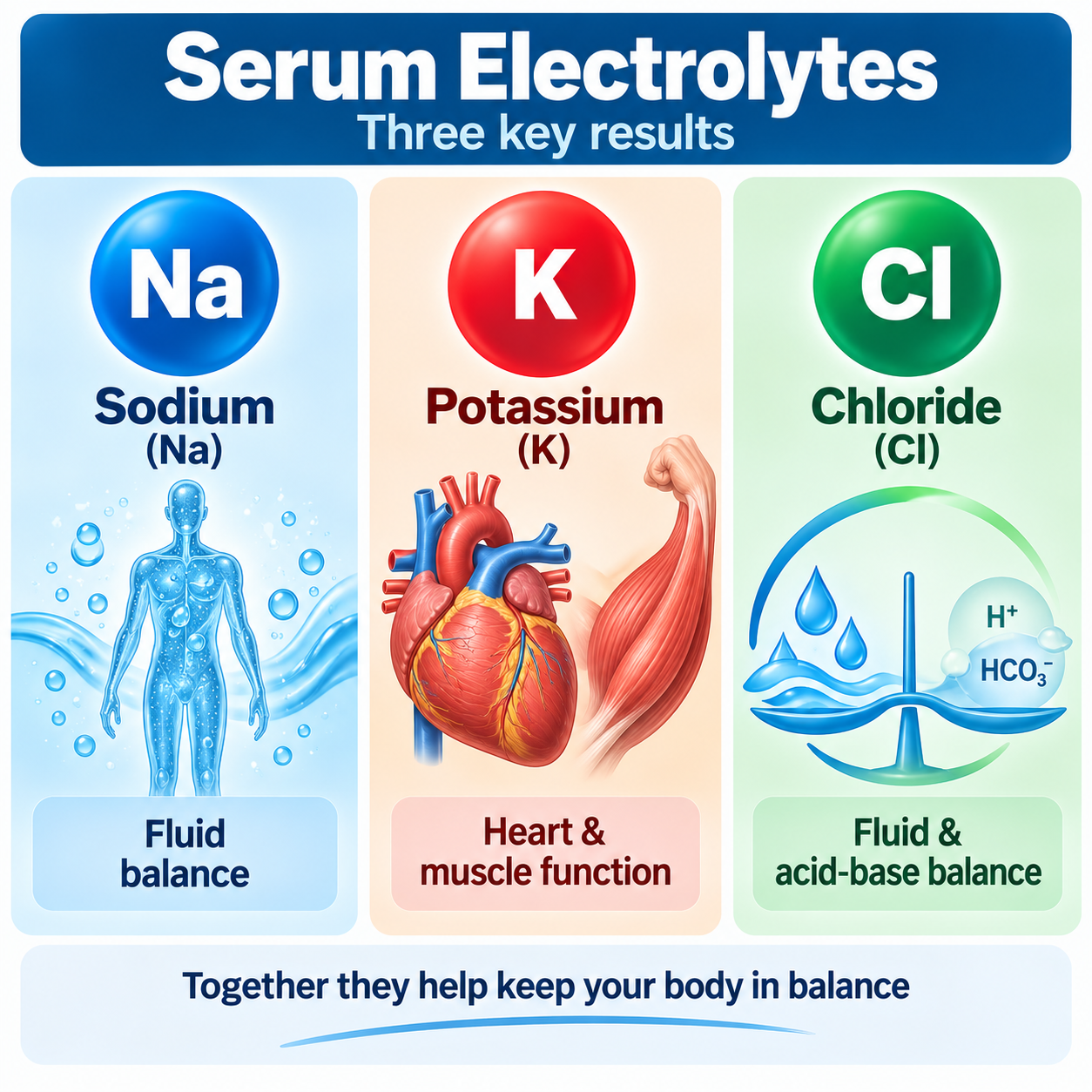
The following sections explain what each of these commonly reported results means.
Sodium — Na
Sodium is one of the main electrolytes measured in blood.
It is closely related to the balance between sodium and water in the body and also contributes to normal nerve and muscle function.
A sodium result should therefore not simply be thought of as “how much salt you ate.”
The result reflects a more complicated balance involving body water and the way the body handles sodium.
What Does a Low Sodium Result Mean?
A sodium level below the laboratory reference range is called hyponatraemia.
Low sodium can occur for many different reasons.
Examples include:
- loss of sodium and fluid through vomiting or diarrhoea;
- some medicines, including certain diuretics;
- conditions that cause the body to retain too much water;
- some kidney, heart or liver conditions;
- certain hormonal disorders;
- and other medical conditions.
The actual cause cannot be determined from the sodium number alone.
Do not increase salt intake or change fluid intake as treatment without appropriate medical advice.
What Does a High Sodium Result Mean?
A sodium level above the laboratory reference range is called hypernatraemia.
High sodium often occurs when there is too little water in relation to the amount of sodium in the body.
Possible situations include:
- dehydration;
- inadequate water intake;
- significant fluid loss;
- vomiting or diarrhoea;
- certain kidney or hormonal conditions;
- and other medical problems.
A high sodium result does not necessarily mean that the person simply ate too much salt.
The clinical situation needs to be considered.
Potassium — K
Potassium is an important electrolyte needed for normal cell, nerve and muscle function.
It is particularly important for normal heart and muscle activity.
The kidneys play an important role in controlling the amount of potassium in the body, but kidney disease is only one possible reason for an abnormal potassium result.
What Does a Low Potassium Result Mean?
A potassium level below the laboratory reference range is called hypokalaemia.
Possible causes include:
- vomiting;
- diarrhoea;
- some diuretic medicines;
- other medicines;
- certain hormonal conditions;
- inadequate potassium intake in some situations;
- and other causes.
Low potassium may sometimes cause:
- weakness;
- muscle cramps;
- tiredness;
- constipation;
- or abnormal heart rhythm.
Symptoms depend partly on how low the potassium is and how quickly the change occurred.
What Does a High Potassium Result Mean?
A potassium level above the laboratory reference range is called hyperkalaemia.
Possible causes include:
- reduced ability of the kidneys to remove potassium;
- certain medicines;
- some hormonal or metabolic conditions;
- movement of potassium out of cells;
- and other medical problems.
High potassium can sometimes affect the heart's electrical activity.
Can a Potassium Result Be Falsely High?
Yes.
This is an especially important point when interpreting potassium.
Sometimes potassium appears high because blood cells were damaged during or after collection of the sample. This is commonly called haemolysis.
Other sample-collection or handling problems can also affect the result.
Therefore, if an unexpected high potassium result does not fit the clinical situation, the healthcare professional may decide that the test needs to be repeated.
Chloride — Cl
Chloride is another major electrolyte in the blood.
It works closely with sodium and other electrolytes and contributes to the body's fluid and acid-base balance.
Chloride is usually interpreted together with the other electrolyte results rather than as an isolated number.
What Does a Low Chloride Result Mean?
A chloride level below the laboratory reference range is called hypochloraemia.
It can occur in several situations, including:
- prolonged vomiting;
- changes in body fluid balance;
- some medicines;
- certain acid-base disturbances;
- and other medical conditions.
The chloride result should therefore be interpreted together with sodium, potassium and other relevant blood tests.
What Does a High Chloride Result Mean?
A chloride level above the laboratory reference range is called hyperchloraemia.
It may occur with:
- dehydration or changes in body water;
- certain acid-base disturbances;
- some kidney-related conditions;
- administration of certain intravenous fluids;
- and other medical situations.
Again, a high chloride result by itself does not identify the cause.
What About Bicarbonate or CO₂?
Some electrolyte reports also include a result labelled:
- bicarbonate;
- HCO₃;
- CO₂;
- or total CO₂.
This measurement provides information related to the body's acid-base balance.
However, not every serum-electrolyte report contains it.
What Does “Electrolyte Imbalance” Mean?
An electrolyte imbalance simply means that one or more electrolyte levels are outside the expected range.
For example:
- sodium may be too low or too high;
- potassium may be too low or too high;
- chloride may be too low or too high.
The term electrolyte imbalance is not a diagnosis of the cause.
The next question is why the abnormality occurred.
That may require consideration of:
- symptoms;
- fluid intake and fluid loss;
- vomiting or diarrhoea;
- medicines;
- kidney function;
- other illnesses;
- previous results;
- and sometimes additional laboratory tests.
Does an Abnormal Electrolyte Result Mean Kidney Disease?
No.
The kidneys are important in maintaining electrolyte balance, so kidney-related problems can affect electrolytes.
But many other situations can also cause abnormal electrolyte results.
Examples include:
- dehydration;
- excessive fluid intake;
- vomiting;
- diarrhoea;
- medicines;
- heart or liver conditions;
- hormonal disorders;
- serious illness;
- and other causes.
If kidney function is being assessed, results such as creatinine and eGFR may also need to be considered.
Read Serum Creatinine Test Explained.
Also see eGFR Explained.
Can Dehydration Affect Electrolytes?
Yes.
Changes in the amount of water in the body can affect electrolyte concentrations.
Vomiting, diarrhoea, fever, poor fluid intake, heavy fluid losses and other situations may alter fluid and electrolyte balance.
However, an abnormal result should not automatically be labelled as dehydration without considering the patient's situation.
Can Drinking Too Much Water Affect Electrolytes?
Yes.
Excessive water intake can disturb normal fluid and electrolyte balance.
This is another reason not to deliberately drink excessive amounts of water before a blood test unless medically instructed.
Can Medicines Affect Electrolyte Results?
Yes.
Several medicines can raise or lower electrolyte levels.
This is especially relevant for:
- diuretics;
- some blood-pressure medicines;
- medicines that influence kidney function;
- some hormonal medicines;
- and other drugs.
Do not stop a medicine because an electrolyte result is abnormal unless instructed by the healthcare professional responsible for your treatment.
What If Only One Electrolyte Is Abnormal?
One abnormal result does not automatically establish a diagnosis.
The healthcare professional may consider:
- how far the result is outside the laboratory range;
- whether you have symptoms;
- the other electrolyte results;
- kidney-function results;
- medicines;
- previous blood tests;
- recent vomiting or diarrhoea;
- fluid balance;
- and whether the result might have been affected by sample collection or handling.
Sometimes repeat testing is appropriate. In other situations, an abnormal result may require immediate assessment.
What If Several Electrolytes Are Abnormal?
The pattern of several abnormal results may provide more useful information than one isolated number.
However, patients should not attempt to diagnose the cause from the pattern alone.
The results should be interpreted together with the clinical situation.
Have Your Sodium, Potassium or Chloride Results?
Use the Electrolyte Result Interpreter. Enter your laboratory results to receive educational information about the values.
When Should I Discuss an Abnormal Electrolyte Result With a Doctor?
Discuss an abnormal electrolyte result with the healthcare professional who requested the test, particularly when:
- the result is clearly outside the laboratory range;
- the abnormality is new;
- several electrolytes are abnormal;
- you have kidney, heart, liver or hormonal disease;
- you are taking medicines that can affect electrolytes;
- you have ongoing vomiting or diarrhoea;
- or you feel unwell.
The urgency depends on the electrolyte involved, how abnormal the result is, symptoms, previous results and the patient's overall medical condition.
When Can an Electrolyte Problem Be Urgent?
Some electrolyte disturbances can become medically important or even dangerous.
Seek prompt medical assessment if an abnormal electrolyte result is accompanied by symptoms such as:
- significant confusion or altered consciousness;
- seizures;
- severe or worsening weakness;
- fainting;
- marked palpitations or suspected abnormal heart rhythm;
- severe persistent vomiting or diarrhoea;
- or another serious deterioration in the person's condition.
A significantly abnormal potassium result can be particularly important because potassium disturbances can affect heart rhythm.
If the laboratory or healthcare professional has specifically instructed you to obtain urgent medical care because of a result, follow that advice.
Do Not Try to Correct an Electrolyte Result by Yourself
Do not respond to an abnormal result by automatically:
- drinking excessive water;
- restricting water;
- eating large amounts of salt;
- avoiding all salt;
- taking potassium supplements;
- stopping potassium-containing foods;
- taking electrolyte drinks;
- stopping prescribed medicines;
- or starting supplements.
The correct approach depends on why the result is abnormal.
The same laboratory abnormality can occur for different reasons and may require different management.
Serum Electrolytes on a Renal Profile
Serum electrolytes commonly appear as part of broader kidney-related laboratory testing.
If your report also contains:
- creatinine;
- eGFR;
- blood urea/BUN;
- calcium;
- phosphate;
- uric acid;
use the dedicated Renal Profile / Kidney Profile Explained.
For individual results also see:
Related kidney & laboratory topics
Key Points
- Serum electrolytes are blood tests measuring important electrolytes in the blood.
- Sodium, potassium and chloride are commonly reported together.
- Some electrolyte panels also include bicarbonate or total CO₂.
- Sodium is closely related to body water and sodium balance.
- Potassium is important for normal heart, nerve and muscle function.
- Chloride works with other electrolytes in maintaining fluid and acid-base balance.
- High or low electrolyte results can have many different causes.
- An abnormal electrolyte result does not automatically mean kidney disease.
- Vomiting, diarrhoea, dehydration, fluid changes, medicines and several medical conditions can affect electrolyte levels.
- A falsely high potassium can sometimes occur because of problems with the blood sample, including haemolysis.
- Never assume an abnormal potassium result is only a sample error.
- Use the reference range printed on your own laboratory report.
- Do not try to correct abnormal electrolytes yourself with salt, water, food, supplements or medication changes.
- Significant electrolyte abnormalities or concerning symptoms may require prompt medical assessment.