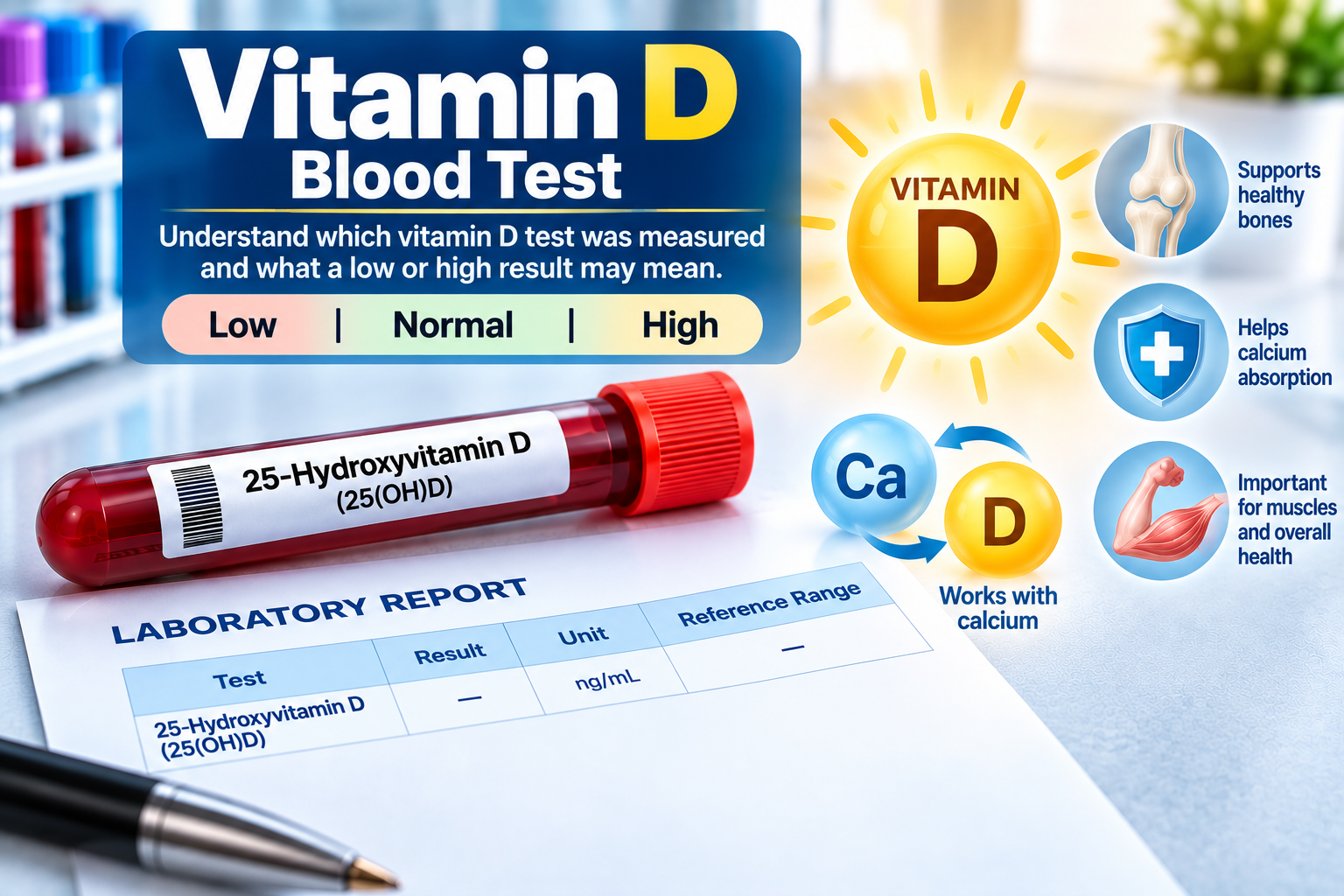
Vitamin D Blood Test Explained: Low and High Results
A vitamin D blood test measures a form of vitamin D in your blood.
The most commonly used test for assessing vitamin D status is 25-hydroxyvitamin D. It may appear on a laboratory report as 25-Hydroxyvitamin D, 25-OH Vitamin D, 25(OH)D, Vitamin D, 25-Hydroxy, or a similar laboratory name.
This distinction matters because there is another blood test called 1,25-dihydroxyvitamin D. These two tests are not interchangeable.
Why Is Vitamin D Important?
Vitamin D helps the body absorb calcium and is important for maintaining healthy bones. It also has roles in normal muscle, nerve and other body functions.
Vitamin D in the body comes from production in the skin after sunlight exposure, food, and supplements.
Before vitamin D can perform its biological functions, it undergoes processing in the body. For understanding a routine vitamin D laboratory report, however, the most important point is that 25-hydroxyvitamin D is usually the blood test used to assess vitamin D status.
What Is 25-Hydroxyvitamin D?
25-hydroxyvitamin D — 25(OH)D is the main circulating form used to assess the body's vitamin D status. It reflects vitamin D obtained from sunlight-related production, food, and supplements.
This is generally the test patients mean when they say “I had my vitamin D level checked.”
What Is 1,25-Dihydroxyvitamin D?
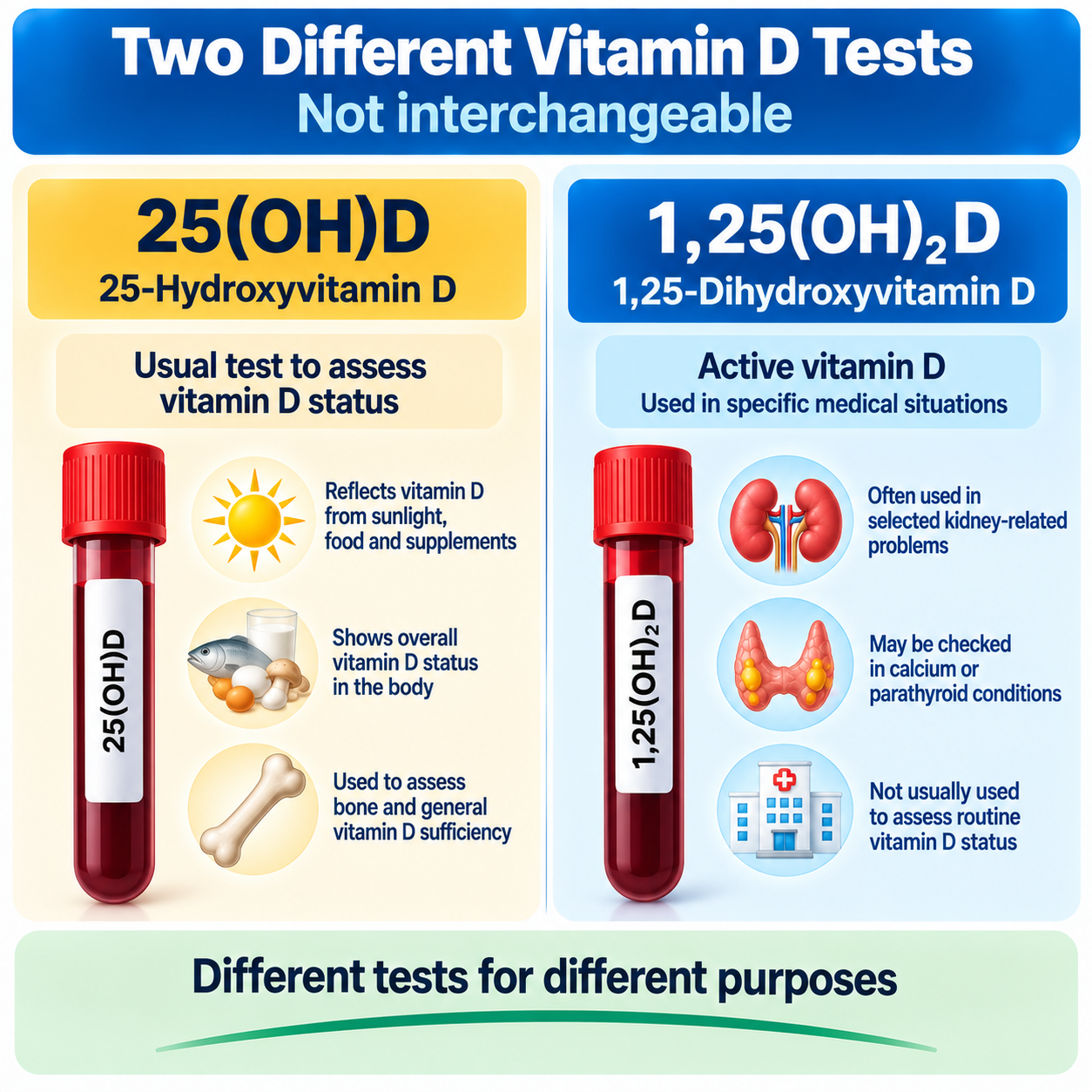
Another vitamin D blood test measures 1,25-dihydroxyvitamin D. This may also be called 1,25(OH)₂D, calcitriol, or active vitamin D.
It is a different test. It is not usually the preferred test for determining whether your body's vitamin D stores/status are adequate.
Doctors may request it in selected situations, including certain kidney-related problems, calcium abnormalities, parathyroid-related problems, or other specific medical conditions.
Do not order either test yourself.
Why Might a Vitamin D Blood Test Be Requested?
A healthcare professional may request a 25-hydroxyvitamin D test when vitamin D deficiency or another vitamin-D-related problem is clinically suspected. Examples of situations where testing may be considered include:
- bone-health problems;
- suspected osteomalacia or rickets;
- unexplained abnormalities in calcium;
- certain conditions affecting absorption from the intestine;
- selected kidney or liver conditions;
- certain medicines;
- monitoring of an established vitamin D problem or treatment;
- or other clinical circumstances where vitamin D status is relevant.
The reason for testing should be considered when interpreting the result.
Does Everyone Need a Vitamin D Blood Test?
No. Routine vitamin D testing is not recommended for every healthy person.
Whether testing is useful depends on the clinical situation. A healthcare professional may recommend testing when there is a specific reason to suspect a vitamin-D-related problem or when the result is likely to affect management.
How Is a Vitamin D Blood Test Performed?
The test requires a blood sample. A healthcare worker usually takes a small amount of blood from a vein in your arm.
The laboratory then measures the requested vitamin D form, usually 25-hydroxyvitamin D when vitamin D status is being assessed.
Do I Need to Fast for a Vitamin D Blood Test?
Usually, special fasting is not required for a 25-hydroxyvitamin D test itself.
However, preparation may depend on the laboratory, the testing method, and other blood tests being performed at the same time.
Should I Stop Vitamin D Before the Blood Test?
Do not stop prescribed vitamin D or other medicines solely because you are having a vitamin D blood test unless the healthcare professional managing your treatment tells you to do so.
Tell the healthcare professional about vitamin D supplements, calcium supplements, multivitamins, prescribed vitamin D preparations, and other medicines or supplements. This information may be important when interpreting the result.
How Do I Read My Vitamin D Report?
First identify exactly which vitamin D test was performed. For routine vitamin D status, look for wording such as 25-Hydroxyvitamin D or 25(OH)D.
Then check your result, the unit, and the laboratory reference or interpretation range.
| Test | Result | Unit | Laboratory interpretation |
|---|---|---|---|
| 25-Hydroxyvitamin D | Your result | ng/mL or nmol/L | Laboratory range |
Vitamin D may commonly be reported using ng/mL or nmol/L. These are different units.
Why Does My Report Mention Vitamin D2 and Vitamin D3?
Vitamin D occurs in different forms. Two commonly discussed forms are Vitamin D2 — ergocalciferol and Vitamin D3 — cholecalciferol.
Some laboratory methods may report components separately, while others primarily provide a total 25-hydroxyvitamin D result.
For most patients assessing overall vitamin D status, the total 25-hydroxyvitamin D result is usually the key value to discuss with the healthcare professional.
What Is a Normal Vitamin D Level?
Vitamin D interpretation is more complicated than simply applying one universally agreed “normal” number.
Different laboratories, professional organizations, clinical situations, and treatment contexts may use somewhat different terminology and thresholds.
In addition, recent clinical guidance emphasizes that a single universal blood concentration that provides optimal health outcomes for every healthy person has not been established.
Why Do Different Websites Give Different Vitamin D “Normal Ranges”?
You may notice different websites or laboratories using different thresholds. This occurs because different organizations have used different definitions, laboratory interpretation can vary, the clinical purpose of testing matters, and evidence does not support one universal “optimal” 25(OH)D target for every healthy person and every health outcome.
This is why a result should not be interpreted from an isolated number copied from the internet.
What Does a Low Vitamin D Result Mean?
A low 25-hydroxyvitamin D result suggests that vitamin D availability in the body is lower than expected according to the relevant laboratory or clinical interpretation.
A clearly low result may be described as vitamin D deficiency.
However, the significance of the result depends on how low it is, why the test was requested, symptoms, age, bone health, calcium and other laboratory results, medical conditions, medicines, and whether vitamin D treatment is already being used.
What Can Cause Low Vitamin D?
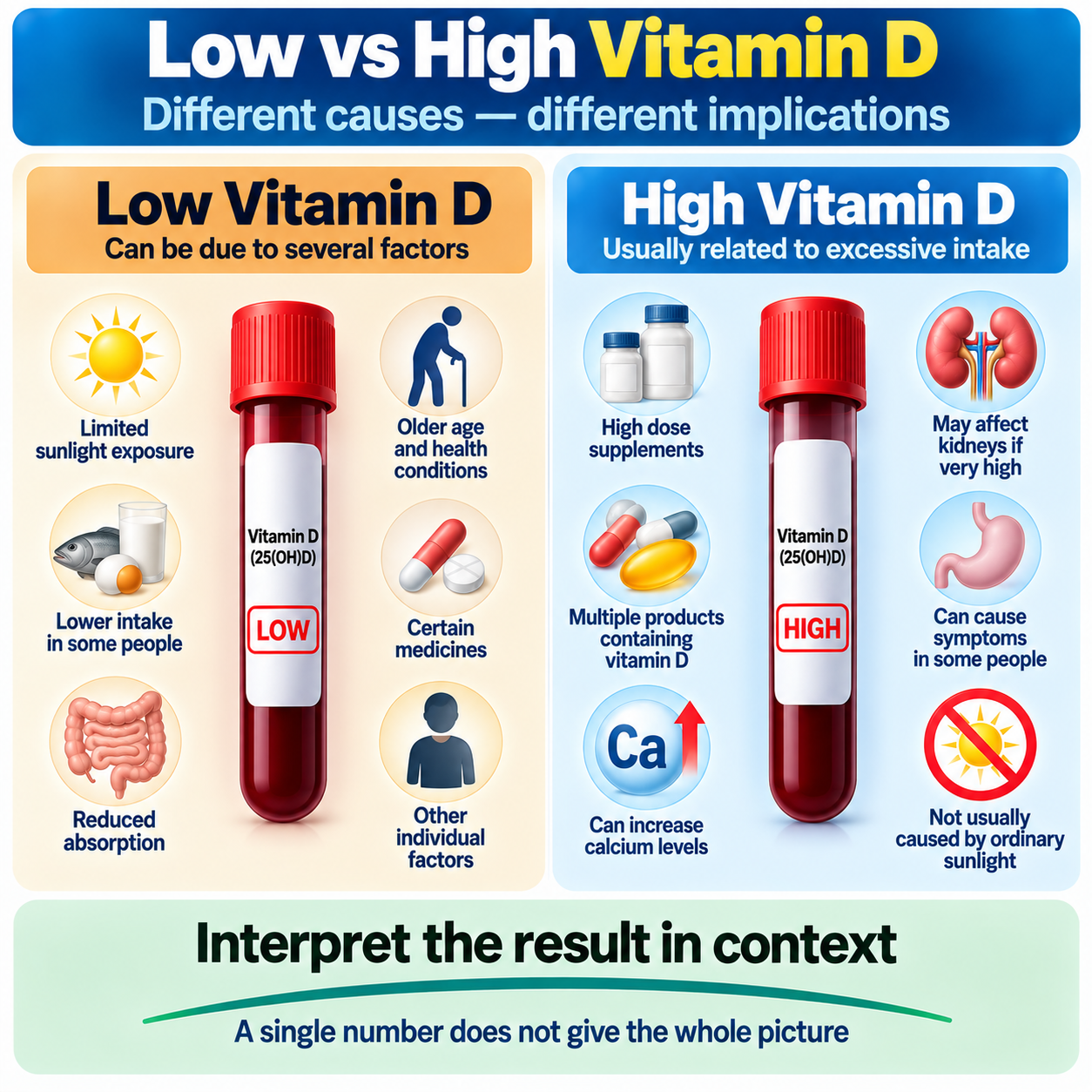
Several factors can contribute. Examples include:
- limited vitamin D production from sunlight exposure;
- inadequate vitamin D intake in some people;
- reduced absorption from the intestine;
- conditions affecting fat absorption;
- certain liver or kidney conditions;
- some medicines;
- older age;
- and other individual medical or lifestyle factors.
Sometimes more than one factor contributes.
Does Low Vitamin D Always Mean I Need More Sunlight?
No. Sunlight exposure can contribute to vitamin D production in the skin, but vitamin D status is affected by many factors. These include skin exposure, season and geography, age, skin characteristics, diet, supplements, absorption, medicines, and medical conditions.
Does Low Vitamin D Mean My Diet Is Poor?
Not necessarily. Only a limited number of foods naturally contain substantial vitamin D, and vitamin D status is influenced by more than diet.
A low result can occur even when a person's general diet is otherwise adequate. Similarly, changing food intake alone may not be sufficient for every patient with a clinically important deficiency.
Does Low Vitamin D Cause Symptoms?
Some people with low vitamin D have no obvious symptoms.
When deficiency is clinically significant or prolonged, possible problems can include bone discomfort or pain, muscle weakness, reduced bone mineralization, and bone disorders such as osteomalacia in adults or rickets in children.
However, symptoms such as tiredness or generalized aches have many possible causes.
How Does Vitamin D Affect Bones?
Vitamin D helps the body absorb calcium. When vitamin D is severely or persistently deficient, normal bone mineralization can be affected. This is one reason vitamin D may be assessed in patients with certain bone-related problems.
Bone health depends on many factors.
What Is the Relationship Between Vitamin D and Calcium?
Vitamin D helps the intestine absorb calcium. Because of this relationship, doctors may consider vitamin D when investigating an abnormal calcium result.
However, low vitamin D does not always mean blood calcium will be low, abnormal calcium does not automatically mean vitamin D is the cause, and vitamin D and calcium should be interpreted according to the overall clinical situation.
What Is the Relationship Between Vitamin D and Phosphate?
Vitamin D also contributes to phosphate balance. Calcium, phosphate, vitamin D, the kidneys and parathyroid hormone interact in maintaining normal mineral and bone health. Doctors may therefore consider these results together in selected patients.
Why Might PTH Be Checked With Vitamin D?
Parathyroid hormone — PTH is involved in regulating calcium and phosphate.
When vitamin D is low, or when calcium/phosphate results are abnormal, a healthcare professional may sometimes request PTH to better understand the pattern. The PTH result must be interpreted together with the other findings.
What Is the Relationship Between Vitamin D and the Kidneys?
The kidneys participate in converting vitamin D into its active hormonal form. Kidney disease can therefore affect vitamin D-related mineral regulation.
Kidney function is assessed separately using appropriate clinical information and tests such as creatinine and eGFR.
What Does a High Vitamin D Result Mean?
A high 25-hydroxyvitamin D result means the measured concentration is above the relevant laboratory or clinical interpretation range.
Very high vitamin D levels can be harmful. Unlike low vitamin D, excessive vitamin D is most often related to excessive vitamin D intake from supplements or treatment, rather than ordinary sunlight exposure.
High vitamin D can increase calcium absorption and may lead to hypercalcaemia — high blood calcium.
What Is Vitamin D Toxicity?
Vitamin D toxicity occurs when excessive vitamin D causes harmful effects in the body. It is also called hypervitaminosis D.
The major problem is often excessive calcium in the blood. This can affect several body systems and, in severe cases, can damage the kidneys.
Vitamin D toxicity is usually associated with excessive intake of vitamin D, particularly supplements or inappropriate high-dose use. It is not generally caused by ordinary sunlight exposure.
What Symptoms Can Occur With Excess Vitamin D?
Symptoms related to vitamin D toxicity and associated high calcium can include nausea or vomiting, poor appetite, constipation, excessive thirst, frequent urination, dehydration, weakness, tiredness, confusion, and other symptoms depending on severity.
These symptoms are not specific to vitamin D toxicity. A blood result and clinical assessment are needed.
What Should I Do if My Vitamin D Is High While Taking Supplements?
Do not take additional high-dose vitamin D simply because vitamin D is generally considered beneficial.
If your result is unexpectedly or significantly high, the healthcare professional should know the exact vitamin D product, the dose, how frequently you take it, how long you have taken it, whether you use more than one supplement containing vitamin D, and whether you also take calcium.
Do not independently restart or increase high-dose vitamin D after an unexpectedly high result. If a clinician has prescribed vitamin D treatment, discuss an abnormal result with that clinician rather than making an unsupervised major treatment change.
Can Too Much Sun Cause Vitamin D Toxicity?
Vitamin D toxicity is generally caused by excessive vitamin D intake rather than ordinary sunlight exposure. The body has mechanisms that limit excessive vitamin D production from sunlight.
Does One Low or High Vitamin D Result Diagnose the Cause?
No. A vitamin D result tells you the measured level of the requested vitamin D form. It does not by itself explain why the result is abnormal.
The healthcare professional may consider previous results, symptoms, diet, sunlight exposure, supplements, medicines, absorption problems, calcium, phosphate, PTH, kidney or liver disease, bone health, and other relevant clinical information.
When Might a Vitamin D Test Be Repeated?
Repeat testing may be useful in selected patients, for example when an established deficiency is being treated, an unexpectedly high result needs follow-up, a medical condition affecting vitamin D persists, the healthcare professional needs to assess response to treatment, or the previous result needs clinical reassessment.
The timing of repeat testing depends on the reason for testing and treatment plan.
Need Help Understanding Your Vitamin D Report?
The site already contains a Vitamin D Report Reader.
What Should I Do if My Vitamin D Is Low?
Do not panic and do not automatically choose a high-dose supplement regimen from the internet. Consider:
- Which vitamin D test was performed?
- What unit was used?
- How did the laboratory interpret the result?
- Why was the test requested?
- Are you already taking vitamin D?
- Are calcium or phosphate abnormal?
- Are there bone-health concerns?
- Could absorption, medicines or another medical condition be relevant?
Discuss a clinically important low result with the healthcare professional responsible for your care. Treatment depends on the individual situation.
Should I Start Vitamin D Supplements if My Level Is Low?
A low result may lead to vitamin D supplementation in appropriate patients, but the appropriate approach depends on factors such as age, severity, medical history, other laboratory results, current supplements, kidney function, absorption, and the reason for testing.
What if My Vitamin D Result Is Only Slightly Low or Borderline?
Do not assume that every borderline result requires aggressive treatment.
Interpretation depends on the laboratory, clinical context, reason for testing, symptoms, bone-health risk, and relevant medical conditions. Different professional guidance may also use different terminology around vitamin D status.
Discuss the result in context rather than treating the number alone.
What Should I Do if My Vitamin D Is High?
Check whether you are taking vitamin D tablets or capsules, vitamin D drops, multivitamins, calcium-plus-vitamin-D products, or other combination supplements.
A clearly high result, particularly in someone taking substantial vitamin D supplementation, should be reviewed by a healthcare professional. Calcium and kidney-related tests may also be relevant depending on the situation.
When Should I Discuss My Vitamin D Result With a Doctor?
Medical advice is particularly appropriate when:
- the result is clearly low or high;
- the abnormality persists;
- you have bone pain or significant muscle weakness;
- calcium or phosphate is also abnormal;
- you have a condition affecting absorption;
- you have significant kidney or liver disease;
- you are taking prescribed high-dose vitamin D;
- you are taking multiple supplements containing vitamin D;
- you have had previous vitamin D abnormalities;
- or you are uncertain how the result applies to your medical condition.
When Can a Vitamin D Problem Require Urgent Assessment?
Most low vitamin D results are not medical emergencies. However, severe vitamin D excess can cause significant hypercalcaemia.
Seek prompt medical assessment if an abnormal vitamin D result is accompanied by concerning symptoms such as:
- repeated vomiting;
- marked dehydration;
- severe or worsening weakness;
- significant confusion or unusual drowsiness;
- fainting;
- significant palpitations;
- inability to maintain fluids;
- or another rapidly worsening illness.
If the laboratory or healthcare professional specifically tells you that a result requires urgent assessment, follow that advice.
Do Not Treat the Number Yourself
Do not automatically:
- start high-dose vitamin D;
- repeatedly take large vitamin D doses;
- combine several vitamin D products;
- increase calcium supplements;
- stop prescribed treatment without advice;
- use prolonged unprotected sunlight as treatment;
- or aim for the highest possible vitamin D blood level.
Related laboratory & bone-health topics
Key Points
- The usual blood test for vitamin D status is 25-hydroxyvitamin D — 25(OH)D.
- 1,25-dihydroxyvitamin D is a different test and is not usually used to assess routine vitamin D status.
- Vitamin D helps calcium absorption and supports normal bone health.
- Not every healthy person needs routine vitamin D testing.
- Vitamin D results may be reported in ng/mL or nmol/L. Always check the unit.
- Different laboratories and professional guidance may use somewhat different interpretation thresholds.
- There is no universally established “optimal” blood level for every healthy person and every health outcome.
- A low vitamin D result does not identify its cause.
- Low vitamin D does not automatically mean poor diet or inadequate sunlight.
- Symptoms alone cannot diagnose vitamin D deficiency.
- A low result does not by itself diagnose osteoporosis.
- Calcium, phosphate and sometimes PTH may help provide context.
- A low vitamin D result does not automatically mean kidney disease.
- Excessive vitamin D can be harmful.
- Vitamin D toxicity is usually associated with excessive supplementation rather than ordinary sunlight exposure.
- Vitamin D toxicity can cause high calcium.
- Do not select high-dose vitamin D treatment from one laboratory result.
- Do not aim for the highest possible vitamin D level.
- Repeat testing is useful in selected circumstances but is not routinely required for every healthy person.