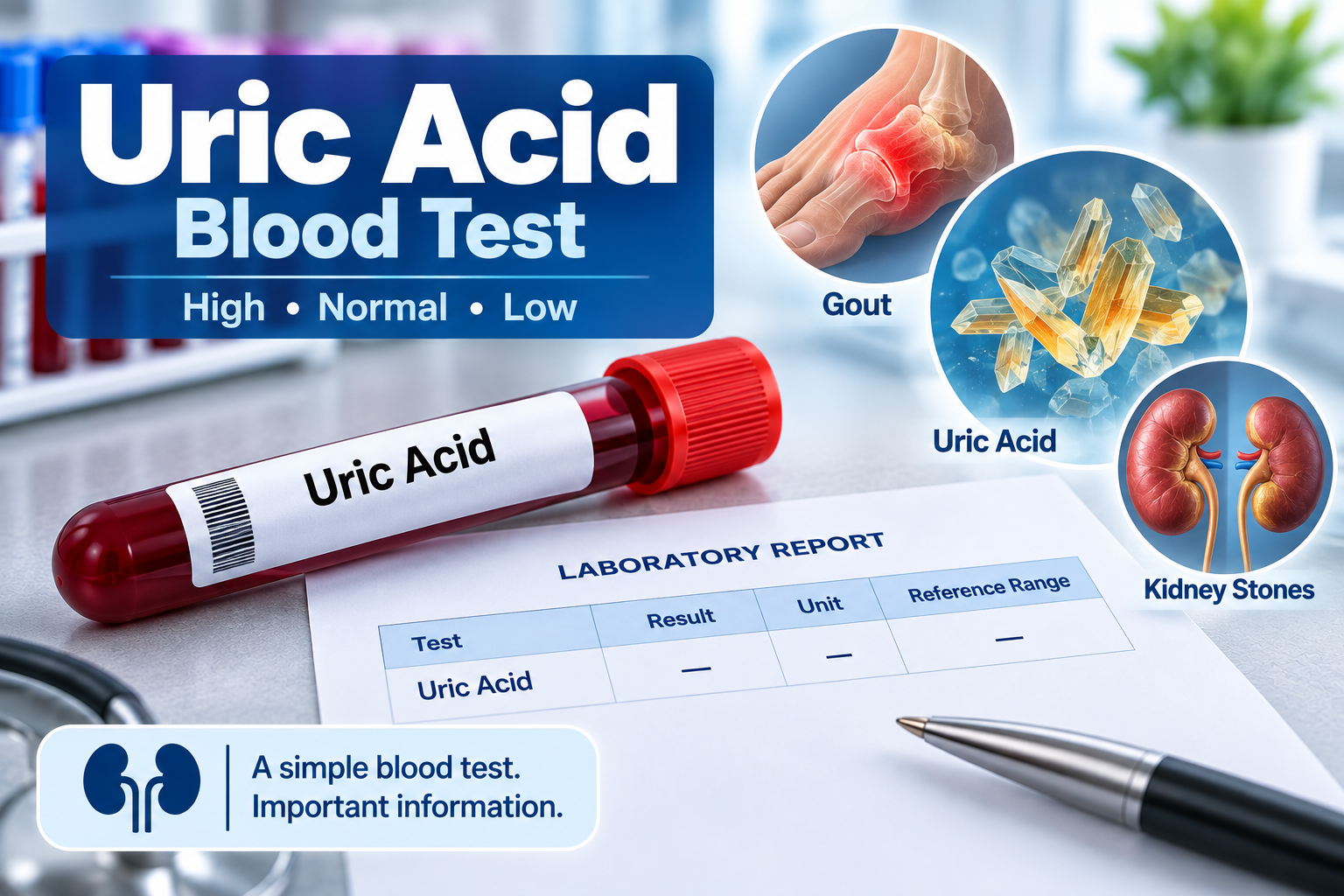
Uric Acid Blood Test Explained: High and Low Results
A uric acid blood test measures the amount of uric acid in your blood.
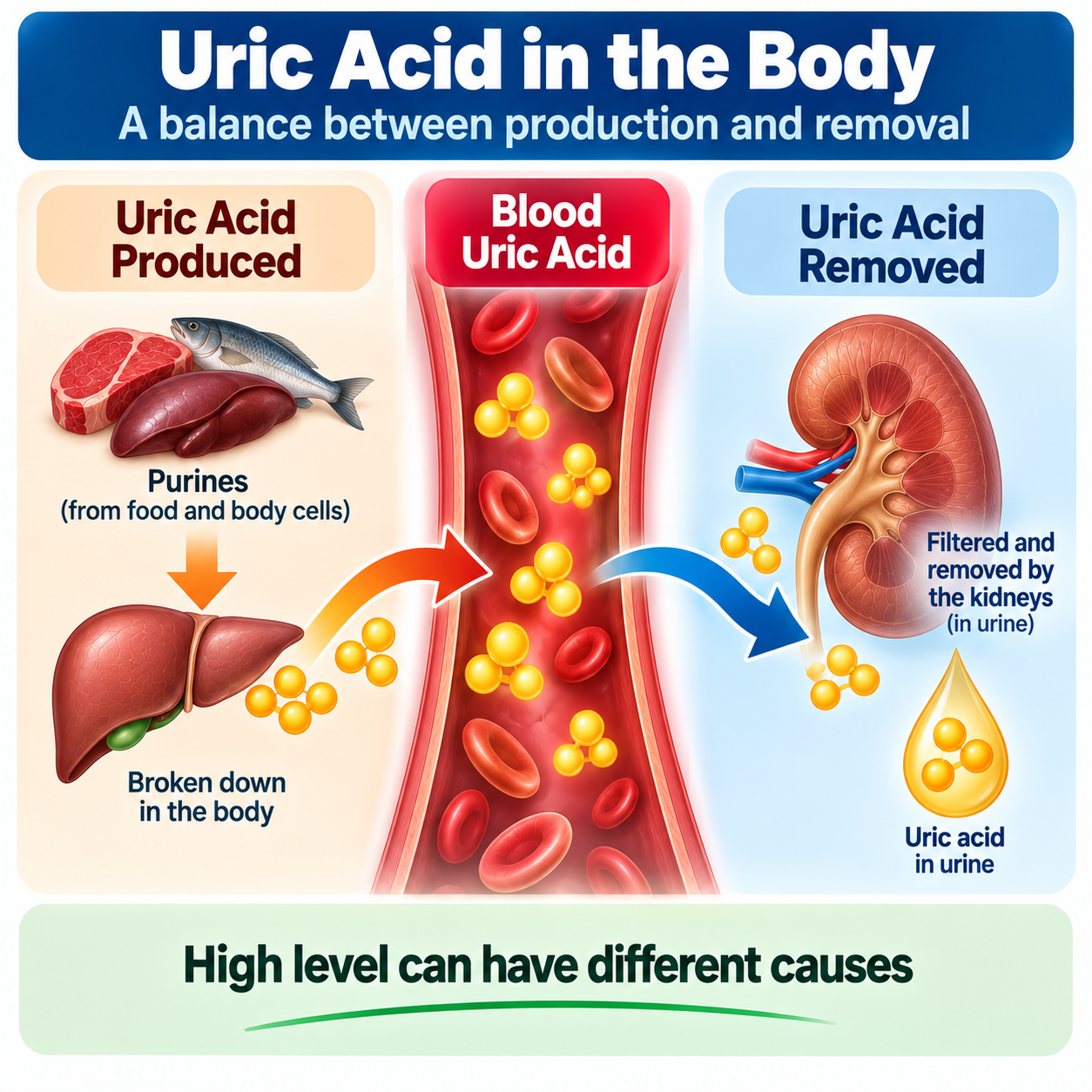
Uric acid is produced when the body breaks down substances called purines.
Most uric acid dissolves in the blood, passes through the kidneys and leaves the body in urine.
If the body produces more uric acid than it can remove, or if the kidneys remove less uric acid, the blood level can rise.
A high blood uric acid level is called hyperuricaemia. A low level is called hypouricaemia.
Uric acid is particularly well known because of its relationship with gout, but an abnormal uric acid result does not automatically diagnose gout or kidney disease.
What Is Uric Acid?
Uric acid is a waste product formed when the body breaks down purines.
Purines occur naturally in the body's cells and are also present in some foods.
After uric acid is produced, it travels in the blood.
The kidneys remove much of it from the body through urine.
The blood uric acid level therefore depends on a balance between:
- how much uric acid is produced;
- and how much is removed from the body.
If this balance changes, the blood uric acid level can become high or low.
Why Is a Uric Acid Blood Test Done?
A doctor may request a uric acid blood test for several reasons.
Examples include:
- assessing a person with symptoms that may suggest gout;
- monitoring a person with known gout or hyperuricaemia;
- assessing certain types of kidney stones;
- investigating an unexpectedly high uric acid result;
- monitoring particular medical conditions or treatments;
- assessing kidney-related laboratory results;
- or as part of a broader laboratory profile.
Some laboratories may include uric acid in a Renal Profile / Kidney Profile.
Some RFT packages may also contain uric acid, while others do not.
Therefore, the presence of uric acid on a report does not by itself tell you why the test was requested.
How Is a Uric Acid Blood Test Done?
The test is performed using a blood sample.
A healthcare worker usually takes a small amount of blood from a vein in your arm.
The laboratory measures the amount of uric acid in the sample.
Your report usually shows:
- the test name;
- your result;
- the unit;
- the laboratory reference range.
The test may appear as:
- Uric Acid;
- Serum Uric Acid;
- Urate;
- or Serum Urate.
Do I Need to Fast for a Uric Acid Blood Test?
Special preparation is not always required for a uric acid blood test.
However, uric acid is often measured together with other laboratory tests that may have their own preparation or fasting requirements.
Therefore:
If you are unsure whether fasting is required, check with the laboratory or the healthcare professional who requested the tests.
Should I Drink Extra Water Before the Test?
Do not deliberately drink unusually large amounts of water simply to try to change the uric acid result.
Dehydration can influence uric acid levels, but excessive water intake before the test is not an appropriate way to produce a better laboratory result.
Unless you have received specific medical instructions, follow your usual appropriate fluid intake.
Patients who have been advised to restrict fluid should continue to follow their medical advice.
Can Medicines Affect Uric Acid?
Yes.
Some medicines can increase or decrease blood uric acid levels.
This can include certain:
- diuretics or “water tablets”;
- medicines used to lower uric acid;
- medicines used in particular medical conditions;
- and other prescription or non-prescription medicines.
Tell the healthcare professional interpreting your result about the medicines and supplements you take.
How Do I Read a Uric Acid Report?
Look for:
Uric Acid or Serum Uric Acid / Serum Urate
Then check:
- your result;
- the unit;
- the laboratory reference range.
Use the reference interval printed on your own laboratory report.
Reference ranges can vary according to factors including:
- laboratory method;
- reporting unit;
- and patient characteristics.
Therefore, do not assume that one numerical range found online applies to every laboratory.
What Is the Normal Uric Acid Level?
There is no single universal reference range that should replace the range printed by your laboratory.
Different laboratories may use different:
- methods;
- units;
- and reference intervals.
Your report may use units such as mg/dL or µmol/L.
Use the reference range printed beside your own result.
What Does High Uric Acid Mean?
A blood uric acid level above the relevant laboratory reference range is called hyperuricaemia.
High uric acid means that uric acid is accumulating in the blood more than expected.
This can happen when:
- the body produces more uric acid;
- the body removes less uric acid;
- or both occur.
High uric acid has several possible causes and does not by itself identify which one applies to a particular patient.
What Can Cause High Uric Acid?
Possible factors and medical situations associated with high uric acid include:
- reduced removal of uric acid by the kidneys;
- reduced kidney function;
- dehydration;
- certain medicines;
- increased production of uric acid;
- some dietary and alcohol-related factors;
- some metabolic or medical conditions;
- rapid breakdown of large numbers of cells in certain illnesses or treatments;
- and inherited differences in how the body handles uric acid.
The importance of each possibility depends on the individual patient.
Does High Uric Acid Mean My Kidneys Are Failing?
No.
The kidneys play an important role in removing uric acid, so reduced kidney function can contribute to a high uric acid level.
However, a high uric acid result does not by itself diagnose kidney failure or chronic kidney disease.
Kidney function is usually assessed using other information, particularly tests such as serum creatinine, eGFR, and, when appropriate, urine testing.
Read Serum Creatinine Test Explained and eGFR Explained.
If a broader kidney laboratory panel was performed, read Renal Profile / Kidney Profile Explained.
Uric Acid, Gout and Kidney Stones
High uric acid, gout and kidney stones are related, but a high blood result does not automatically establish either diagnosis.
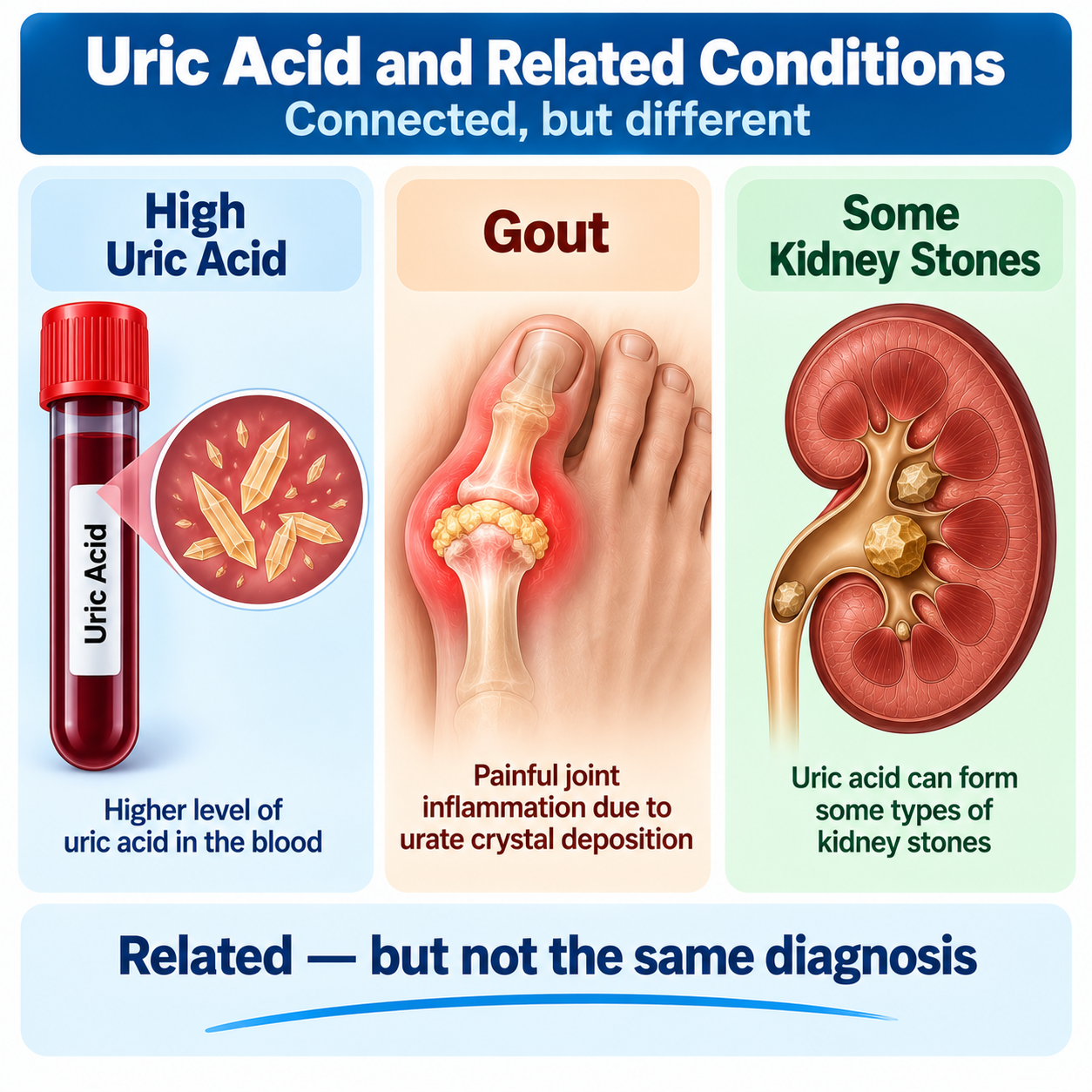
The following sections explain each of these connections separately.
Does High Uric Acid Mean I Have Gout?
No.
This is one of the most important points in this article.
A high uric acid level is associated with gout because urate crystals can form when urate levels are sufficiently elevated under appropriate conditions.
These crystals can accumulate in joints and cause the painful inflammation of gout.
Some people have high uric acid for years without developing gout.
Conversely, diagnosing gout involves more than simply seeing a high uric acid result. Symptoms, examination and sometimes additional investigations are important.
What Is Gout?
Gout is a type of inflammatory arthritis caused by deposition of monosodium urate crystals in tissues, particularly joints.
A gout attack commonly causes:
- sudden severe joint pain;
- swelling;
- redness;
- warmth;
- and marked tenderness.
The big toe is a well-known site, but gout can affect other joints.
Can Uric Acid Be Normal During a Gout Attack?
Yes.
A serum uric acid result taken during an acute gout attack may not always be elevated.
If gout is suspected clinically, the result must be interpreted together with the patient's symptoms and medical assessment.
Does High Uric Acid Without Symptoms Mean I Have Gout?
No.
A person can have hyperuricaemia without gout.
The presence of a high laboratory value does not mean that urate crystals are necessarily causing joint inflammation.
This is sometimes called asymptomatic hyperuricaemia when there are no symptoms attributable to urate crystal disease.
Does Every High Uric Acid Result Need Medicine?
No.
A high uric acid result does not automatically mean that uric-acid-lowering medicine should be started.
The decision depends on the clinical situation. Important considerations can include:
- whether the patient has gout;
- previous gout attacks;
- urate-related complications;
- kidney stones;
- kidney function;
- how high and persistent the uric acid level is;
- medicines;
- other medical conditions;
- and the reason the test was performed.
The result should be assessed in the appropriate clinical context.
Can Uric Acid Cause Kidney Stones?
Yes.
Uric acid can contribute to some types of kidney stones.
However, not every person with high blood uric acid develops kidney stones, and not every kidney stone is made of uric acid.
Kidney stones can have different compositions and causes.
If kidney stones are being investigated, additional information may be needed.
Can Food Affect Uric Acid?
Yes.
Diet can influence uric acid levels because some foods and drinks affect purine intake or uric acid metabolism.
However, blood uric acid is not determined by diet alone. Other important influences include:
- kidney handling of uric acid;
- genetics;
- medicines;
- body metabolism;
- alcohol intake;
- hydration;
- and medical conditions.
Should I Completely Avoid Purine-Rich Foods?
Do not make extreme dietary restrictions based solely on one laboratory result.
Dietary advice depends on:
- why uric acid is elevated;
- whether gout is present;
- whether kidney stones are present;
- other medical conditions;
- and the person's overall diet.
Can Alcohol Affect Uric Acid?
Alcohol can contribute to higher uric acid levels in some people and can be relevant in patients with gout.
However, the effect varies according to the individual and drinking pattern.
Do not reduce the interpretation of a high uric acid result to alcohol alone. The complete medical situation should be considered.
Can Dehydration Increase Uric Acid?
Yes.
Dehydration can contribute to a higher measured uric acid level in some situations.
This is one reason an isolated high result should be interpreted according to the patient's condition at the time of testing.
Patients with heart, kidney or other medical conditions may also have specific fluid instructions.
What Does Low Uric Acid Mean?
A uric acid result below the laboratory reference range is called hypouricaemia.
Low uric acid is generally less commonly discussed than high uric acid.
It can occur for several reasons, including situations in which:
- the body produces less uric acid;
- the kidneys remove more uric acid;
- certain medicines lower uric acid;
- or particular medical conditions affect uric acid metabolism.
A low result should be interpreted according to the patient's medical situation.
What Can Cause Low Uric Acid?
Possible causes or associations include:
- medicines that lower uric acid;
- increased urinary loss of uric acid;
- some kidney-tubule disorders;
- certain hormonal or metabolic situations;
- severe illness in some circumstances;
- and other less common medical conditions.
Do not attempt to diagnose the cause from the uric acid number alone.
Is Low Uric Acid Dangerous?
A mildly low uric acid result may not necessarily represent a serious problem.
Its importance depends on:
- how low the result is;
- whether it is persistent;
- symptoms;
- medicines;
- other laboratory abnormalities;
- and the patient's medical condition.
If the result is unexpectedly or persistently low, discuss it with the healthcare professional who requested the investigation.
Does One Abnormal Uric Acid Test Confirm a Disease?
No.
A single high or low uric acid result does not by itself establish the cause.
The healthcare professional may consider:
- previous uric acid results;
- symptoms;
- gout history;
- kidney function;
- kidney-stone history;
- medicines;
- hydration;
- diet and alcohol where relevant;
- and other laboratory results.
Sometimes repeat testing may be appropriate.
Why Might Uric Acid Be Repeated?
Uric acid may be repeated when:
- an unexpected abnormality is found;
- the healthcare professional wants to see whether the change persists;
- gout or hyperuricaemia is being monitored;
- treatment affecting uric acid is being monitored;
- or the patient's medical situation changes.
A trend over time may provide more useful information than one isolated measurement.
Why Is Uric Acid Included in Some Renal Profiles?
The kidneys remove much of the body's uric acid.
For this reason, some laboratories include serum uric acid in a broader Renal Profile / Kidney Profile.
A high or low uric acid result should therefore not be interpreted as though it were another version of creatinine or eGFR.
For the broader report, read Renal Profile / Kidney Profile Explained.
Is Uric Acid Part of an RFT?
Sometimes.
Different laboratories and healthcare settings may use RFT for different combinations of tests.
Some RFT packages may contain uric acid. Others may contain only a smaller group of tests such as blood urea and serum creatinine.
If your doctor wrote only RFT, read RFT / Renal Function Test Explained.
Can Uric Acid Be High When Creatinine Is Normal?
Yes.
Uric acid and creatinine measure different things.
A person can have an elevated uric acid result even when serum creatinine is within the laboratory reference range.
Similarly, a normal creatinine result does not explain why uric acid is high.
Each result should be interpreted for its own purpose and then considered together with the patient's overall medical situation.
What If My Uric Acid Is High but I Feel Completely Well?
This can happen.
Some people have an elevated blood uric acid level without gout attacks, kidney-stone symptoms, or another obvious urate-related problem.
Do not assume that symptoms must develop.
At the same time, do not start treatment solely from the laboratory result without appropriate clinical assessment.
Discuss the result with the healthcare professional who requested the test, particularly if it is clearly elevated, repeatedly elevated, or associated with other medical problems.
What Should I Do If My Uric Acid Is High?
Do not panic and do not attempt to treat the number yourself.
First consider:
- Why was the test requested?
- Is this the first high result or has it been high before?
- Do you have symptoms suggestive of gout?
- Have you had kidney stones?
- What are your kidney-function results?
- What medicines are you taking?
- Were you unwell or dehydrated around the time of testing?
Then discuss the result with the healthcare professional who requested the investigation when appropriate.
What Should I Do If My Uric Acid Is Low?
If the result is only mildly below the laboratory range and you are otherwise well, the clinical importance may be limited.
However, discuss an unexpectedly or persistently low result with the healthcare professional who requested the test, particularly if:
- other blood tests are abnormal;
- you have relevant symptoms;
- you take medicines that alter uric acid;
- or there is another medical condition requiring assessment.
Have Your Uric Acid Result?
Use the Uric Acid Result Interpreter. Enter your laboratory result to receive educational information about the value.
When Should I Seek Medical Advice?
Discuss the result with your doctor or other responsible healthcare professional if:
- uric acid is repeatedly high or low;
- you have recurrent attacks of severe joint pain and swelling;
- gout has been diagnosed or suspected;
- you have kidney stones;
- kidney-function results are abnormal;
- the result changed significantly from previous measurements;
- you are taking medicines that affect uric acid;
- or you are unsure why the test was performed.
When Might More Urgent Assessment Be Needed?
The uric acid number itself is not usually interpreted as an emergency in isolation.
However, seek appropriate urgent medical assessment if you are significantly unwell or have symptoms such as:
- severe pain with fever or systemic illness;
- inability to pass urine;
- severe persistent vomiting;
- marked reduction in urine output;
- severe flank pain with significant illness;
- confusion or altered consciousness;
- or another rapidly worsening medical condition.
These symptoms can have many causes and should not simply be attributed to uric acid.
Do Not Treat the Laboratory Number Yourself
Do not automatically respond to a high uric acid result by:
- starting allopurinol or another uric-acid-lowering medicine;
- stopping prescribed medicines;
- taking supplements;
- drinking excessive amounts of water;
- starting an extreme low-purine diet;
- or making major dietary restrictions.
Similarly, do not try to raise a low uric acid result yourself.
Related kidney & laboratory topics
Key Points
- Uric acid is produced when the body breaks down purines.
- Much of the body's uric acid is removed through the kidneys.
- High blood uric acid is called hyperuricaemia.
- Low blood uric acid is called hypouricaemia.
- High uric acid has several possible causes.
- A high uric acid result does not automatically mean kidney disease.
- A high uric acid result does not automatically diagnose gout.
- Some people have high uric acid without developing gout.
- A serum uric acid result can sometimes be within the laboratory range during an acute gout attack.
- Uric acid can contribute to some kidney stones, but not all kidney stones are uric acid stones.
- Uric acid may be included in some renal profiles and some RFT packages.
- Uric acid is not a direct measurement of kidney filtration.
- Creatinine and uric acid are different tests and can be abnormal independently.
- Medicines, hydration and several medical conditions can influence uric acid.
- Low uric acid can also occur and should be interpreted according to the clinical situation.
- Use the reference range and unit printed on your own laboratory report.
- Do not start uric-acid-lowering medicine solely because of one high laboratory result.
- Do not make major medication, fluid or dietary changes without appropriate medical advice.