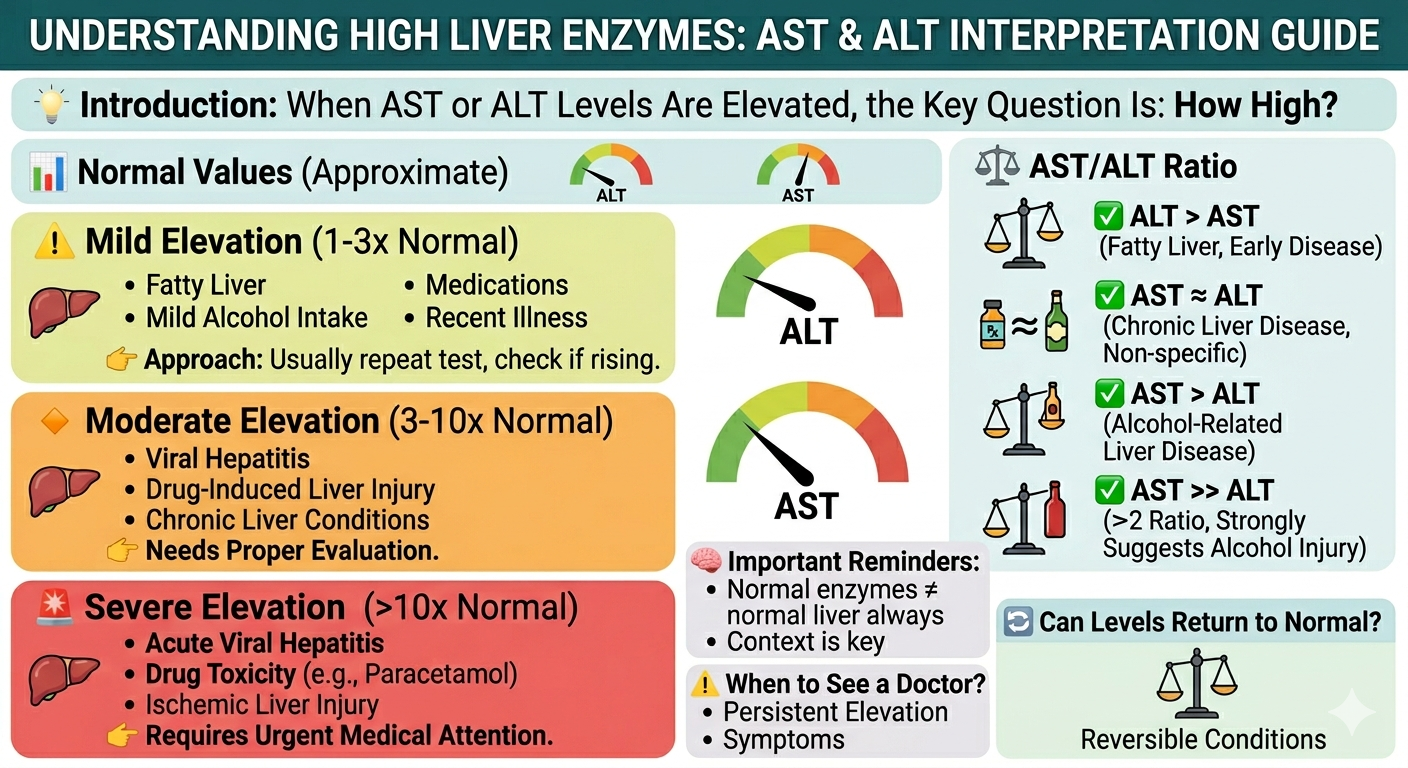
High AST and ALT levels need context
Many patients become anxious when they see high AST or ALT on a blood report. The result can look alarming, especially when the report flags it in red or marks it as abnormal.
The actual meaning depends on several factors: the level of elevation, whether values are rising or improving, whether symptoms are present, and what the other liver profile tests show.
Read: AST (SGOT) & ALT (SGPT) Blood Tests: Purpose, Preparation and Results
What is considered high?
AST or ALT is considered high when the result is above the reference range printed on your laboratory report. Reference ranges vary slightly between laboratories, so your own report range matters most.
| Test | Approximate common reference | When it is high |
|---|---|---|
| ALT (SGPT) | Usually less than 40 U/L | Above the laboratory reference range |
| AST (SGOT) | Usually less than 40 U/L | Above the laboratory reference range |
Understanding mild, moderate, and severe elevation
Mild elevation: 1-3 times normal
Mild elevation is the most common pattern. It often means AST or ALT is up to about three times the upper limit of normal. Common causes include fatty liver, obesity, diabetes, alcohol intake, medications, supplements and recent illness.
For mild elevation, doctors often repeat the test and review risk factors before moving to more extensive investigations.
Moderate elevation: 3-10 times normal
Moderate elevation needs proper evaluation. Possible causes include viral hepatitis, alcohol-related injury, medication-related liver injury, autoimmune hepatitis, gallstone-related liver irritation and more active fatty liver disease.
Severe elevation: more than 10 times normal
Severe elevation can be serious and may occur with acute viral hepatitis, drug-induced liver injury, ischemic liver injury, toxin exposure and some herbal or supplement-related liver injuries.
Does ALT matter more than AST?
ALT is more liver-specific than AST, so a high ALT often points more directly toward liver cell irritation. AST is also found in muscle and heart, so AST can rise from non-liver causes.
This does not mean AST is unimportant. The relationship between AST and ALT, together with symptoms and other tests, can provide useful clues.
Understanding the AST/ALT ratio
The AST/ALT ratio compares the AST value with the ALT value. It can give clues, but it is not a diagnosis by itself.
| Ratio Pattern | Possible Interpretation | Important Limitation |
|---|---|---|
| Ratio < 1 ALT higher than AST | Common in fatty liver and many early liver conditions | Not specific to one disease |
| Ratio around 1 AST and ALT similar | May occur in non-specific or chronic patterns | Needs the full clinical picture |
| Ratio > 1 AST higher than ALT | Can occur with alcohol-related disease, advanced fibrosis or muscle contribution | AST can come from muscle |
| Ratio > 2 AST much higher than ALT | Can strongly support alcohol-related injury in the right context | History and other tests still matter |
Can muscle injury cause high AST?
Yes. AST is found in muscle as well as the liver. Heavy gym workouts, muscle injury, intense exercise, seizures and rhabdomyolysis can raise AST, and sometimes ALT too.
If muscle injury is suspected, doctors may consider a CK test, symptoms such as muscle pain or weakness, urine color and the timing of recent exercise.
Common causes of elevated AST and ALT
| Cause | Typical Pattern |
|---|---|
| Fatty liver | Mild or moderate elevation; ALT often higher than AST |
| Alcohol-related injury | AST may be higher than ALT, sometimes with high GGT |
| Viral hepatitis | Can cause moderate or severe elevation |
| Medication injury | Pattern varies; can be mild, moderate or severe |
| Gallstone hepatitis | Can cause sudden elevations with abdominal pain and abnormal bilirubin or ALP |
| Autoimmune hepatitis | Persistent or significant elevation; needs specialist evaluation |
| Muscle injury | AST may rise more than ALT; CK may be elevated |
Do rising results matter?
Yes. Even if AST and ALT are not extremely high, an increasing trend over time can be important. A single result gives one snapshot. Repeated results show direction.
| Example Trend | Possible Meaning |
|---|---|
| ALT 95 to 48 U/L | Improving pattern |
| ALT 85 to 90 U/L | Persistent elevation needing follow-up |
| ALT 75 to 180 U/L | Rising pattern needing evaluation |
| ALT 220 with jaundice | More urgent clinical review |
When should you seek medical attention?
You should seek medical review if AST or ALT elevations are moderate or severe, persistent, rising over time, or associated with red-flag symptoms.
- Jaundice
- Confusion or drowsiness
- Persistent vomiting
- Significant abdominal pain
- Dark urine or pale stools
- Bleeding or easy bruising
- Rapidly rising AST or ALT values
Can AST and ALT return to normal?
Yes. AST and ALT can return to normal, especially when the cause is reversible or treatable. Fatty liver and lifestyle-related liver enzyme elevation may improve with weight reduction, healthier diet, regular activity and avoiding alcohol when advised.
Medication-related elevations may improve after the responsible medicine or supplement is changed by a doctor. Viral hepatitis, autoimmune liver disease and obstruction require cause-specific management.
What tests may be ordered next?
The next step depends on the level, pattern and clinical context. Doctors may order tests that show bile flow, liver function, clotting function, viral causes, autoimmune causes or liver structure.
| Test | Why it may be ordered |
|---|---|
| Bilirubin | To assess jaundice and bilirubin processing |
| ALP | To look for bile duct or cholestatic patterns |
| GGT | To support liver or biliary interpretation |
| Albumin | To assess liver synthetic function and nutrition context |
| INR | To assess blood clotting and liver function in significant illness |
| Ultrasound | To assess fatty liver, obstruction or structural liver disease |
| Hepatitis screen | To look for viral hepatitis |
| Autoimmune markers | To assess autoimmune liver disease when suspected |
When should AST and ALT be repeated?
Repeat testing is often considered for mild elevations, commonly within about 2-4 weeks, but the timing depends on the clinical situation. Your doctor may repeat sooner if values are high, rising or associated with symptoms.
Moderate or severe elevations usually need more direct assessment rather than simply waiting for a routine repeat test.
What is the highest ALT ever recorded?
Extremely high ALT values can occur in severe acute liver injury, such as acute viral hepatitis, drug toxicity, ischemic liver injury or toxin-related liver damage.
The exact number is less important than the clinical situation. A very high ALT should be interpreted with symptoms, bilirubin, INR, kidney function, medication history and urgent medical assessment when appropriate.
Continue the liver health cluster
Frequently asked questions about high AST and ALT
Level, trend, and context give the real meaning
High AST and ALT results are useful clues, but they do not tell the whole story by themselves.
Level + trend + symptoms + other tests = the true meaning.