Dengue can affect children as well as adults.
Most children with dengue recover, but some can become seriously ill.
One of the challenges for parents is that a child may not always be able to explain exactly what they are feeling.
A young child may not say, “I have abdominal pain,” “I feel dizzy,” or “I am becoming weaker.”
Instead, parents may notice changes such as refusing drinks, repeated vomiting, unusual sleepiness, irritability, reduced activity or simply that the child appears much more unwell.
There is another important point:
The fever coming down does not always mean that the dangerous part of dengue has passed.
Warning signs can sometimes appear around the time the temperature begins to return to normal.
For this reason, parents should monitor the child's overall condition rather than concentrating only on the temperature or one blood-test result.
Can Children Get Dengue?
Yes.
Children can become infected with dengue virus after being bitten by an infected Aedes mosquito.
The illness can range from mild dengue to severe disease.
Some children may have relatively mild symptoms and recover with appropriate medical follow-up and supportive care.
Others may develop warning signs and need hospital monitoring or treatment.
Infants deserve particular attention. Age below one year is among the factors CDC identifies when considering whether inpatient management may be appropriate on a case-by-case basis, even in the absence of warning signs.
Therefore, a baby with suspected dengue should be assessed and followed carefully by healthcare professionals.
What Are the Symptoms of Dengue in Children?
Dengue can cause symptoms such as:
- fever;
- headache;
- pain behind the eyes;
- muscle or body aches;
- nausea;
- vomiting;
- rash;
- tiredness or weakness.
Not every child develops every symptom.
Some symptoms may also be difficult to recognize in younger children.
A child who cannot describe headache, nausea or body aches may simply appear miserable, less active, irritable or unwilling to eat and drink.
The symptoms of dengue can also resemble many other childhood illnesses.
Therefore:
You cannot confirm dengue from symptoms alone.
A healthcare professional may need to assess the child and decide whether blood tests or other investigations are appropriate.
Can Dengue Be Harder to Recognize in Younger Children?
Yes.
Older children may be able to explain symptoms such as:
“My stomach hurts.”
“I feel dizzy.”
“I feel like vomiting.”
“I feel very weak.”
A toddler or baby cannot give the same information.
Parents therefore need to pay attention to changes in behaviour and normal activities.
For example, notice whether the child:
- is much less active than usual;
- is unusually sleepy;
- becomes unusually irritable or restless;
- repeatedly refuses drinks;
- vomits repeatedly;
- passes much less urine than usual;
- appears to be getting worse rather than better.
These observations do not diagnose severe dengue by themselves.
However, they can provide important information when deciding whether the child needs reassessment.
What Should Parents Monitor at Home?
If a healthcare professional has decided that your child can be managed at home, follow the medical follow-up plan you have been given.
Do not simply wait for the fever to disappear.
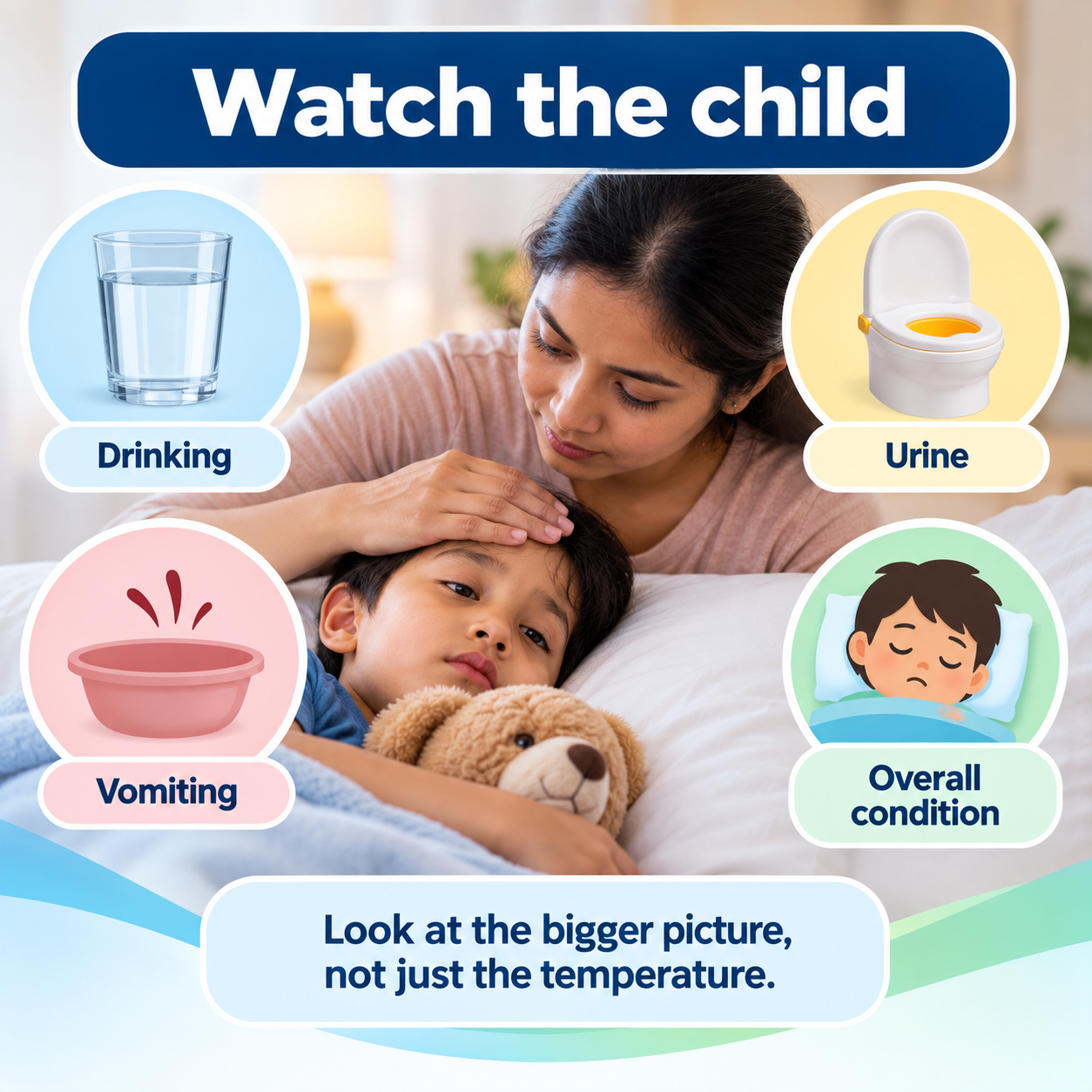
Parents should pay attention to several things.
Overall condition
Ask yourself:
Is my child generally improving, remaining about the same, or becoming worse?
A child who suddenly looks much more unwell needs attention even if the temperature is lower.
Drinking
Observe whether the child can drink and keep fluids down.
Vomiting
Notice whether vomiting is becoming repeated or persistent.
Urine
Pay attention to whether the child continues to pass urine.
Behaviour and alertness
Watch for unusual drowsiness, marked irritability, restlessness or a major change from the child's normal behaviour.
Pain
Older children may report abdominal pain.
Younger children may cry, become distressed, protect the abdomen or behave differently when they are uncomfortable.
Bleeding
Look for unusual bleeding such as bleeding from the nose or gums, blood in vomit or stool, or other unexplained bleeding.
These observations are often more useful to parents than repeatedly focusing on the temperature alone.
Why Is Drinking Important?
Maintaining adequate hydration is an important part of supportive care for dengue.
Children with fever can lose fluid, and vomiting or poor appetite can make adequate intake more difficult.
Children being managed outside hospital should generally be able to tolerate oral fluids. CDC guidance specifically includes the ability to tolerate oral fluids and maintain normal urine output among the features used when considering outpatient management.
Offer fluids according to the advice provided by your child's healthcare professional.
A child who feels nauseated may tolerate smaller amounts given more frequently better than a large drink at once.
Breastfeeding should generally be continued for a breastfed infant.
Do not force large quantities of fluid rapidly into a child who feels sick or is vomiting.
More importantly:
If your child cannot drink adequately or repeatedly vomits what they drink, seek medical advice.
A child who cannot maintain oral fluid intake may need reassessment and possibly hospital-based treatment.
Why Should Parents Watch Urine Output?
Urine output provides useful information about hydration and circulation.
Parents do not usually need to measure urine precisely.
Instead, notice whether the child continues to urinate reasonably regularly compared with normal.
For babies, this may mean noticing whether wet nappies continue.
For older children, notice whether they are going to the toilet.
A substantial reduction in urine, particularly when combined with poor drinking, repeated vomiting, increasing weakness or worsening general condition, should not be ignored.
Tell the healthcare professional if your child is passing much less urine than usual.
What If the Child Is Vomiting?
Vomiting can occur with dengue.
An occasional episode is different from vomiting that becomes repeated or persistent.
Persistent vomiting is an important dengue warning sign.
Repeated vomiting can also make it difficult for a child to maintain adequate fluid intake.
Do not concentrate only on the number of vomiting episodes.
Consider the whole situation:
- Can the child still drink?
- Can the child keep fluids down?
- Is urine output decreasing?
- Is abdominal pain developing?
- Is the child becoming unusually sleepy, restless or weak?
- Is the overall condition becoming worse?
If vomiting becomes persistent, the child cannot maintain fluids, or other warning signs appear, seek medical assessment promptly.
What Happens When the Fever Goes Away?
This is one of the most important things for parents to understand about dengue.
With many common childhood illnesses, parents feel reassured when the temperature returns to normal.
With dengue, the period around the time the fever settles requires continued attention.
The critical phase of dengue often begins around defervescence — the time when the fever resolves.
Therefore:
Do not assume that your child is completely safe simply because the fever has disappeared.
Continue observing:
- overall condition;
- drinking;
- vomiting;
- urine output;
- abdominal pain;
- bleeding;
- alertness and behaviour;
- breathing.
A child whose fever has settled but who is becoming more unwell needs medical reassessment.
What Are the Warning Signs of Dengue in Children?
Important warning signs include:
- significant or worsening abdominal pain;
- persistent vomiting;
- bleeding from the nose or gums or other mucosal bleeding;
- unusual drowsiness;
- marked irritability or restlessness;
- worsening general condition.
Other concerning findings can include difficulty maintaining fluids, reduced urine output, breathing difficulty, fainting or signs that the child's circulation may be deteriorating.
Warning signs often become particularly important around the time the fever settles.
Do not wait for every warning sign to appear.
If your child develops a concerning change or appears significantly more unwell, seek medical assessment.
Read more:
When Should a Child With Dengue Be Taken for Urgent Medical Care?
Seek urgent medical assessment if a child with suspected or confirmed dengue develops:
- severe or worsening abdominal pain;
- persistent or repeated vomiting;
- significant bleeding;
- blood in vomit or stool;
- unusual drowsiness or difficulty waking;
- marked restlessness or irritability;
- breathing difficulty;
- fainting or collapse;
- inability to maintain adequate fluid intake;
- substantially reduced urine output together with worsening illness;
- rapidly worsening overall condition.
Parents know their child's usual behaviour.
If your child appears dramatically different from normal or you feel the child is deteriorating, do not wait for a particular blood-test value before seeking help.
Severe dengue can progress quickly and requires urgent medical care.
What Medicines Can Be Given for Fever?
For a child with suspected or confirmed dengue, medicines should be used according to appropriate medical advice.
Paracetamol is the usual medicine used for fever and discomfort in dengue.
The dose for a child depends on factors including body weight and the preparation being used.
Parents should therefore follow the dose recommended by their healthcare professional or the appropriate product instructions rather than guessing a dose.
Do not give aspirin.
Medicines in the NSAID group, such as ibuprofen, should also be avoided when dengue is suspected because they can increase bleeding risk.
Do not combine multiple cold-and-fever medicines without checking their ingredients, because some products may contain the same medicine under different brand names.
Read more:
Does a Low Platelet Count Mean the Child Has Severe Dengue?
Not by itself.
Platelet counts commonly fall during dengue, but a single platelet result does not tell you everything about how sick a child is.
Doctors interpret blood-test results together with:
- the child's symptoms;
- examination findings;
- stage of illness;
- hydration and circulation;
- bleeding;
- hematocrit and other relevant investigations;
- changes over time.
A child should therefore not be considered safe simply because the platelet count is above a particular number.
Similarly, a falling platelet count alone does not automatically mean that the child has severe dengue.
The child's clinical condition is extremely important.
Do not wait for the next platelet result if the child develops warning signs or becomes significantly more unwell.
Read more:
Platelets in Dengue: What Platelet Counts Mean and When to Worry
When Does a Child With Dengue Need Hospital Care?
Not every child with dengue needs to remain in hospital.
Some children without warning signs can be managed outside hospital with appropriate medical follow-up when they are clinically stable, can drink adequately and continue to pass urine.
Hospital care becomes more important when the child develops warning signs, cannot maintain adequate oral fluids, requires closer monitoring or develops severe dengue.
Age and other medical or social circumstances can also influence the decision.
Infants require particular consideration.
The decision to admit a child is therefore not based on the platelet count alone.
It depends on the child's overall clinical condition and ability to be safely monitored and managed outside hospital.
Follow the assessment and follow-up plan given by the healthcare team caring for your child.
How Do Children Recover From Dengue?
As recovery begins, the child's general condition should progressively improve.
Appetite may begin to return.
Drinking usually becomes easier.
Activity and interest in normal surroundings should gradually improve.
Blood counts also recover over time, although they do not necessarily return to normal immediately.
Some tiredness can continue after the acute illness.
Allow the child to return to normal activities gradually according to how they feel and any medical advice you have been given.
Do not use one platelet count as the only measure of recovery.
The overall direction should be toward improvement.
If the child initially improves but then becomes unwell again, develops new symptoms or is not recovering as expected, seek medical review.
Read more:
Recovery After Dengue Fever: Weakness, Tiredness and Returning to Normal
One-Minute Summary
- Children can develop dengue, and some can become seriously ill.
- Younger children may not be able to clearly describe symptoms such as abdominal pain, nausea, dizziness or weakness.
- Parents should watch the child's overall condition, drinking, vomiting, urine output, behaviour, pain and bleeding.
- A child being managed at home should be able to take adequate oral fluids.
- Persistent vomiting or inability to maintain fluids requires medical attention.
- Reduced urine output can be an important sign that the child needs reassessment.
- The fever going away does not always mean the risky period has passed.
- Warning signs can appear around the time the fever settles.
- A platelet count alone does not determine whether dengue is mild or severe.
- If your child develops warning signs or appears to be getting significantly worse, seek medical care promptly.
Most Important Message
Do not monitor a child with dengue by looking only at the fever or platelet count.
Watch the child.
Pay attention to whether they can drink, whether they are vomiting, whether they continue to pass urine, whether abdominal pain or bleeding develops, and whether their behaviour and overall condition are improving or worsening.
Remember that warning signs can appear around the time the fever settles.
If your child appears significantly more unwell, develops warning signs, cannot maintain fluids or you are concerned about a major change in their condition, seek medical assessment promptly.
Frequently Asked Questions
Can children get dengue?
Yes. Children can become infected with dengue and can develop illness ranging from mild dengue to severe disease. Most recover, but careful monitoring is important because some children can develop warning signs and require hospital care.
What are the common symptoms of dengue in children?
Symptoms can include fever, headache, pain behind the eyes, body aches, nausea, vomiting, rash and tiredness. Younger children may not describe these symptoms clearly and may instead become less active, irritable, sleepy or reluctant to eat and drink.
How can I tell if my young child with dengue is becoming worse?
Pay attention to changes in the child's usual behaviour and overall condition. Concerning changes include persistent vomiting, significant abdominal pain, inability to drink, reduced urine output, unusual drowsiness, marked restlessness or irritability, bleeding, breathing difficulty or a rapidly worsening general condition.
Is it safe when my child's fever goes away?
The temperature returning to normal is encouraging in many illnesses, but in dengue the period around the time the fever settles can be important because warning signs may appear then. Continue monitoring your child even after the fever comes down.
What should my child drink during dengue?
Adequate oral fluids are important. Follow the advice provided by your child's healthcare professional. A nauseated child may tolerate small amounts given frequently better than a large amount at once. Breastfeeding should generally continue for a breastfed infant. Seek medical advice if your child cannot drink adequately or repeatedly vomits fluids.
Why should I watch how much my child urinates?
Urine output provides useful information about hydration and circulation. A child passing substantially less urine than usual, particularly together with poor drinking, repeated vomiting or worsening illness, should be medically reassessed.
Can I give ibuprofen to a child with dengue?
Ibuprofen and other NSAIDs should be avoided when dengue is suspected because of bleeding risk. Paracetamol is generally used for fever and discomfort, with the appropriate dose determined according to the child and product. Follow medical or appropriate dosing advice.
Does a low platelet count mean my child needs hospital admission?
Not necessarily. Hospital admission is not decided from the platelet count alone. Doctors consider the child's overall condition, warning signs, ability to drink, urine output, examination findings, stage of illness, blood-test trends and whether the child can be safely monitored outside hospital.
Are babies at greater concern with dengue?
Infants require particular attention because they cannot describe symptoms and their clinical condition can be harder for parents to assess. Age below one year is also a factor healthcare professionals consider when deciding whether closer observation or inpatient care may be appropriate.
When should I take my child with dengue to hospital urgently?
Seek urgent medical assessment if your child develops severe or worsening abdominal pain, persistent vomiting, significant bleeding, blood in vomit or stool, unusual drowsiness, marked restlessness or irritability, breathing difficulty, fainting, inability to maintain fluids, substantially reduced urine output with worsening illness, or a rapidly worsening overall condition.
Related Articles
- Dengue Fever: Symptoms, Warning Signs, Tests and Treatment
- Dengue Warning Signs: When Should You Go to Hospital?
- Dengue Home Management Explained
- Fluids in Dengue
- Medicines to Avoid in Dengue Fever
- Platelets in Dengue: What Platelet Counts Mean and When to Worry
- Recovery After Dengue Fever: Weakness, Tiredness and Returning to Normal
- When to Admit a Dengue Patient: Hospital vs Home