Creatinine results need context
After receiving a serum creatinine report, many patients immediately worry if the value is high or become falsely reassured if the value is normal. In reality, interpreting creatinine results is more complex than simply looking at a single number.
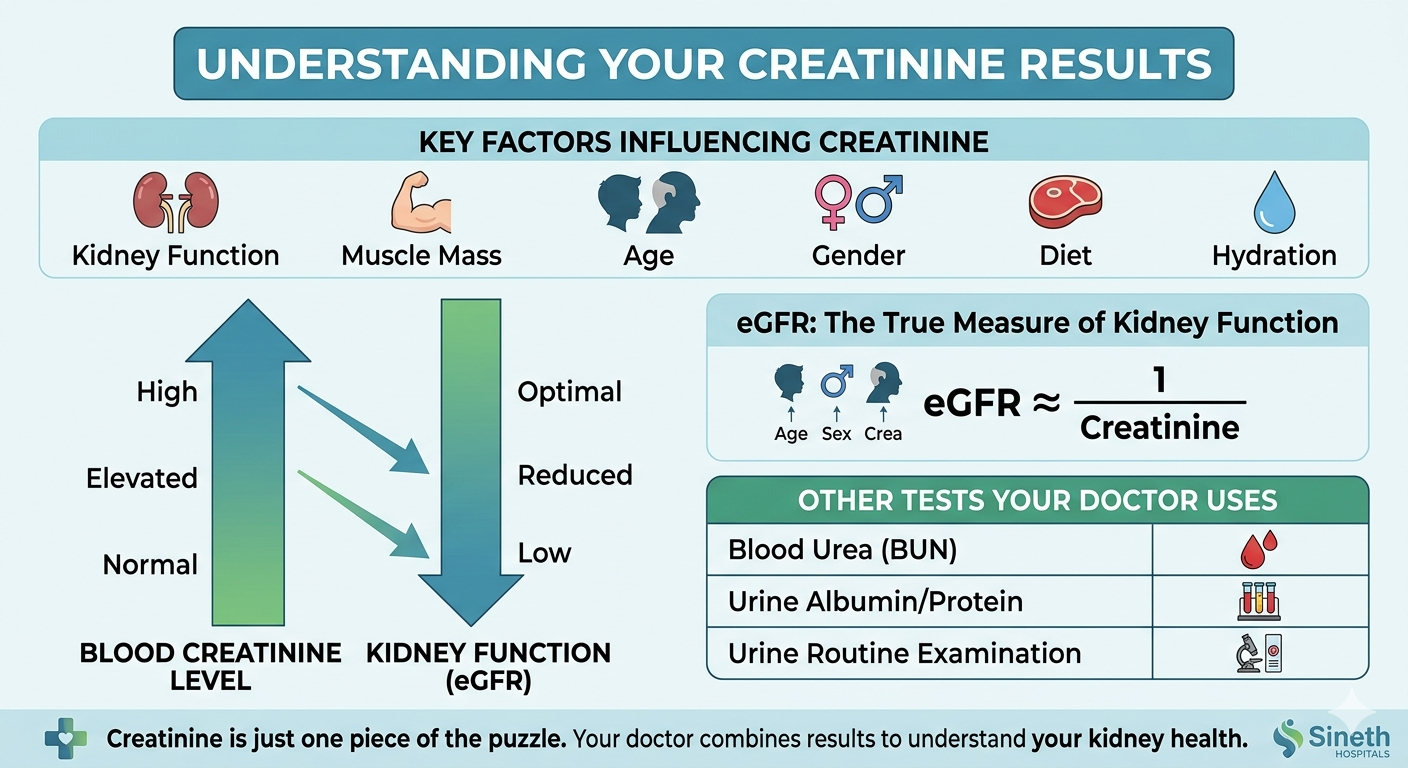
A creatinine level can be influenced by kidney function, muscle mass, age, sex, hydration, medications, and diet. This article explains how doctors interpret serum creatinine results and why additional tests are often needed.
What does high creatinine mean?
The kidneys continuously remove creatinine from the blood. When kidney filtration decreases, less creatinine is removed and blood creatinine rises. Therefore, a higher creatinine level often suggests poorer kidney function.
However, the relationship is not perfectly linear. Small increases in creatinine may sometimes represent significant kidney damage, especially when compared with a patient's previous baseline.
| General pattern | Usual meaning |
|---|---|
| Higher creatinine | Often lower kidney filtration |
| Lower eGFR | Poorer kidney filtering capacity |
| Rapid rise from baseline | May be clinically important even if the number is not very high |
What is eGFR?
eGFR stands for estimated glomerular filtration rate. It estimates how efficiently the kidneys filter blood and is usually calculated using serum creatinine, age, and sex. Some equations may also include other patient factors.
In general, higher creatinine is associated with lower eGFR, and lower eGFR suggests poorer kidney function. Doctors commonly use eGFR to stage chronic kidney disease, monitor progression, and adjust medication doses.
Why muscle mass affects creatinine
Creatinine comes from muscles. People with large muscle mass naturally produce more creatinine, while frail or elderly individuals produce less.
For example, a muscular athlete may have mildly elevated creatinine despite healthy kidneys. An elderly patient may have severe kidney disease despite near-normal creatinine. This is one reason doctors do not interpret creatinine in isolation.
Factors that can increase serum creatinine
Reduced kidney function is an important cause of high creatinine, but it is not the only possible explanation.
- Chronic kidney disease or acute kidney injury
- Severe dehydration
- Kidney infections or urinary obstruction
- Higher muscle mass
- Heavy exercise, especially intense muscle activity
- Certain medications, including NSAID painkillers, some antibiotics, and some blood pressure medicines
- High meat intake before testing
Factors that can lower serum creatinine
Lower creatinine may occur in elderly patients, people with low muscle mass, malnutrition, severe chronic illness, or pregnancy. Low creatinine usually does not indicate kidney disease by itself.
What is a dangerous creatinine level?
There is no single dangerous number that applies to everyone. The seriousness depends on baseline kidney function, the speed of rise, symptoms, urine output, and associated electrolyte abnormalities.
For example, a sudden rise from 0.8 to 1.6 may be clinically important, while a stable creatinine of 2.0 in chronic kidney disease may be less urgent. This is why trend monitoring is extremely important.
Other kidney function tests used alongside creatinine
Modern kidney assessment usually combines creatinine with eGFR, urine tests, clinical examination, and medical history. This provides a more accurate picture of kidney health.
| Test | Why it may be used |
|---|---|
| Blood urea / BUN | Reflects another waste product removed by kidneys. It may rise with kidney disease, dehydration, gastrointestinal bleeding, or high protein intake. |
| Urine routine examination | May identify protein leakage, blood in urine, infection, or kidney inflammation. |
| Urine albumin or protein testing | Can detect early kidney damage, especially in diabetes and hypertension. |
| Cystatin C | May be useful when creatinine interpretation is unreliable, such as in very muscular or frail elderly patients. |
Creatinine clearance and 24-hour urine creatinine
A 24-hour urine creatinine test measures the amount of creatinine excreted in urine over 24 hours. It may help assess kidney filtration, evaluate muscle mass, or estimate creatinine clearance.
A creatinine clearance test combines blood creatinine with 24-hour urine creatinine to estimate kidney filtration more directly. Today, eGFR calculations are more commonly used because they are easier and more convenient.
Related kidney and metabolic health topics
Frequently asked questions about creatinine results
Creatinine is valuable, but one number is not enough
Serum creatinine is an extremely valuable test, but interpreting it correctly requires understanding many influencing factors. A single creatinine value should never be interpreted without considering age, muscle mass, hydration, symptoms, trend over time, and other laboratory findings.
Patients should discuss abnormal results with a qualified healthcare professional rather than relying only on internet reference ranges.