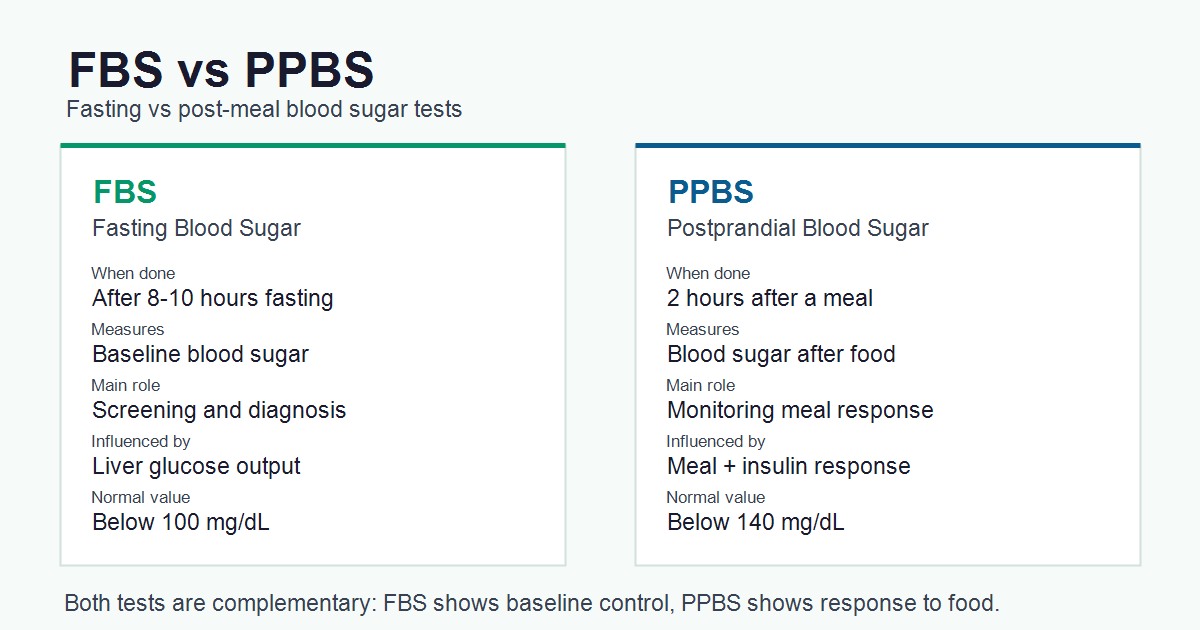
FBS and PPBS measure blood sugar at different times
FBS and PPBS are both blood glucose tests, but they answer different questions.
FBS (Fasting Blood Sugar) measures your blood glucose after a period without food, usually after an overnight fast.
PPBS (Postprandial Blood Sugar) measures your blood glucose after eating, usually at a specified time after a meal.
Because the tests are performed under different conditions, the results should not be interpreted as if they were interchangeable.
FBS vs PPBS at a Glance
| Feature | FBS | PPBS |
|---|---|---|
| Full name | Fasting Blood Sugar | Postprandial Blood Sugar |
| When measured | After fasting | After a meal |
| What it mainly reflects | Baseline fasting glucose regulation | Glucose response after eating |
| Food before test | No caloric food or drink during the required fast | Meal is taken before the timed test |
| Common role | Screening and diagnosis; also monitoring | Mainly assessment of post-meal glucose control |
| Standardization | More standardized for diagnosis | Depends more on meal content and timing |
What Is FBS (Fasting Blood Sugar)?
FBS measures the concentration of glucose in the blood after fasting. It is commonly performed in the morning after an overnight fast.
Because there has been no recent meal, FBS provides information about fasting or baseline glucose regulation.
FBS is commonly used for:
- screening for diabetes and prediabetes;
- helping diagnose diabetes;
- assessing fasting glucose control in people with diabetes;
- following changes in glucose control over time.
Read the complete FBS test guide, including how long to fast before an FBS test.
What Is PPBS (Postprandial Blood Sugar)?
PPBS measures blood glucose after eating. “Postprandial” simply means after a meal.
The result provides information about how blood glucose rises and is controlled following food intake.
The exact timing of PPBS should follow the instructions given by the laboratory or treating clinician because interpretation depends on when the sample is taken in relation to the meal.
PPBS can be useful for:
- assessing post-meal glucose control;
- identifying high glucose levels that may not be obvious from fasting measurements alone;
- monitoring selected people with diabetes;
- providing additional information alongside other glucose tests.
FBS vs PPBS: The Key Difference
A person can therefore have different patterns in fasting and post-meal glucose. One test should not automatically be assumed to predict the other.
Which Is Better for Diagnosing Diabetes: FBS or PPBS?
For formal diagnosis of diabetes, standardized tests are preferred.
Fasting plasma glucose is an established diagnostic test. HbA1c and the oral glucose tolerance test (OGTT) are also commonly used diagnostic approaches.
A routine PPBS value after an ordinary meal is less standardized because the result can be affected by:
- what was eaten;
- how much was eaten;
- the timing of the sample;
- physical activity;
- medications;
- individual glucose response.
Therefore, a routine PPBS result should not simply be treated as equivalent to a standardized diagnostic glucose test.
Which Test Is Better for Monitoring Diabetes?
Neither FBS nor PPBS gives a complete picture by itself.
FBS can show how well glucose is controlled during the fasting period.
PPBS can provide additional information about glucose levels after meals.
HbA1c provides a broader picture of average glucose exposure over the preceding months.
The combination of tests needed depends on the individual patient, treatment and clinical question.
Can FBS Be Normal but PPBS Be High?
Yes. Fasting and post-meal glucose do not always become abnormal at exactly the same time or to the same degree.
Some people may have acceptable fasting glucose but excessive glucose rises after meals.
The reverse pattern can also occur.
This is one reason doctors interpret glucose results in context rather than relying on a single isolated number.
Frequently Asked Questions
FBS and PPBS give different information
FBS and PPBS both measure blood glucose, but they do so under different conditions.
FBS reflects fasting glucose regulation, while PPBS reflects the glucose response after eating.
FBS has an established role in diabetes screening and diagnosis, while PPBS can provide useful additional information about post-meal glucose control.
Neither result should be interpreted in isolation. Depending on the clinical situation, doctors may also use HbA1c, OGTT or other glucose measurements to obtain a more complete picture.