Nipple Discharge: When Is It Normal and When Should You Worry?
Fluid from the nipple without breastfeeding can feel alarming — but many causes are harmless. A doctor-reviewed guide to types, causes, warning signs and what to do next.
👨⚕️ Dr. Seneth Gajasinghe — MBBS (Col) — MD (Col)
Nipple discharge can appear in several colours and from one or both breasts. Understanding what is normal — and what is not — helps you act at the right time.
Nipple discharge means fluid coming out from the nipple without breastfeeding. This can feel alarming — but the important thing to know is:
📌
Most nipple discharge is not cancerous. Many causes are benign and treatable. However, certain types of discharge — particularly bloody, one-sided, or spontaneous discharge — need proper medical evaluation.
Nipple discharge may appear as:
💧 Clear fluid
🥛 White or milky discharge
🟡 Yellow or green discharge
🩸 Bloody discharge
It may come from one breast or both breasts, from one nipple duct or multiple ducts, and may occur spontaneously or only when the nipple is squeezed.
✅ Normal Situations
When Can Nipple Discharge Be Normal?
Some nipple discharge is entirely expected and does not require concern, especially in the following situations:
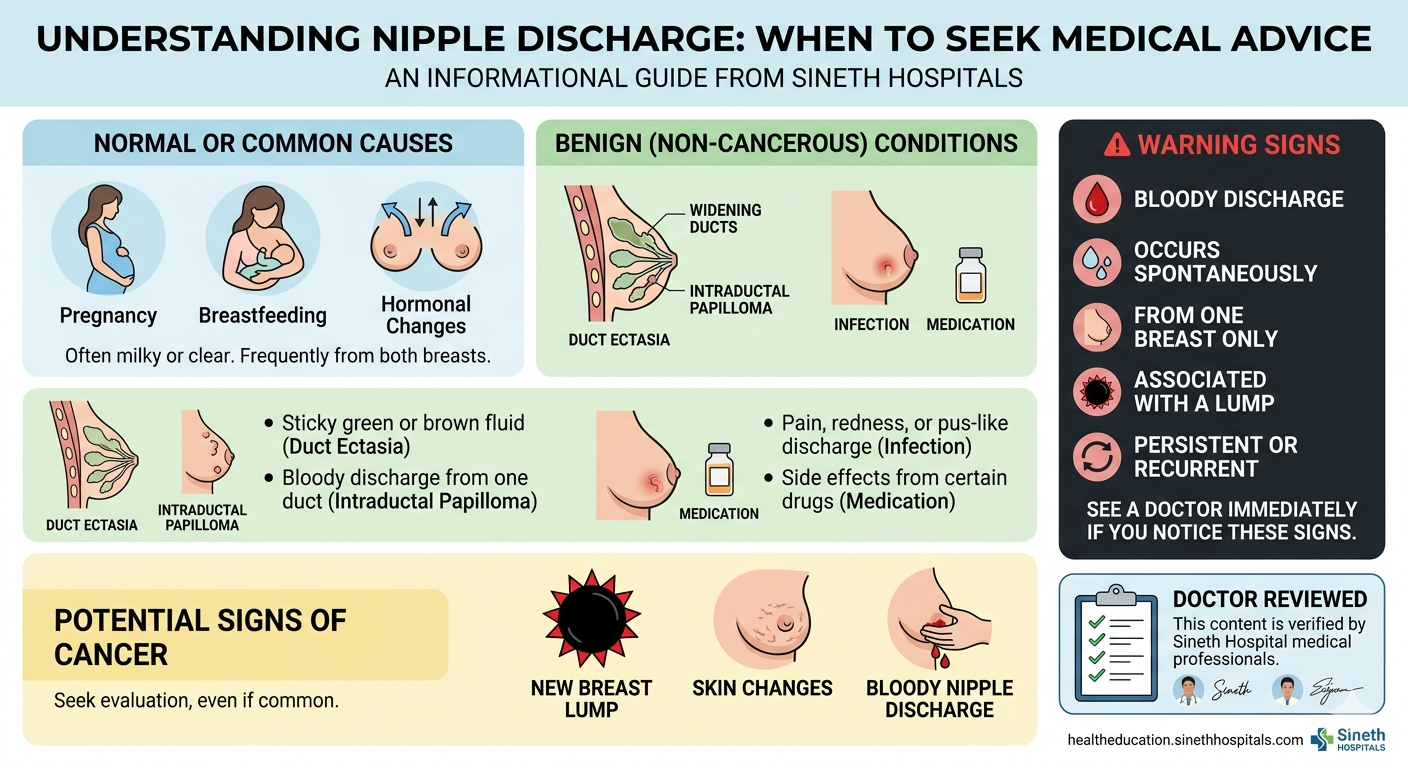
🔵During pregnancy — hormonal changes prepare the breast for milk production
🔵During breastfeeding — milk production is completely normal
🔵For months after stopping breastfeeding — the breast may continue to produce small amounts of milk
🔵Occasionally after nipple stimulation — physical stimulation can trigger discharge
✅
Milky discharge from both breasts can sometimes occur due to hormonal changes or certain medications — even outside of pregnancy or breastfeeding. This is usually benign but should still be checked by a doctor if it is new or unexpected.
📌 Causes
Common Non-Cancerous Causes
Most cases of nipple discharge are caused by benign (non-cancerous) conditions. Here are the most common:
1 Hormonal Changes
Hormonal imbalance — including elevated prolactin levels — can lead to milky discharge, often from both breasts. This may occur without pregnancy or breastfeeding.
2 Duct Ectasia
A common condition in middle-aged women where the breast ducts become widened and blocked. Symptoms may include a sticky, thick discharge that is green or brown in colour, along with mild breast discomfort.
3 Intraductal Papilloma
A small benign growth inside a milk duct, close to the nipple. This is one of the most common causes of bloody nipple discharge and discharge from one breast only. Despite the bleeding, it is usually non-cancerous — but it still requires medical assessment.
4 Breast Infection (Mastitis)
Especially common during breastfeeding. Infection of the breast tissue may cause a pus-like discharge along with pain, fever, and redness of the breast.
5 Medications
Certain medicines can cause nipple discharge as a side effect, including some psychiatric medications (such as antipsychotics and antidepressants) and hormonal medications.
📌
Even when a cause is likely benign, it is important to have a doctor confirm this — especially if the discharge is new, persistent, or associated with any other breast changes.
🚩 Warning Signs
When Should Nipple Discharge Be Considered Concerning?
Seek medical advice promptly if the discharge is:
🔴Bloody — the most important warning sign
🔴From one breast only — unilateral discharge is more concerning than bilateral
🔴Spontaneous — occurring without any squeezing or stimulation
🔴Associated with a breast lump — any lump alongside discharge needs urgent assessment
🔴Associated with skin changes — dimpling, redness, or thickening of the skin
🔴Persistent or recurrent — discharge that keeps returning without a clear cause
Does Nipple Discharge Mean Cancer?
Usually, no. Most nipple discharge is due to benign conditions. However, some breast cancers can present with:
🩸 Bloody discharge
📍 One-sided discharge
⚪ Associated breast lump
⚠️ Skin or nipple changes
🚨
This is why proper evaluation matters.
Bloody nipple discharge should always be evaluated by a doctor — even if it turns out to be a benign condition. Do not wait to see if it resolves on its own.
Important Advice: Do Not Repeatedly Squeeze the Nipple
Many people squeeze the nipple repeatedly to check whether the discharge is still there. This is not recommended because:
🔵 Squeezing can stimulate more discharge, making the problem appear worse
🔵 It can cause local irritation of the nipple and duct
🔵 It makes proper clinical assessment more difficult for the doctor
Nipple Discharge During Pregnancy and Breastfeeding
Discharge during pregnancy and breastfeeding is commonly due to normal hormonal changes and is not usually a cause for concern. However, seek medical advice if there is:
🌡️ Fever
😣 Severe breast pain
🔴 Redness of the breast
🩸 Bloody discharge
🔬 Tests & Evaluation
What Tests May Be Needed?
A doctor will first perform a clinical breast examination. Depending on the findings, further investigations may be recommended:
🩺 Clinical breast examination
📷 Ultrasound scan
🩻 Mammogram (especially over age 40)
🧪 Blood tests (in selected cases)
💉 Biopsy (if needed)
The choice of investigation depends on the patient's age, the nature of the discharge, and any associated findings on clinical examination. The doctor will guide you on which tests are appropriate in your situation.
✅
Key Takeaways
✅ Many causes of nipple discharge are harmless
⚠️ Bloody or one-sided discharge should never be ignored
🩺 Early medical assessment helps identify serious conditions at the earliest opportunity
🩺
If you have noticed nipple discharge — especially if it is bloody, from one breast, or associated with a lump — visit our clinic early. Our doctor can perform a clinical examination and advise you on the next steps. Book an appointment →
❓ FAQ
Frequently Asked Questions
Sometimes yes. It can occur normally during pregnancy, breastfeeding, or for months after stopping breastfeeding. It can also occur due to hormonal changes or certain medications. However, any new or unexplained discharge should be assessed by a doctor.
Bloody discharge is more concerning than other types and should always be evaluated by a doctor. It can be caused by a benign intraductal papilloma — a small non-cancerous growth inside a milk duct — but it can also be a sign of breast cancer. Do not wait to see if it resolves on its own.
Yes. Most cases are caused by benign conditions such as duct ectasia (widened breast ducts) or intraductal papilloma (a small benign growth inside a duct). Hormonal changes and certain medications are also common non-cancerous causes. However, proper evaluation is always important to confirm this.
No. Repeated squeezing can stimulate more discharge, cause nipple irritation, and make proper medical assessment more difficult for the doctor. If you have noticed discharge, let your doctor examine you without squeezing the nipple beforehand.
Bloody discharge is the most concerning and should always be evaluated promptly. Persistent clear discharge from one breast only may also need assessment. Green or brown discharge is more typical of duct ectasia, which is usually benign — but still worth reporting to a doctor if it is new or recurrent.
Doctors may use clinical breast examination, ultrasound scan, mammogram (especially in women over 40), blood tests in selected cases (e.g., to check prolactin levels), and biopsy if further confirmation is needed. The appropriate tests depend on your age and the nature of the discharge.
Yes. Hormonal changes — including elevated prolactin — can sometimes cause milky discharge from both breasts. Certain medications such as antipsychotics and some hormonal treatments can also cause nipple discharge as a side effect.
Seek medical advice promptly if the discharge is bloody, comes from one breast only, occurs without squeezing (spontaneous), is associated with a breast lump, is associated with skin changes (dimpling, redness), or is persistent and keeps returning.
All articles on Health Education are created with the expert input and medical oversight of Dr. Seneth Gajasinghe. As an SLMC-registered doctor, he ensures the accuracy, quality and clinical relevance of every article on this platform.
Health Education is proudly supported by Sineth Hospitals. Contact us today to find out about free treatment opportunities available for eligible patients and their families.
The information on this website is for general educational purposes only and is not a substitute for professional medical advice, diagnosis, or treatment. Always consult your doctor or a qualified healthcare provider for personalised medical advice.